
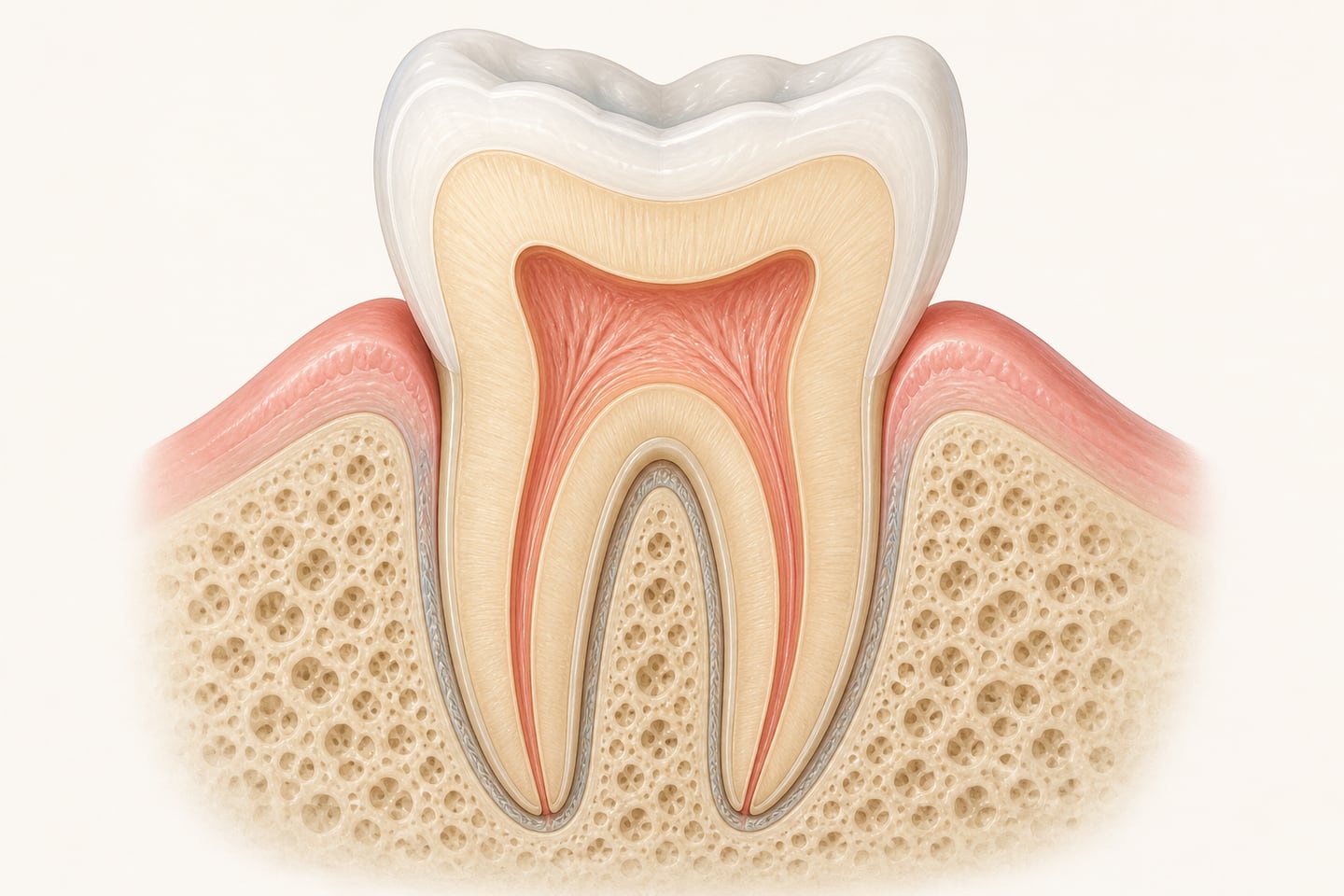
For most people, dentists generally recommend a professional cleaning and exam about twice a year. But "every six months" is a general guideline, not a rule of nature. Some people genuinely need cleanings more often than that; a smaller group may do fine with a schedule built around their own risk. The right interval for you is set by your gum health, your history with cavities, and your daily habits — and it can change over time.
Why six months became the default
The twice-a-year rhythm persists because it works as a practical middle ground. Tartar, the hardened deposit that brushing can't remove, accumulates at a pace where six-month removal keeps most mouths ahead of trouble, and six months is a short enough window that a new cavity or early gum inflammation gets caught while it's still a small fix. It's a sensible default for average risk. The catch is that nobody is exactly average.
Who needs cleanings more often
The clearest case is anyone treated for gum disease. After periodontal treatment, patients are typically placed on a maintenance schedule with visits closer together than six months — the interval your dentist sets is part of the treatment, and stretching it undoes the work. Beyond that, several situations tilt toward more frequent cleanings:
- Gums that bleed when you brush or floss — an inflammation sign, not a normal one.
- A history of frequent cavities, or several fillings in recent years.
- Smoking or vaping, both hard on gum health.
- Diabetes — it and gum disease each make the other harder to control.
- Dry mouth (often a side effect of common medications), which removes saliva's natural protection.
- Braces, aligner attachments, bridges, or implants, all of which give plaque more places to hide.
Could you need them less often?
Possibly. A person with healthy gums, no cavities in years, disciplined home care, and no risk factors may be a candidate for a longer interval — and a good dentist will say so rather than defaulting everyone to six months. But before stretching the schedule, remember what the visit includes beyond polishing: an exam that screens for decay, gum measurements that catch disease before it hurts, and an oral cancer check. Cleanings on a longer interval should be a decision made with your dentist based on your record — not a habit that forms by itself out of a busy calendar.
What a cleaning does that brushing can't
Even excellent brushing leaves some plaque behind, and within days plaque begins hardening into tartar, which bonds to the tooth and can only be removed with professional instruments. Tartar below the gumline is the more serious version — it irritates the gums where you can't see or reach, and it's how gum disease gets started quietly. That is the reason cleanings exist: not to out-brush you, but to remove what no toothbrush can.
What actually happens when you skip
Nothing, at first — which is exactly the trap. Early gum inflammation is silent and reversible with a cleaning and better home care. Left alone, it can progress to periodontitis, where the bone supporting teeth is damaged; that stage can be managed but not reversed. The same logic applies to decay: a small cavity caught at a checkup is a small filling, while the same cavity found two years later may be a crown or a root canal. Skipped cleanings rarely save money; they usually defer a larger bill. Everyone's risk is different — but the direction of the trade is the same for everyone.
What happens in the appointment, and why it takes the time it does
A routine visit is two jobs, and the order matters. The hygienist measures the gums first — a probe reads the depth of the pocket around each tooth, and depths that have increased since the last visit are the earliest sign of gum disease, before anything bleeds or hurts. Then the cleaning: tartar is scaled off above and just below the gumline, the teeth are polished, and floss is run through every contact. The dentist's exam comes after, with X-rays at the interval your history calls for, checking each tooth, the bite, the soft tissues and the lymph nodes under the jaw. A good share of the appointment is measurement and examination, which is why a cleaning skipped is more than a polish missed.
How the interval gets set
The American Academy of Periodontology describes a comprehensive periodontal evaluation as something adults should have once a year; the cleaning interval is set from what it finds. Shallow, stable measurements with no bleeding and no new decay support the standard interval or occasionally a longer one. Deeper pockets, bleeding on probing, new cavities, or the risk factors above move the visits closer together — three or four months is common after gum treatment. The interval is a prescription that gets rewritten at each visit, not a subscription.
Making the schedule affordable
If cost is the reason cleanings keep sliding, there are structural fixes. Every office in our group offers a membership plan with routine cleanings and exams included for an annual fee — the price is the same everywhere but what's included differs per office, so check the plan where you'll actually go. Read more about what happens at a cleaning and exam visit, or simply request an appointment — if it's been longer than you meant it to be, that's the most common sentence our front desks hear, and the visit is easier than the dread.