
Beachside Dental Group
18800 Main St Ste 110Huntington Beach, CA 92648
Four named practices — one group. Each office has its own phone line.
Restorative
A crown covers and strengthens a damaged tooth so you can chew on it again. Learn when a crown beats a filling, what the visits involve, and what drives the cost.

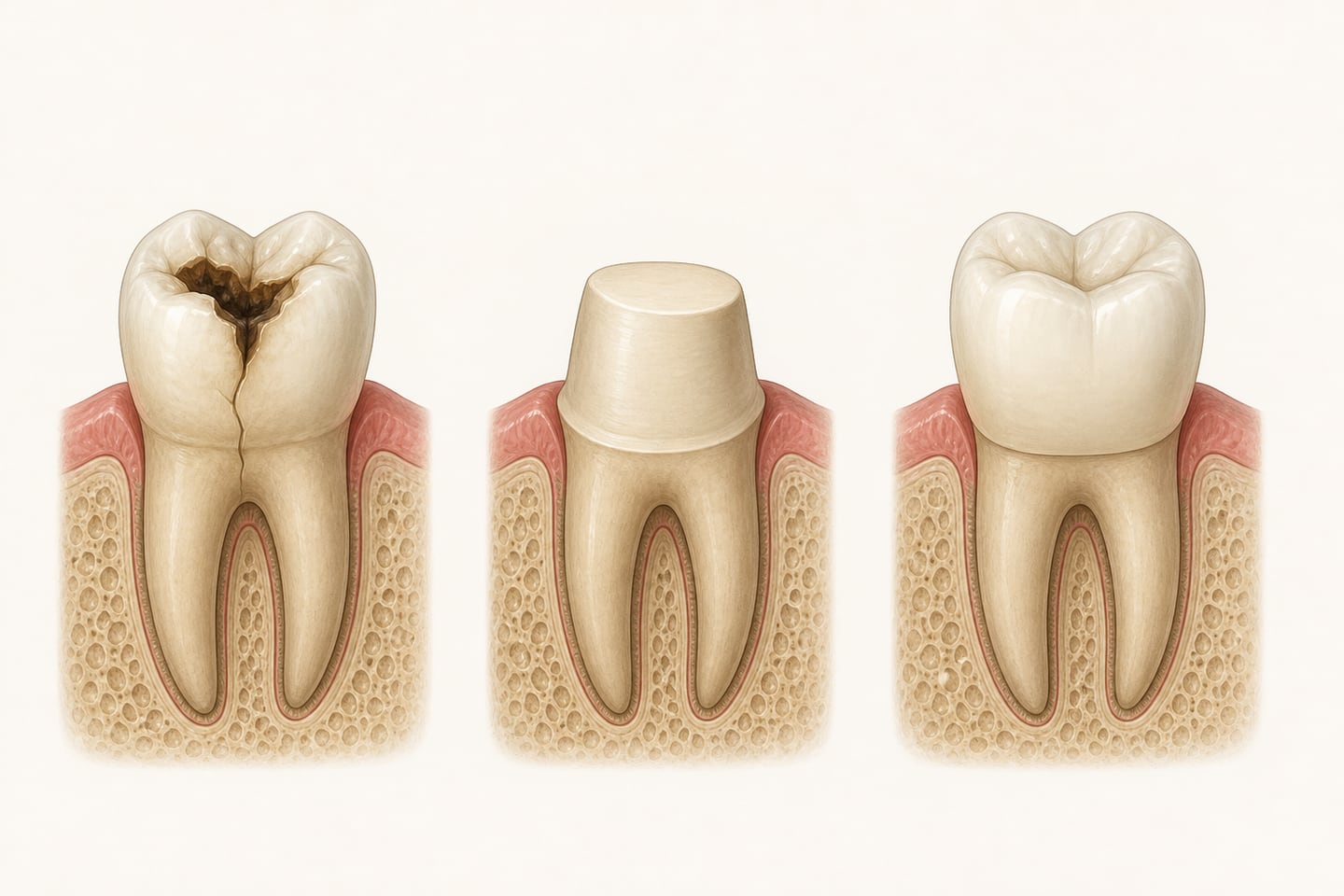
A dental crown is a custom-made cap that covers a damaged tooth down to the gumline. It restores the tooth's shape and strength so you can chew on it again, and it shields what remains of the natural tooth from breaking further.
Crowns are recommended for teeth that are cracked, heavily worn, weakened by large or failing fillings, or hollowed out by root canal treatment. In each case the problem is the same: not enough sound tooth structure left to carry chewing forces on its own.
For most patients the change is practical, not cosmetic. A tooth you have been chewing around becomes a tooth you can trust — and because crowns are shaded and shaped to match their neighbors, a well-made one goes unnoticed.
The deciding factor is how much healthy tooth remains. Once decay, cracks, or old fillings take up a large share of a tooth, packing in more filling material leaves thin walls that can fracture under load — that is the point where a crown protects more than it costs.
One sequencing note: if the nerve inside the tooth is infected or the tooth aches on its own, root canal therapy usually comes first. The crown is placed afterward to protect the treated tooth.
Crown fees vary case to case, and the differences are explainable rather than arbitrary. The main drivers:
Your exam ends with an itemized written plan before any work starts. Each of our offices carries its own financing partners and membership plan — see financing and membership, or request an appointment to have a specific tooth looked at.

Benefits
A crowned tooth can take normal biting force again, so you stop routing food around it.
Covering the tooth holds it together under load. A crack that spreads to the root usually means extraction — a crown placed in time can prevent that.
Back teeth become more brittle after root canal treatment; a crown is the accepted way to keep them from fracturing.
Shade, shape, and bite are checked before the crown is cemented, so it blends in with the teeth around it.
Brushing, flossing at the gumline, and routine exams are all a crown asks for. Longevity varies with habits like grinding, but there is no extra care routine to learn.
Candidacy
A crown is worth considering when a tooth is damaged but still has a healthy root and enough structure to build on. Common candidates: a cracked or fractured tooth, a tooth with a large or failing filling, a heavily worn tooth, or a tooth that has just had root canal treatment.
A crown is the wrong tool when the cavity is small (a filling preserves more tooth) or when too little tooth remains above the gum to grip. In that second case the honest advice may be extraction followed by an implant or bridge, and we will say so plainly.
Active gum disease around the tooth needs treatment first; a crown cemented onto an unstable foundation fails early. Patients who grind their teeth can still get crowns, but a night guard is usually part of the plan. If you are weighing replacement instead of repair, read about dental implants and bridges.
The process
X-rays and an exam confirm the tooth is worth crowning — healthy root, no hidden infection, enough structure to build on. You get the plan and the alternatives in writing before anything starts.
part of a standard exam visit
After the area is fully numbed, the dentist reshapes the tooth: decay and old filling material come out, and a thin outer layer is removed all the way around so the crown can slide over the tooth and sit flush at the gumline. If too little tooth remains, a build-up filling creates the foundation first. You should feel pressure and vibration, not sharp pain — tell the team if you feel more, and they will stop and re-numb.
usually about an hour; longer if a build-up is needed
A temporary crown protects the prepared tooth while the final crown is made. It is attached with weak cement on purpose — skip sticky and chewy foods on that side and it will stay put.
worn between visits; timing varies by case
The temporary comes off, the final crown is tried in, and fit, bite, and shade are checked before it is cemented. Small bite adjustments at this visit are normal, not a sign of a problem.
typically shorter than the prep visit
Recovery & risks
Numbness wears off within a few hours of each visit. The gum around the tooth may be tender for a few days; warm salt-water rinses and over-the-counter pain relief handle it for most people.
Sensitivity to cold or to biting pressure is common in the first days to weeks after the final crown is placed and usually settles on its own. A bite that feels even slightly high is worth a quick adjustment visit — do not wait for it to wear in.
Long term, care for a crown like a natural tooth: brush, floss along the gumline where crown meets tooth, and keep routine exams so the margin gets checked.
Straight answers about what can go wrong:
How long a crown lasts varies with material, bite forces, and home care — no honest practice promises a number. What we can do is match the material and bite protection to your situation and check the crown at every exam.
Where to go
FAQ
The tooth is numbed before any drilling, so the prep visit involves pressure and vibration rather than sharp pain — most patients compare it to a long filling appointment. If you feel more than pressure, say so; adding anesthetic takes a moment.
Afterward, expect a tender gumline and some cold sensitivity for a few days. If dental anxiety is the real obstacle, ask about sedation options when you book — managing anxiety honestly beats pretending the appointment is nothing.
There is no honest single number. Longevity depends on the material, your bite, grinding habits, and whether the margin where crown meets tooth stays clean. Many crowns serve for many years; some need replacement sooner.
What extends a crown's life is unglamorous: brushing and flossing at the gumline, wearing a night guard if you grind, not chewing ice, and keeping routine exams so problems at the margin are caught while they are small.
Sometimes you can — and when a filling is enough, that is what we recommend, because it preserves more of your tooth. A filling repairs a contained cavity in a tooth that still has strong walls.
A crown enters the conversation when there is not enough sound structure left for a filling to hold: a crack, a large failing filling, heavy wear, or a tooth after root canal treatment. Packing a large filling into a weak tooth risks a fracture that can make the tooth unsavable — the crown exists to prevent exactly that.
Common options are all-ceramic (including zirconia), porcelain fused to a metal base, and gold alloy. All-ceramic crowns lead on appearance and are the usual choice for visible teeth. Zirconia and metal-based crowns trade some translucence for strength, which can matter on molars. Gold remains a durable option that is gentle on opposing teeth, and some patients still prefer it in the back.
The right answer depends on the tooth's position, your bite, and your priorities. The recommendation comes with reasons — and the choice is yours.
Call the office; recementing a temporary is a quick visit. Temporaries are attached with weak cement on purpose, so this is common, not a crisis.
Until you are seen, keep the temporary somewhere safe, chew on the other side, and avoid very hot, cold, or sweet foods — the prepared tooth underneath is sensitive. Do not glue it back with anything from a hardware store.
Because a crown is not one product. The fee reflects the material, the lab work behind it, the tooth's position, and how much rebuilding the tooth needs first — a build-up or a root canal before the crown are separate procedures with their own fees.
That is why we put an itemized plan in writing before treatment starts. Each of our offices also carries its own financing partners and membership plan — see financing and membership for how patients spread out treatment costs.
Keep exploring
A filling repairs a cavity or small break with tooth-colored composite, restoring the tooth in one visit…
Root canal therapy removes infected tissue from inside a tooth so you can keep it. What the procedure…
A bridge replaces a missing tooth by anchoring a false tooth to crowns on its neighbors. Compare bridges with…
A dental implant replaces a missing tooth from the root up: a titanium post in the jaw, a connector, and a…
A temporary is cemented lightly on purpose, which is exactly why it comes loose. What it is protecting, what…
At least five years for most, 15 to 20 for many. The crown material almost never wears out first; the tooth…
A large old filling breaking down, a fractured cusp, a jolt of pain when you release a bite, a tooth after…
A filling replaces the missing piece. A crown covers what is left and holds it together. Four things settle…
An exam and consultation gives you your options, their costs, and the time to decide.