
Beachside Dental Group
18800 Main St Ste 110Huntington Beach, CA 92648
Four named practices — one group. Each office has its own phone line.
Replace missing teeth
All-on-4 replaces a full arch of teeth on four implants — a fixed alternative to a removable denture for people who have lost most or all of their teeth.

Anatomy
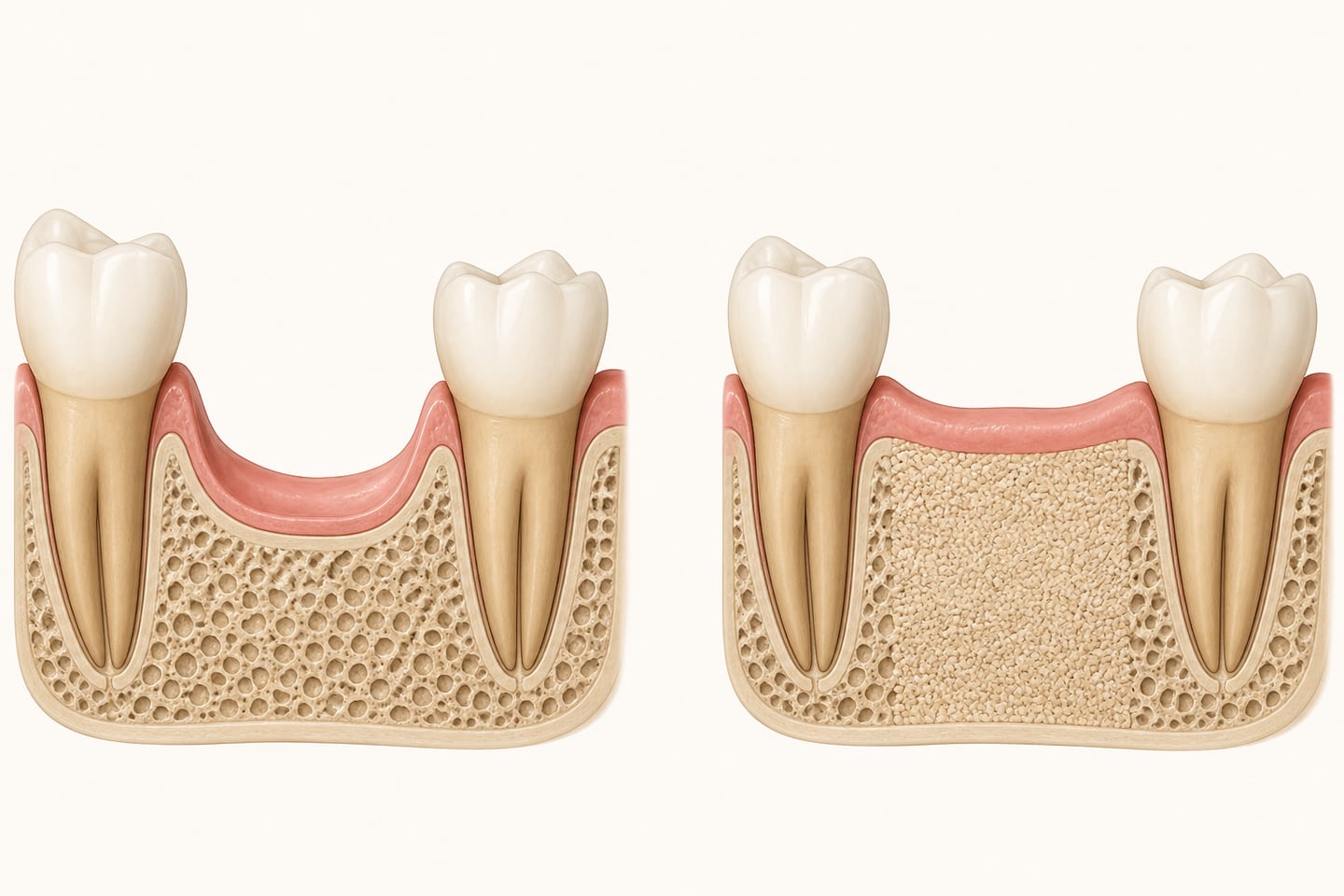
All-on-4 uses this same construction — but instead of one post per tooth, four posts placed at engineered angles carry a full arch of teeth.
All-on-4 replaces an entire arch of teeth (upper, lower, or both) with a fixed bridge anchored on four dental implants. It is a treatment for people who have lost most or all of their teeth, or whose remaining teeth are failing, and who want teeth that stay in: no adhesive, no nightly removal, no plate covering the roof of the mouth.
The idea behind the name: rather than one implant per tooth, four posts placed at engineered angles carry a full row of teeth. The angled placement uses the strongest available bone, which is why many patients qualify without the extensive grafting that a mouthful of individual implants would demand.
All-on-4 sits between two alternatives you may also be weighing — conventional dentures and individual dental implants. This page covers who it actually fits, what the process involves, and what drives the cost. Not everyone is a candidate, and the candidacy section below says so plainly.
All-on-4 is not a denture, but they are relatives. A conventional denture rests on the gums and stays put by suction and adhesive; it can move when you chew, and the bone beneath it continues to shrink over the years — which is why dentures need periodic relining and remaking. An All-on-4 bridge is fastened to implants: it does not move, it restores much more chewing force, and the implants keep the bone they are anchored in working.
There are also middle options — removable dentures that snap onto implants for stability. Whether your bone, health, and budget point to fixed, snap-on, or conventional is exactly what the exam conversation is for.
Full-arch treatment is one of dentistry's larger investments, and the honest cost conversation is about drivers, not a sticker:
Every case gets a written, itemized plan after imaging and before treatment starts. Each office offering this treatment maintains its own financing partners — see financing — and the membership plans differ by office as well.

Benefits
The bridge is fixed to the implants — no adhesive, no removal at night, no movement mid-sentence or mid-meal.
Fixed full-arch teeth restore far more biting force than a removable denture. Results vary, but the difference is what patients mention first.
The angled placement of the four posts is designed to use the bone you still have, so many patients skip the grafting a tooth-by-tooth approach would need.
Loaded implants stimulate the bone they sit in, slowing the shrinkage that reshapes the face of long-term denture wearers.
Extractions, placement, and provisional teeth are planned as a single sequence with one team — not a series of disconnected procedures.
Candidacy
All-on-4 fits a specific patient: someone who has lost most or all of an arch, or is about to, and wants fixed teeth. It is not the answer to every failing mouth, and not everyone is a candidate.
Good candidates have enough bone at the four anchor points (the technique is designed to work with less bone than individual implants require, but there is still a minimum), are healthy enough for oral surgery, and are prepared for the daily cleaning a fixed bridge demands — it must be cleaned under and around, every day.
Reasons a dentist may steer you elsewhere: heavy smoking, unmanaged diabetes or other conditions that impair bone healing, too little bone even for angled placement without major grafting first — or remaining teeth healthy enough that saving them is simply better dentistry. If several of your teeth can be saved, an honest exam will say so; extracting salvageable teeth to fit a product is not a plan, it is a shortcut.
Surgical anxiety is worth raising early — sedation options exist for full-arch cases, and the office confirms what is available when you book.
The process
Imaging maps bone quality at the four anchor sites and settles whether you are a candidate at all. You see the full plan and its itemized cost before committing to anything.
one to two visits
Failing teeth are removed and four implants are placed per arch. In many cases a provisional fixed bridge is attached the same day — but that depends on implant stability measured during surgery. It is a clinical call, not a promise.
varies by case
The implants fuse with the bone while you wear the temporary bridge. The soft-food diet in this stretch is one of the biggest success factors you control.
typically a few months
Once the implants are fully integrated, the definitive bridge is fabricated, fitted, and adjusted to your bite.
several visits over a few weeks
Recovery & risks
Expect a genuine surgical recovery — more than a single implant, less than most patients fear. Swelling, bruising, and soreness peak in the first two to three days, then fade; many patients manage with over-the-counter medication and a few days away from work.
The soft-food period matters most. Chewing force is what disturbs healing implants, so the office's eating guidance (typically measured in months, not days) is protection, not caution theater. Follow it.
Once the final bridge is in, daily cleaning under and around it plus regular professional maintenance is what keeps a full-arch result healthy long term. Budget attention, not just money.
Full-arch implant treatment is well established, and it carries real risks worth naming plainly.
Outcomes vary by patient. The consultation should end with your specific risk profile discussed openly — if it doesn't, ask.
Where to go
FAQ
Only imaging can say for certain, but the profile is: most or all teeth in an arch missing or failing, enough bone at the four anchor points, general health adequate for oral surgery, and willingness to clean a fixed bridge daily. Long-term denture wearers sometimes have too little bone even for angled placement — grafting may come first, or a different treatment may fit better. Not everyone is a candidate, and a good consultation tells you which you are, with reasons.
Different — and for many people preferable where it matters most: it does not move, restores far more chewing function, and keeps jawbone working. But a conventional denture involves no surgery, costs far less upfront, and remains the medically sensible choice for some patients. The right answer depends on your bone, health, budget, and how much the denture experience bothers you.
Compare with dentures.
Because two patients getting "All-on-4" can need very different treatment: one arch or two, the number of extractions, grafting at anchor sites, the provisional teeth, sedation choices, and the material of the final bridge all move the number. An itemized written plan after imaging is the only honest quote.
Each office's payment options are at financing.
Often — but it is a clinical decision made during surgery, not a promise made in marketing. If the four implants reach sufficient stability at placement, a provisional fixed bridge is attached that day. If they don't, forcing it risks the implants, and you wear a removable temporary while the bone heals. The final bridge always comes later, after full integration.
The implants are intended to serve for decades; the bridge on top is a wear item that may need repair, adjustment, or eventual replacement depending on material and habits. The single biggest factor in longevity is cleaning — infection around implants, not hardware fatigue, is what usually ends full-arch results early.
Soft foods for the first stretch of healing — the office gives exact guidance, typically measured in months, because chewing force is what disturbs integrating implants. Once the final bridge is placed on fully healed implants, most patients eat what they like. Results vary, and extremely hard or sticky foods remain a lifetime caution with any dental prosthetic.
Keep exploring
A dental implant replaces a missing tooth from the root up: a titanium post in the jaw, a connector, and a…
Full and partial dentures replace missing teeth without surgery. An honest guide to the adjustment period…
Sedation dentistry helps anxious patients get through appointments comfortably — from mild relaxation you…
Both put a fixed arch of teeth on implants. All-on-4 uses four; All-on-X means the number is chosen for your…
Fixed, removable on implants, or removable with no implants at all. The three full-arch options compared on…
Most implant plans include a cone beam CT scan — a 3D image of the jaw. What it shows that a regular X-ray…
Some plans pay toward implant treatment, some exclude it by name, and no website can tell you which yours…
An exam and consultation gives you your options, their costs, and the time to decide.