
Beachside Dental Group
18800 Main St Ste 110Huntington Beach, CA 92648
Four named practices — one group. Each office has its own phone line.
Restorative
Root canal therapy removes infected tissue from inside a tooth so you can keep it. What the procedure actually feels like with modern anesthesia, and when saving beats extracting.
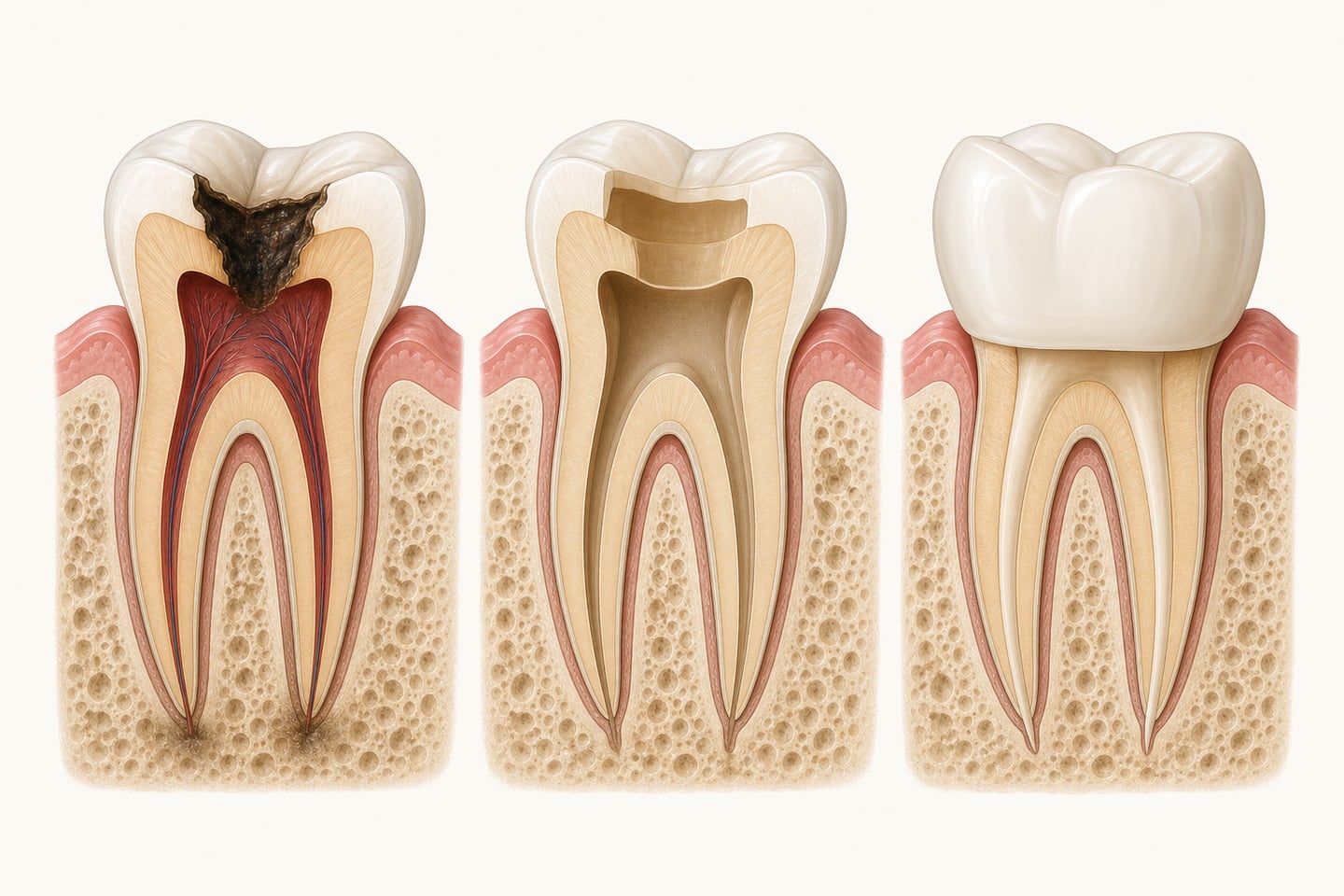
Root canal therapy treats infection or inflammation inside a tooth. The dentist removes the damaged nerve tissue from the tooth's inner canals, cleans and disinfects the space, and seals it — keeping a tooth that would otherwise need to come out.
It is for teeth where deep decay, a crack, or trauma has reached the nerve. The warning signs are hard to ignore: throbbing that wakes you at night, pain that lingers after hot or cold, pain on biting, or a pimple-like bump on the gum. Sometimes there are no symptoms at all and an X-ray finds the problem first.
Root canals carry a reputation they no longer deserve. The pain people associate with them is the toothache before treatment — the procedure itself is done under thorough local anesthesia, and the tooth is tested for numbness before work starts. Most patients report it feels like having a deep filling placed: pressure, vibration, and a long stretch of holding your mouth open, rather than sharp pain.
Honesty requires two footnotes. A badly inflamed tooth can be harder to numb, and dentists have specific techniques for exactly that — additional anesthetic placed at additional sites, and time. And expect soreness for a few days afterward, especially on biting; that is your body resolving inflammation, and over-the-counter pain relief manages it for most people.
When a tooth's nerve is infected, there are only two honest paths: root canal therapy to save it, or extraction. Doing nothing lets infection spread. Where the tooth is structurally sound, keeping it usually wins:
One more thing to budget for from the start: most back teeth need a crown after root canal treatment. The tooth becomes more brittle once its nerve and blood supply are gone, and the crown keeps it from fracturing. Think of it as one treatment in two acts.

Benefits
Removing the inflamed nerve removes the source of the pain. Relief typically begins within days as the surrounding tissue calms down.
The root stays in the jaw and the tooth keeps working — which no replacement matches exactly.
An infected tooth does not heal on its own. Cleaning and sealing the canals treats the infection at its source.
Extraction followed by an implant or bridge means more procedures over more months. Where the tooth is savable, saving it is simpler.
Candidacy
Root canal therapy fits a tooth whose nerve is infected or dying but whose structure is still restorable — enough sound tooth above the gum, roots without fractures, and gum support worth building on.
It is the wrong path when a crack runs down the root, decay reaches too far below the gumline to rebuild, or the tooth is loose from advanced gum disease. In those cases extraction and replacement is the honest recommendation — money spent saving an unsavable tooth serves no one.
Only an exam and X-rays place your tooth on the right side of that line. Severe pain or facial swelling deserves a same-day call — see emergency dentistry, or request an appointment for anything that can wait a few days.
The process
X-rays and simple tests (temperature, gentle tapping) confirm which tooth is the problem and whether the nerve is savable. Pain sometimes refers from a different tooth than the one you would point at, so this step matters.
The tooth is anesthetized thoroughly and tested before work begins. A small protective sheet called a rubber dam isolates the tooth to keep the canals clean and keep materials out of your mouth.
The dentist opens the tooth, removes the nerve tissue from each canal, disinfects the space, and seals it. Front teeth have one canal; molars have three or more — which is much of why appointment length varies.
commonly one to two visits, depending on the tooth and the infection
A filling or crown rebuilds the tooth. For most back teeth a crown is the standard recommendation — this step protects everything the root canal accomplished.
scheduled after the tooth settles
Recovery & risks
Expect the tooth and surrounding gum to be sore for a few days, especially on biting. Over-the-counter pain relievers, taken as directed, manage it for most patients. Chew on the other side until the final restoration is placed — an unrestored root-canal tooth is at its most fragile in that window.
Call the office if pain worsens after the first couple of days, swelling appears, or the temporary filling comes out. All of these are fixable, and all are better handled early.
The honest fine print:
Where to go
FAQ
The procedure is done under thorough local anesthesia, and the tooth is tested before work starts. Most patients say it felt like getting a deep filling: pressure and vibration, not sharp pain. The agony associated with root canals is the toothache beforehand — which the treatment ends.
Two honest caveats: a badly inflamed tooth can take extra anesthetic and extra time to numb fully — tell your dentist if you feel anything, and they will stop and re-numb. And the tooth will be sore to biting for a few days afterward while the inflammation settles.
On the day, extraction usually costs less. Over the following years it often costs more — the empty space needs an implant or bridge to keep neighboring teeth from drifting and the bite from degrading, and those carry their own fees and timelines.
Keeping a structurally sound natural tooth is generally the better investment. When a tooth genuinely cannot be saved, we will say so and lay out replacement options with a written plan from the office treating you.
For most back teeth, yes — and skipping it is the most common way patients lose a tooth they just paid to save. A root-canal-treated tooth is more brittle, and molars take the heaviest chewing forces; a crown holds the tooth together under that load.
Front teeth with minimal structure loss can sometimes be restored with a filling alone. Ask which camp your tooth is in, and budget for the crown from the start — it is one treatment in two acts.
Commonly one or two, and it honestly depends on the tooth. Front teeth have a single canal and go quicker; molars have three or more. An active infection sometimes calls for medication placed inside the tooth between visits before it is sealed.
The final restoration, usually a crown on back teeth, takes additional visits after the root canal itself. Your dentist can give you a specific plan once X-rays show the anatomy.
Chew on the other side until the permanent restoration is placed — the tooth is at its most fragile in that window. Soreness on biting for a few days is expected; over-the-counter pain relievers, taken as directed, manage it for most patients.
Call the office if pain intensifies after the first couple of days, swelling develops, or the temporary filling comes loose. And schedule the final restoration promptly — delaying it risks fracture or reinfection, undoing the work.
Keep exploring
A crown covers and strengthens a damaged tooth so you can chew on it again. Learn when a crown beats a…
A filling repairs a cavity or small break with tooth-colored composite, restoring the tooth in one visit…
What counts as a dental emergency, first-aid steps for a knocked-out tooth, severe pain, or swelling, and how…
A back tooth that has had a root canal is more brittle than it was. The crown is what keeps it from…
When a tooth can be saved, saving it is usually the better call — but not always. How dentists decide, what…
Gel first, then pressure and a few seconds of sting. Numb feels fat rather than absent, so you still feel…
Rinse, floss gently, take pain relief as the label directs, cold compress on the outside of the cheek. Never…
An exam and consultation gives you your options, their costs, and the time to decide.