
Beachside Dental Group
18800 Main St Ste 110Huntington Beach, CA 92648
Four named practices — one group. Each office has its own phone line.
Restorative
A bridge replaces a missing tooth by anchoring a false tooth to crowns on its neighbors. Compare bridges with implants honestly before you choose either one.
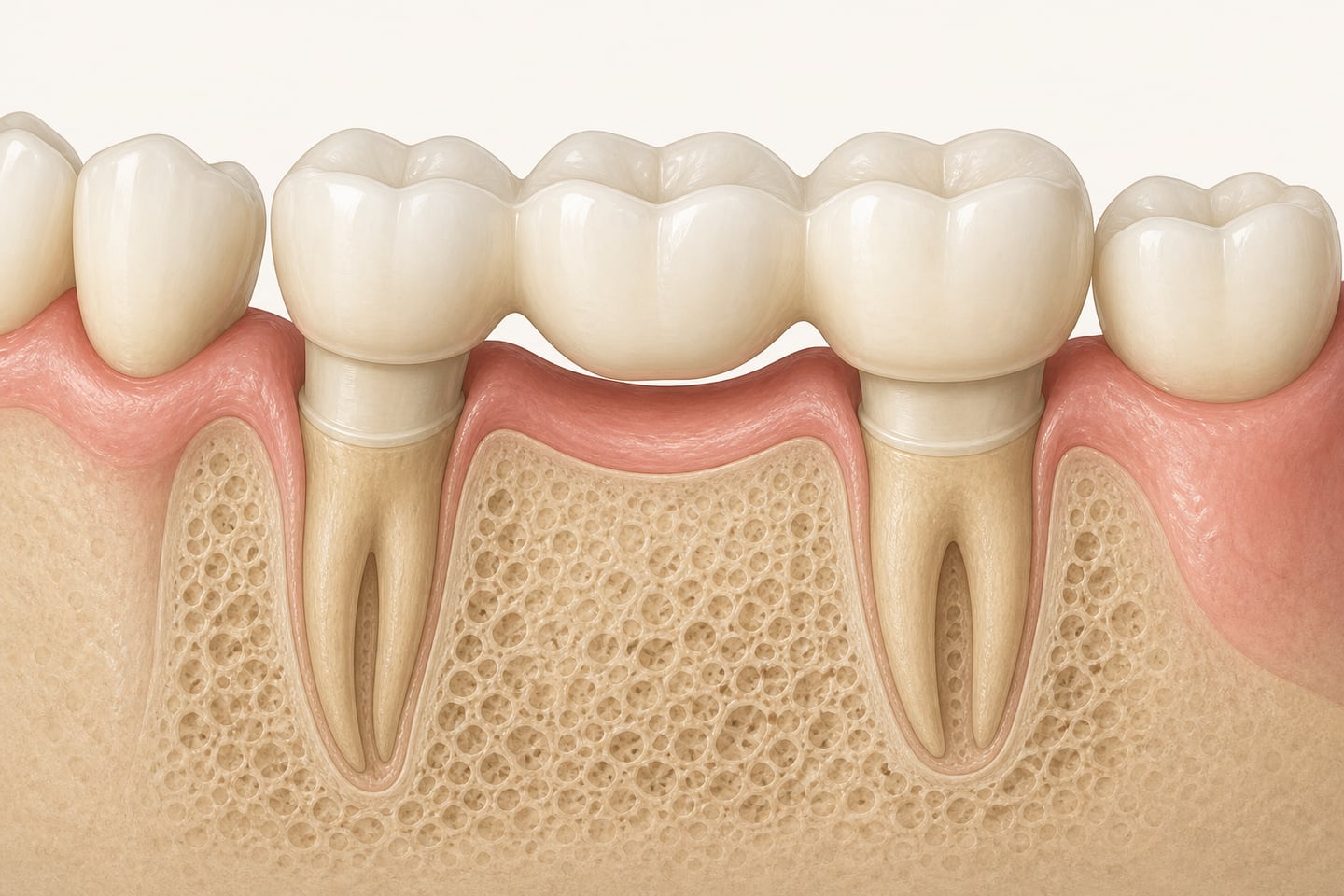
A dental bridge replaces one or more missing teeth without surgery. Crowns are placed on the teeth on either side of the gap, and a false tooth spans between them — one connected piece, cemented in place, that does not come out.
Bridges suit patients who have solid teeth on both sides of a gap and want a fixed replacement on a shorter timeline than an implant — or who cannot have implant surgery for medical or personal reasons.
The trade is worth understanding before you choose: a bridge borrows from its neighbors. The anchor teeth must be reshaped for crowns, and that is irreversible. So the decision deserves a real comparison, not a default.
Both replace a missing tooth well. Which fits you depends on the neighboring teeth, the bone under the gap, your timeline, and your health.
The comparison is worth an in-person look at X-rays. Request an appointment and ask for both options to be explained side by side, with an itemized plan for each.

Benefits
A bridge is cemented in place. It does not come out at night and does not shift when you eat or speak.
Treatment uses the same numbing and technique as crown work, which matters for patients who cannot or will not have implant surgery.
Most bridges finish in a handful of visits, without the healing timeline implant treatment needs.
An open gap invites neighboring teeth to tilt and the opposing tooth to over-erupt. Filling the gap keeps your bite aligned.
Side by side
| Comparison point | Dental bridge | Dental implant |
|---|---|---|
| Surgery | None — the same numbing and technique as crown work. | A minor surgical visit to place the post. |
| Neighboring teeth | Reshaped for crowns to anchor the bridge — irreversibly. | Left untouched; the implant stands on its own. |
| Timeline | Weeks — most bridges finish in a handful of visits. | Months — the post must fuse with the bone before the final tooth. |
| Bone under the gap | Slowly recedes over the years — nothing stimulates it. | Preserved — the post takes over the root's job. |
| Daily cleaning | The space under the false tooth needs a floss threader, super floss, or water flosser daily. | Brushed and flossed like the tooth it replaced. |
| Where it shines | When the neighboring teeth already need crowns anyway. | When the neighbors are healthy and you want the longest-lasting result. |
Candidacy
Good bridge candidates have healthy, well-rooted teeth on both sides of the gap, healthy gums, and a gap of one to a few teeth — the longer the span, the more strain on the anchors.
A bridge is a poor fit when an anchor tooth is loose or heavily compromised, or when gum disease is active — a bridge is only as strong as its weakest anchor. Gaps at the very back of the mouth with no rear tooth to anchor to usually need an implant-based answer instead.
Missing many or all teeth in an arch? A bridge is not the tool — read about dentures and dental implants instead.
The process
X-rays confirm the anchor teeth and gums can carry a bridge, and the bridge-versus-implant question is settled with you before any tooth is touched.
The teeth on each side of the gap are numbed and reshaped for crowns, and an impression or scan records the prepared teeth so the bridge can be made to fit precisely.
usually about an hour
A temporary protects the prepared teeth and covers the gap while the final bridge is made.
worn between visits
The final bridge is tried in; fit, bite, and shade are checked before cementing. Small bite refinements afterward are normal.
Recovery & risks
Tenderness in the gums around the prepared teeth and some cold sensitivity are normal for a few days after each visit and settle on their own for most patients.
The main adjustment is hygiene. Floss cannot pass between the connected crowns, so the space under the false tooth is cleaned daily with a floss threader, super floss, or a water flosser. It takes a week or two to become habit — and it is not optional, because the anchor teeth decay at their margins if the area is neglected.
What can go wrong with a bridge, plainly:
Bridge lifespan varies widely with hygiene and bite forces — outcomes vary, and no fixed number is honest. What you control most is the daily cleaning underneath.
Where to go
FAQ
Neither wins universally. An implant spares the neighboring teeth and preserves bone, but involves surgery and a months-long timeline. A bridge is faster and surgery-free, but requires reshaping the neighboring teeth and does not stop bone loss under the gap.
The tiebreakers are the condition of the neighboring teeth, available bone, your health, timeline, and budget. If the neighbors already need crowns, a bridge does double duty; if they are untouched, the implant usually deserves the first look. Read more on our dental implants page, then ask for a side-by-side plan.
It varies too much for one honest number. The bridge itself is durable; what usually ends a bridge's life is decay at the anchor teeth or gum problems beneath it — which is why daily cleaning under the false tooth and routine exams matter more than the bridge material does.
Grinding and long spans shorten a bridge's life; night guards and well-chosen anchor teeth extend it.
Regular floss cannot pass between the connected crowns, so the space under the false tooth is cleaned with a floss threader, super floss with a stiff end, or a water flosser — once a day, alongside normal brushing.
Your hygienist will show you the technique when the bridge is delivered. It takes a week or two to feel routine, and it is the single biggest factor you control in how long the bridge lasts.
It changes them irreversibly — that is the honest cost of a bridge. The anchor teeth are reshaped to receive crowns, which removes healthy enamel if those teeth were untouched. That is why a bridge is most attractive when the neighboring teeth already need crowns anyway.
Once crowned, anchor teeth carry extra load and need clean margins to stay healthy. If your neighboring teeth are pristine, ask whether an implant serves you better — we will tell you plainly.
Keep exploring
A dental implant replaces a missing tooth from the root up: a titanium post in the jaw, a connector, and a…
A crown covers and strengthens a damaged tooth so you can chew on it again. Learn when a crown beats a…
Full and partial dentures replace missing teeth without surgery. An honest guide to the adjustment period…
Four designs, and what separates them is what holds the false tooth up. How each is anchored, where each…
Four to eight months for a straightforward single implant, longer once an extraction or a graft is involved…
Nobody sees a missing molar, so it's the tooth people skip replacing. But back teeth do most of the chewing…
Both replace a missing tooth — they just get there differently. The right choice usually comes down to your…
An exam and consultation gives you your options, their costs, and the time to decide.