
Beachside Dental Group
18800 Main St Ste 110Huntington Beach, CA 92648
Four named practices — one group. Each office has its own phone line.
Replace missing teeth
A dental implant replaces a missing tooth from the root up: a titanium post in the jaw, a connector, and a crown built to match your bite and your remaining teeth.

Anatomy
Implants are the closest thing dentistry has to a new tooth. Because the post bonds with your jawbone, an implant restores most of your natural biting strength, keeps the bone in that spot from shrinking, and is brushed and flossed like the tooth it replaced. Outcomes vary from patient to patient, but a well-placed, well-maintained implant routinely serves for decades.
This page explains how implants work, who they fit, why treatment takes months rather than weeks, and what actually drives the cost. All four of our offices offer implant treatment. When you are ready to talk specifics, request an appointment and bring your questions — an exam turns everything below into a plan for your mouth.
The distinction matters for planning: the post is the long-term investment, while the crown is a wear part that can be repaired or replaced years later without disturbing the post underneath.
A single implant with a crown replaces one tooth. Several missing teeth in a row do not necessarily need one implant each — an implant-supported bridge can span the gap with two posts carrying three or four teeth, which changes both the surgery and the cost.
When most or all of the teeth in a jaw are gone or failing, a full arch can be secured on as few as four implants. That approach has its own page: All-on-4 dental implants.
Plan on several months from first scan to final crown for most cases. That is not the office being slow — it is bone biology. The titanium post needs months to fuse with the jaw before it can safely carry chewing forces; load it too early and it fails. Cases that start with an extraction or bone grafting add healing time of their own. The step-by-step timeline below shows where the months go — most of them are quiet healing at home, not appointments.
There is no single implant price, because there is no single implant case. The honest answer is that cost is driven by a handful of knowable factors, and an exam turns them into a real number for you:
After an exam you get a written treatment plan that itemizes each of these before anything starts.
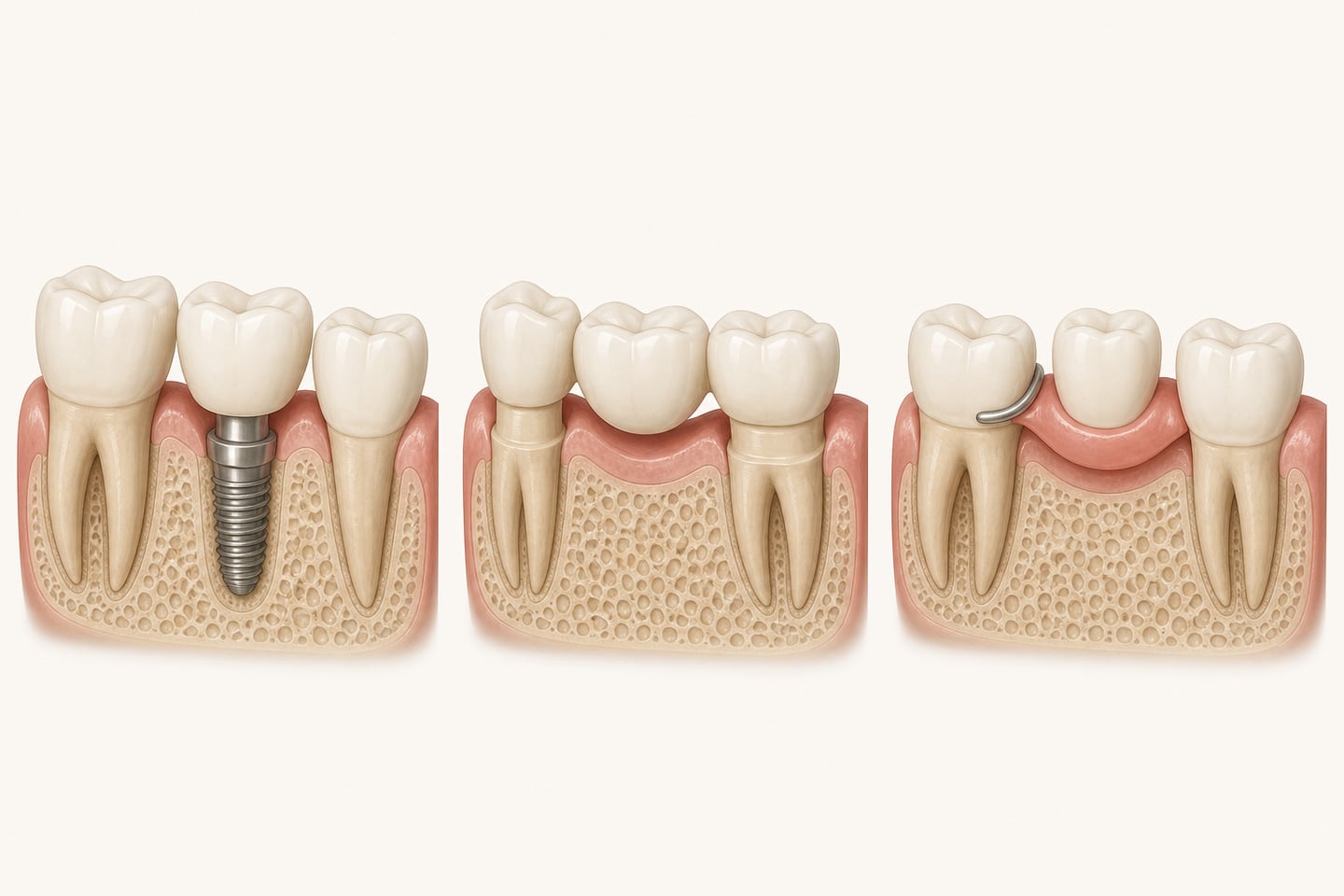
An implant is not the only way to replace a tooth — and it is not always the right one. The honest comparison:
Our offices provide all three, so the recommendation you get can be based on your mouth rather than on the one treatment available. Read more about dental bridges and dentures.
A missing tooth is not a stable situation. The jawbone that held the root starts to shrink within the first year, because it is no longer stimulated by chewing forces. Neighboring teeth drift into the gap, which changes your bite, and the tooth above or below the space can over-erupt. None of this is an emergency — but each change can make eventual treatment more involved. The most common example: waiting long enough that bone grafting becomes necessary before an implant is possible at all.
If you are not ready for an implant, that is a legitimate choice. Make it with an exam on record, so you know what your bone looks like now and what your actual timeline is — deciding with information beats deciding by default.

Benefits
The post takes over the missing root's job of carrying chewing force and stimulating the jawbone — which no bridge or denture can do.
Bone under a missing tooth shrinks over time. A loaded implant keeps that bone working, which supports your facial structure and your remaining teeth.
A traditional bridge requires grinding down the two teeth beside the gap. An implant stands on its own.
Once fully healed, most patients eat what they ate before losing the tooth. Results vary, but the functional gap between an implant and a removable denture is large.
With daily cleaning and regular checkups, implants routinely serve for decades — though no honest dentist promises a lifetime.
Candidacy
Most healthy adults with a missing tooth are candidates — but not all, and honesty here matters more than optimism. You are likely a good candidate if your gums are healthy, your jaw has enough bone to anchor a post, and your general health allows a minor surgical procedure.
Bone loss does not automatically rule you out — but it is the most common consequence of waiting. If the tooth was lost years ago or you have worn a denture a long time, the bone may have shrunk below what an implant needs. Grafting can often rebuild it; that adds months and cost, and in some mouths a bridge or a well-made denture is genuinely the better recommendation.
Some situations need extra planning or argue against implants: uncontrolled diabetes, heavy smoking, untreated gum disease, certain medications that affect bone healing, and a history of radiation treatment in the jaw area. None of these ends the conversation by itself — they are findings your dentist plans around, or reasons to choose a different treatment with your eyes open.
One rule is not negotiable: active gum disease gets treated first, because implants placed into infection fail. See gum disease treatment.
The process
X-rays or 3D imaging show how much bone you have and exactly where. You leave with an itemized plan: what will be done, in what order, and what each part costs.
one visit
A failing tooth is removed; bone is grafted where it is too thin. Some patients skip this step entirely — for others it is the longest part of the timeline.
adds months of healing when required
The titanium post is placed under local anesthetic, with sedation available for anxious patients. Most people describe pressure and vibration rather than pain, and return to normal routines within a day or two.
about an hour for a single implant in most cases
The bone fuses to the post. There is nothing to do but heal and keep the site clean; a temporary tooth covers the gap if it shows when you smile.
typically a few months; varies by case
Once the post is solid, the connector goes on and the final crown is fitted and adjusted to your bite. This stage feels like ordinary dentistry — impressions and fittings, no surgery.
usually two shorter visits
Recovery & risks
Recovery from implant placement is milder than most patients expect. Soreness, minor swelling, and light bruising around the site are normal for a few days and are typically manageable with over-the-counter pain relief; most people are back at work within a day or two.
For the first days: soft foods, no drinking through straws, no smoking, and gentle cleaning around the site as instructed. Discomfort should trend downward each day — pain that worsens after the third day, or swelling with fever, is a call-the-office situation, not a wait-and-see one.
During the months of bone healing there is usually nothing to feel at all. The final crown has no recovery period — at most a follow-up bite adjustment if it feels high.
Implant treatment is well established and most implants heal without complication — but failure is possible, and you should know how before you decide.
Outcomes vary by patient. A written plan should name your specific risk factors, not read like a brochure.
Where to go
FAQ
Less than most people fear. Placement is done under local anesthetic, and what patients report during the procedure is pressure and vibration, not pain. Afterward, expect soreness at the site for a few days, comparable to a tooth extraction, managed with over-the-counter pain relief for most people.
If anxiety is the real barrier, read about sedation dentistry and mention it when you book.
Several months for most cases — sometimes closer to a year when an extraction or bone grafting comes first. The pace is set by bone healing: the post must fuse with your jaw before it can carry a tooth, and that fusion cannot be rushed. The visits themselves are few; most of the timeline is quiet healing at home.
Because the honest number depends on an exam. Implant cost is driven by how many teeth you are replacing, whether an extraction or bone grafting is needed first, the type of restoration on top, and your anesthesia choices. A phone quote that ignores those is a guess. After an exam you get an itemized written plan — before anything starts.
See financing for how each office handles payment.
Usually not — but it changes the plan. Bone grafting can rebuild many deficient sites, and techniques like sinus lifts extend implants to upper jaws that have thinned. Grafting adds months of healing and its own cost, and in some mouths a bridge or a well-made denture is genuinely the better recommendation. The only way to know which group you're in is imaging.
Routinely for decades with good care — and no honest dentist promises a lifetime. The post is the durable part; the crown on top is subject to normal wear and may need replacement over the years, like any crown. The biggest threat to the implant itself is gum infection around it, which is why home care and regular checkups determine longevity more than the hardware does.
An implant if you want the longest-lasting result and the neighboring teeth are healthy — a bridge grinds those teeth down to serve as anchors. A bridge if you need a faster, initially less expensive fix, can't undergo minor surgery, or the adjacent teeth already need crowns anyway. That last case is the interesting one: when the neighbors need crowns regardless, a bridge stops being a compromise.
More on dental bridges.
Smoking does not automatically disqualify you, but it is the risk factor most under your control. It restricts blood supply to healing bone and gum, raising the chance the implant fails to integrate and the long-term risk of infection around it. Expect a frank conversation about pausing around surgery and healing — and a plan that accounts for the added risk if you can't.
Most commonly through some combination of insurance contribution, third-party financing, and office membership discounts. Each of our four offices maintains its own financing partners and its own membership plan — the details differ by office on purpose.
Start at financing and membership, or ask the office to walk your written plan through with you.
Keep exploring
All-on-4 replaces a full arch of teeth on four implants — a fixed alternative to a removable denture for…
A bridge replaces a missing tooth by anchoring a false tooth to crowns on its neighbors. Compare bridges with…
Full and partial dentures replace missing teeth without surgery. An honest guide to the adjustment period…
The upper back teeth sit just under the sinus, and after one is lost there often isn't enough bone left for…
Most implants are titanium; some are a white ceramic called zirconia. How they differ in track record…
Most implant plans include a cone beam CT scan — a 3D image of the jaw. What it shows that a regular X-ray…
Some plans pay toward implant treatment, some exclude it by name, and no website can tell you which yours…
An exam and consultation gives you your options, their costs, and the time to decide.