
Beachside Dental Group
18800 Main St Ste 110Huntington Beach, CA 92648
Four named practices — one group. Each office has its own phone line.
Restorative
Full and partial dentures replace missing teeth without surgery. An honest guide to the adjustment period, eating and speaking, what drives cost, and the implant-supported alternative.

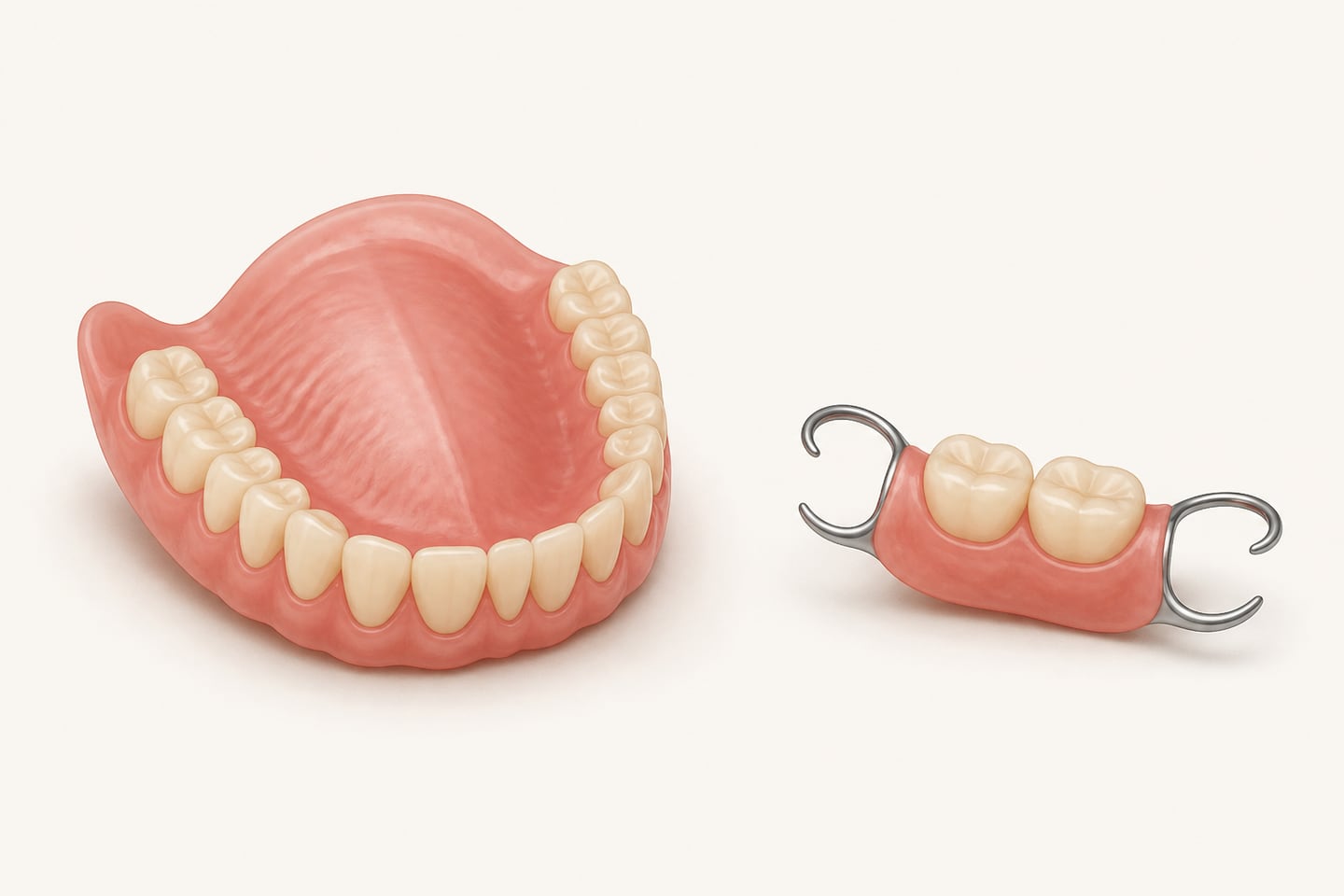
Dentures replace missing teeth with a removable appliance. A full denture replaces every tooth in the upper or lower arch; a partial denture replaces several missing teeth and clasps onto the natural teeth that remain.
They are for patients missing many or all of their teeth who want to chew, speak, and smile again without surgery — at the most accessible cost of any full-arch option.
This page is deliberately honest about the trade-offs. Dentures restore a great deal, and today's materials and fitting techniques are genuinely better than the dentures your parents knew. They are still an adjustment — and knowing that going in is the difference between a frustrating first month and a successful one.
The first weeks take patience, and anyone who says otherwise is selling something. Expect more saliva at first, a feeling of fullness, some sore spots as your gums adapt, and practice before speech and chewing feel natural. Nearly all of this improves — and sore spots are fixed with quick adjustment visits, not endurance.
Chewing with a full denture works, but with less force than natural teeth — that is physics, not a defect. Lower dentures have less to hold onto than uppers and take more practice. This is exactly the problem implant support was designed to solve.
A small number of dental implants can anchor a denture so it snaps firmly into place — or support a fixed full-arch restoration that stays in and is removed only by a dentist. Stability, chewing power, and bone preservation all improve; surgery and higher cost are the trade. If a loose lower denture is your main worry, ask about this option before choosing.
Denture fees vary by case, and the differences trace to real decisions:
You get an itemized plan in writing before treatment starts. Each of our offices sets its own financing partners and membership plan — see financing and membership, or request an appointment to talk through your options in person.

Benefits
Dentures restore the look of a complete smile and the facial support that missing teeth take away — no surgical step required.
Of all the ways to replace many missing teeth, conventional dentures involve the lowest upfront cost and the simplest treatment path.
Chewing with dentures takes learning and is not identical to natural teeth — but it is much better than chewing without them, and most patients return to a broad diet.
Teeth shape speech, and gaps distort it. Dentures restore those sounds after a practice period that is normal and temporary.
Dentures can be relined, adjusted, and repaired as your mouth changes over the years. Maintenance is routine, not a crisis.
Side by side
| Comparison point | Traditional dentures | Implant-supported |
|---|---|---|
| Stability | Rests on the gums and can move when you chew — lowers more than uppers; adhesive helps some patients. | Anchored to implants — snaps firmly into place, or stays fixed and is removed only by a dentist. |
| Bone preservation | The jawbone beneath slowly shrinks over the years — the reason dentures loosen and need relines or remakes. | Implants keep the bone they sit in working, slowing that shrinkage. |
| Daily care | Comes out at night — brushed daily with a soft brush and soaked while your gums rest. | Snap-on styles come out for cleaning; fixed styles are cleaned in place, under and around, every day. |
| Upfront cost factors | The most accessible full-arch option — no surgical step in the plan. | Adds surgical and component costs in exchange for stability. |
| Candidacy | Most patients missing many or all teeth in an arch; no surgery involved. | Needs enough bone to anchor implants and health adequate for minor oral surgery. |
Candidacy
Full dentures fit patients missing all the teeth in an arch, or whose remaining teeth cannot be saved. Partial dentures fit patients missing several teeth who still have healthy, stable natural teeth to anchor to.
Dentures are a poor fit for patients unwilling to accept a removable appliance and a real adjustment period — implant-supported teeth exist for exactly that patient. Severe bone loss, especially in the lower jaw, makes a conventional denture harder to stabilize; implant anchorage often serves those cases better when the bone allows it.
Not sure which group you are in? An exam with X-rays settles it. Request an appointment at the office nearest you.
The process
X-rays and an exam of your teeth, gums, and bone. If teeth need extraction, the sequence and timing, including whether an immediate denture makes sense, is planned here.
Molds or scans of your mouth, plus measurements of your bite and how your jaws relate, so the denture is built for your anatomy rather than an average one.
A trial version is placed so you and the dentist can check fit, bite, and appearance — tooth shade and position are still changeable at this stage. Speak, look in the mirror, and say so if anything feels wrong; changes now are easy, changes after delivery are not.
The finished denture is placed, and first-day instructions cover wearing time, cleaning, and what soreness to expect.
Sore spots in the first weeks are normal and are relieved by small, precise adjustments. These visits are part of proper denture care — never sand or bend a denture yourself.
typically over the first few weeks
Recovery & risks
The adjustment period is real, and it goes better when you know the sequence. The first days bring extra saliva, a feeling of fullness, and gums learning pressure they have not felt before. Practice reading aloud — speech adapts quickly with use.
Eating is a learned skill: start with soft foods cut small, chew slowly on both sides at once, and add firmer foods week by week. Biting into food with the front teeth (a whole apple, crusty bread) is the hardest move with a full denture, and cutting food into pieces remains a useful lifelong habit.
Sore spots mean the fit needs a small adjustment — call the office rather than pushing through. Most patients settle into confident daily wear over the following weeks, though timelines vary person to person.
Daily care: rinse the denture after eating when you can, brush it daily with a soft brush, and give your gums a rest by taking it out at night and soaking it in water or denture solution. Brush your gums, tongue, and any remaining teeth too.
Honest limitations to weigh before choosing dentures:
Outcomes vary with anatomy, adaptation, and habits. What we promise is a careful fitting process, adjustment visits when you need them, and a straight answer about whether implant support would serve you better.
Where to go
FAQ
Mostly, with practice — and it is fair to know the limits up front. Start with soft foods cut small, chew slowly on both sides at once, and build back toward a normal diet over weeks. Most denture wearers return to a broad range of foods.
Some things stay genuinely hard with a full denture: biting into a whole apple, corn on the cob, very chewy or sticky foods. Cutting food into pieces remains a lifelong habit. If chewing power is a priority, implant-supported dentures close much of that gap.
Plan on weeks, not days — and expect the timeline to vary by person. The first days bring extra saliva, a feeling of fullness, and some sore spots. Speech usually adapts within days of practice (reading aloud helps), and confident eating builds over the following weeks.
Sore spots are not something to endure. They mean the denture needs a small adjustment, which is a quick visit — and patients who come in early for adjustments adapt faster than patients who tough it out.
Take them out at night as your default. Gums need a daily rest from pressure, and around-the-clock wear is associated with irritation and fungal infections under the denture. Nightly removal is also when the denture gets its cleaning and soak.
One exception: your dentist may advise wearing an immediate denture through the first night after extractions. Follow the specific instructions you are given for that period.
Because your jaw changes, not because the denture wears out. Without tooth roots, the bone that used to hold them slowly remodels and shrinks — so a denture that fit snugly gradually loosens.
A reline refits the denture's inner surface to your current gum shape and is a routine part of denture ownership. Increasing looseness, food working underneath, or new sore spots are the usual signs it is time. Call the office rather than compensating with more and more adhesive.
A way to give a denture something firm to hold onto. A small number of dental implants placed in the jaw either anchor a removable denture that snaps in and out, or support a fixed full-arch restoration that only a dentist removes.
Stability and chewing power improve substantially, and implants stimulate the bone — slowing the shrinkage that loosens conventional dentures. The trade is surgery and higher cost. See dental implants and All-on-4 full-arch options for the details.
Modern denture teeth come in many shapes and shades, and the try-in stage exists so you approve the look before the denture is finished. Speak up there — changes at try-in are easy, changes after delivery are not.
What reads as denture-looking is usually teeth that are too uniform, too white, or positioned unnaturally. Bringing an old photo of your natural smile helps the design more than most patients expect.
The main variables: full versus partial, one arch or both, the materials chosen, whether extractions or other work come first, whether an immediate denture is placed the day teeth are removed, and whether implants will support the denture.
We put the full plan in writing before starting, including the follow-up care dentures need over time. Each of our offices carries its own financing partners and membership plan — see financing and membership.
Keep exploring
A dental implant replaces a missing tooth from the root up: a titanium post in the jaw, a connector, and a…
All-on-4 replaces a full arch of teeth on four implants — a fixed alternative to a removable denture for…
A bridge replaces a missing tooth by anchoring a false tooth to crowns on its neighbors. Compare bridges with…
A denture that lifts when you talk or rocks when you chew is usually telling you the mouth under it has…
Brush them daily with a non-abrasive cleanser instead of toothpaste, keep them away from hot water, take them…
One replaces every tooth in an arch and rests on the gum ridge. The other replaces some of them and hangs…
One replaces the root and stays in your mouth. The other rests on your gums and comes out to be cleaned. What…
An exam and consultation gives you your options, their costs, and the time to decide.