
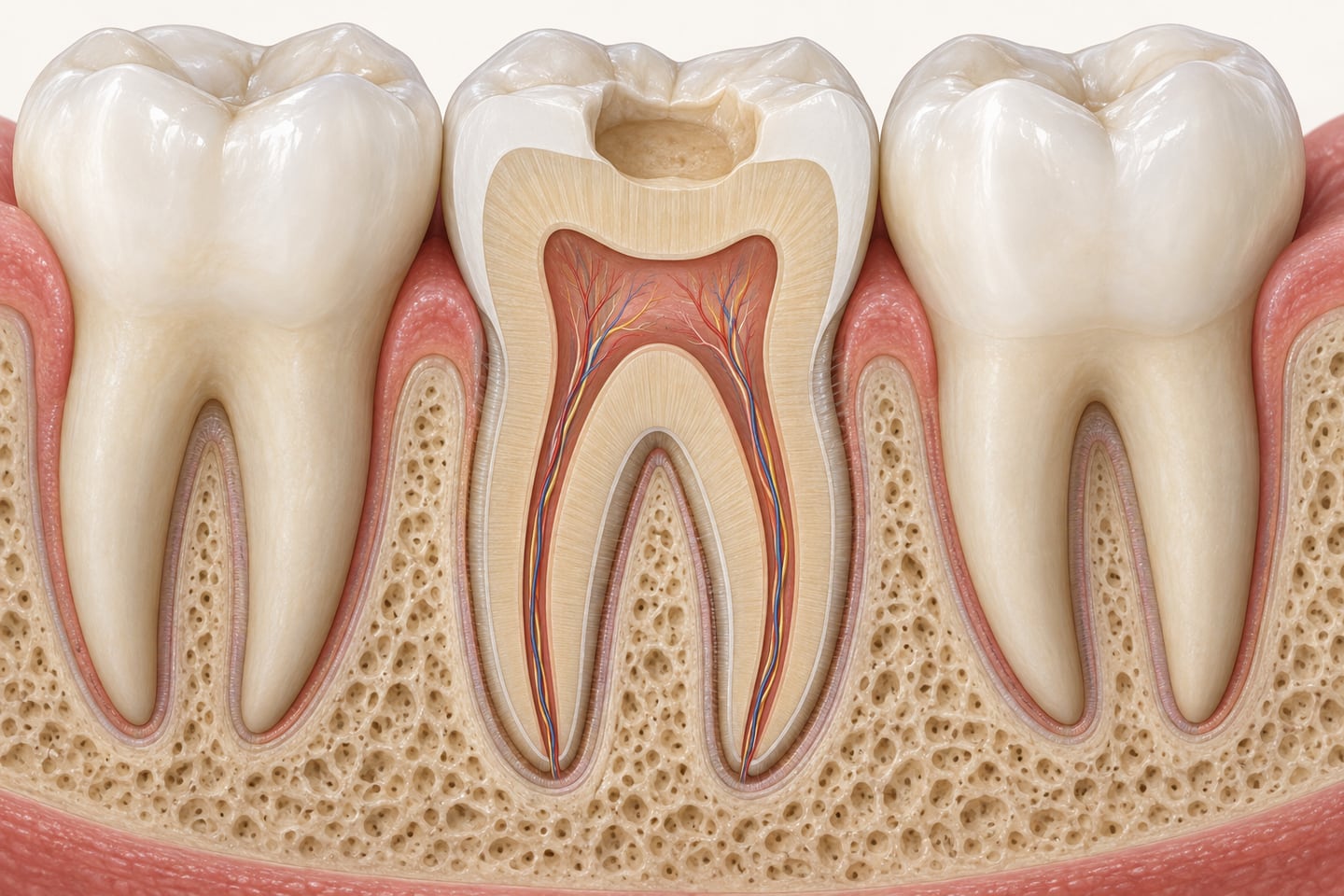
Keep the piece, avoid chewing on that side, and call the office in the morning, unless there is pain or swelling, in which case call now. A lost filling or crown is common, and the tooth underneath is usually fine if you protect it for a night. What you do in the next few hours is about keeping that tooth comfortable and intact until someone can look at it.
The first five minutes
- Find the crown or the piece of filling. Rinse it gently and put it in a small container. A crown that is intact can often be cemented back on.
- Rinse your mouth with warm water. Look at the tooth in a mirror. A hollow or a rough surface is normal. Pink or red in the center, or bleeding from inside the tooth, is not.
- Stop chewing on that side. Switch to soft foods for the rest of the night.
Tonight: protect the tooth
- Avoid very hot, very cold, and sweet food and drink. The inner layer of the tooth is exposed and reacts to all three.
- Pharmacies sell temporary dental filling material and temporary dental cement. Either can cover the spot or hold a crown in place for a day or two. Follow the package directions.
- Household glue of any kind is never an option. It damages the tooth and the crown, and it is not safe in the mouth.
- Cover a sharp edge with orthodontic wax or a small piece of sugar-free gum to protect your tongue and cheek.
- An over-the-counter pain reliever, taken as the label directs, can take the edge off. Do not hold aspirin against the gum. It burns the tissue.
When it is call-now, not call-in-the-morning
A lost filling or crown with no pain and no sensitivity can wait a day or two. These cannot: throbbing pain, pain that wakes you, swelling in the gum or face, bleeding you cannot stop with pressure, a visibly exposed nerve, or a tooth that broke along with the restoration. Any of those is a dental emergency, and the front desk will tell you when to come in and what to do on the way. Swelling that affects breathing or swallowing belongs in a hospital emergency room, not a dental office.
One more rule. If you swallowed the crown, you are usually fine, but tell the office. If you inhaled it, with coughing or trouble breathing, go to the emergency room.
Pain that stopped on its own is not an all-clear. Severe tooth pain that suddenly disappears can mean the nerve has died, and the infection behind it is still there. Get it examined either way.
Temporary crown or permanent crown?
If the crown that came off is a temporary, the one placed while your permanent crown is being made, this is expected rather than alarming. Temporaries are attached with weak cement on purpose so they come off easily at the next visit. Keep it safe, chew on the other side, and call. Recementing a temporary is a quick visit. Do not leave it off for long, because the prepared tooth is sensitive and the neighboring teeth can drift enough that the permanent crown no longer fits.
Why not just wait a few weeks
The tooth under a filling or crown has already lost its outer enamel in that spot. Exposed, it decays faster than a healthy tooth and it is weaker against biting. Teeth also move. Without the restoration holding its place, neighbors tilt toward the gap and the opposing tooth drifts into it. A crown that fit last month may not fit next month. A small repair becomes a new crown, and sometimes a root canal, for no reason other than time.
What the visit does
Expect an exam and usually an X-ray to check the tooth underneath for decay, cracks, and nerve involvement. If the crown is intact and the tooth under it is sound, it is cleaned and cemented back on. If a filling was lost and the cavity is contained, a new filling is placed. If decay has spread or a wall of the tooth broke away, a new crown is the repair that holds the tooth together. If the nerve is exposed or infected, root canal therapy comes first and a crown follows.
Cost depends on that diagnosis. The visit is billed as an exam plus whatever stabilizes you, and costs are explained before any treatment beyond the exam begins. Financing options differ by office and are subject to credit approval.
If a corner of the tooth broke off along with the restoration, our guide to a cracked or chipped tooth in the first 24 hours covers how to tell a chip from a crack and what each one means for the repair.
Who to call in the morning
Three of our four offices list emergency care on their own treatment menus. Call whichever you can reach fastest. Tell the front desk what came off, when, and whether anything hurts. They will tell you when to come in.
- Beachside Dental Group, Huntington Beach: (714) 842-6151
- Marina Dentistry, Marina del Rey: (310) 578-5000
- Rio Hondo Dental Group, Downey: (562) 928-5559
Pacifica Dental's published menu does not include emergency care. If it is not urgent and you would rather book online, request an appointment and describe what happened in the message field. Outcomes depend on what the X-ray shows, but a restoration that came off a sound tooth is one of the more routine repairs in dentistry. Protect it tonight and let the office look tomorrow.