
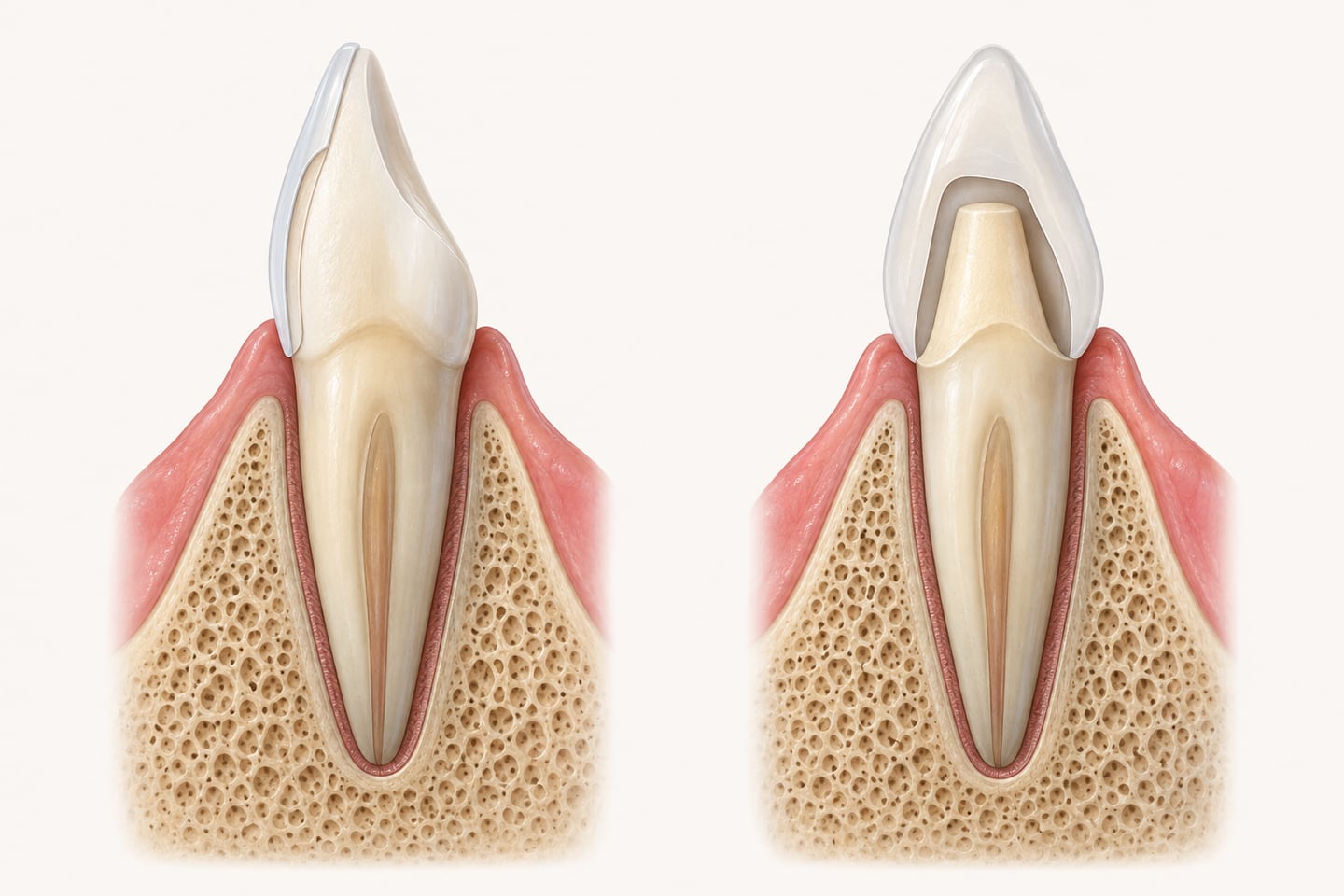
Veneers are for teeth that are structurally sound but don't look the way you want. Crowns are for teeth that are damaged or heavily filled and need rebuilding. If your complaint is color, shape, or small chips on healthy front teeth, you are probably a veneer case. If the tooth has a large filling, a crack, a root canal, or decay, you need a crown regardless of what it looks like. Most problems sort cleanly into one of those two groups.
What each one is
A veneer
A veneer is a thin shell, usually porcelain, bonded to the front face of a tooth. It covers what shows when you smile and leaves the rest of the tooth alone. Preparing a tooth for a veneer typically removes a thin layer of enamel from the front surface only.
A crown
A crown covers the entire tooth above the gumline, all the way around. Preparing a tooth for a crown removes more structure, because the crown needs room on every side. In exchange, the crown holds the tooth together. It takes the chewing force so a weakened tooth doesn't split.
The rule of thumb: a veneer is a cosmetic surface. A crown is a structural shell.
Match the fix to the problem
- Deep staining that whitening can't lift: veneers, if the teeth are otherwise healthy.
- Small chips or worn edges on front teeth: veneers.
- Small gaps, slightly uneven lengths, minor shape issues: veneers.
- A large old filling with little natural tooth left: crown.
- A cracked tooth, or a tooth that hurts when you bite: crown, and an exam first, because a crack can involve the nerve.
- A tooth that has had a root canal: crown, almost always, especially on a back tooth.
- Decay on the front surface: treat the decay first. Then the answer depends on how much tooth is left.
- Crooked or crowded teeth: neither. That is an alignment problem. Invisalign or orthodontics move teeth; veneers and crowns do not.
- A front tooth that is both discolored and badly broken: crown. A veneer needs a solid tooth underneath it.
Where the two overlap
Front teeth are where the choice gets real. A front tooth with moderate damage might take either: a veneer if enough enamel and structure remain, a crown if not. The dentist's judgment here is about how much healthy tooth survives and how much force the tooth takes. A careful dentist chooses the option that removes the least tooth while still lasting. A veneer on a tooth that needed a crown tends to chip or come off. A crown on a tooth that only needed a veneer removed structure for no reason.
Many smile plans mix the two: crowns on the teeth that need rebuilding, veneers on their healthy neighbors, all made in the same material and shade so the result reads as one set. A smile makeover is usually this kind of combined plan.
Enamel: the decision you can't undo
Both treatments remove enamel, and enamel does not grow back. A veneered tooth will always need a veneer, or eventually a crown. A crowned tooth will always need a crown. This is not a reason to avoid either. It is a reason to choose the least invasive option that solves the actual problem, and to be sure the problem is real before treating it. If your teeth are healthy but dull, professional whitening is the first step, not porcelain.
The sequence of visits
The sequence is similar for both. A first visit to plan, with X-rays and photos. A preparation visit where the tooth is numbed and shaped, an impression or digital scan is taken, and a temporary is placed. Then a lab makes the final piece, which usually takes a couple of weeks. A final visit bonds or cements it and adjusts the bite. Crowns sometimes need a root canal or decay removal before preparation, which adds a visit. Veneers on several teeth are usually prepared in one appointment and delivered in another. Some sensitivity to cold between visits is normal for both.
How long each lasts
Both can serve for many years, and neither is permanent. Veneers are thinner and more exposed to chipping, and a chipped veneer is replaced, not repaired. Crowns are sturdier but can wear, loosen, or develop decay at the edge where they meet the tooth. Grinding shortens the life of both, and a nightguard is part of the plan if you grind. Outcomes vary with habits, bite, and the condition of the tooth underneath. Be wary of anyone who promises a number of years.
Cost: how the two differ
Both are priced per tooth, so the count is the biggest factor. Beyond that: material, laboratory work, and whether other treatment (decay removal, a root canal, gum work) has to come first. Insurance usually treats them differently. Crowns needed for a damaged tooth are often partly covered; veneers chosen for appearance usually are not. Financing can spread either into monthly payments, subject to credit approval. Get the cost in writing, per tooth, before you commit.
How to decide
Get an exam with X-rays. That tells you whether the tooth is sound, which is the one fact that decides the question. Then ask: what is the least amount of tooth you would need to remove to solve this? A cosmetic consultation at any of our offices is where that sorting happens. Request an appointment and bring a photo of what you'd like to change. The answer may be veneers, may be a crown, and may be something simpler.