
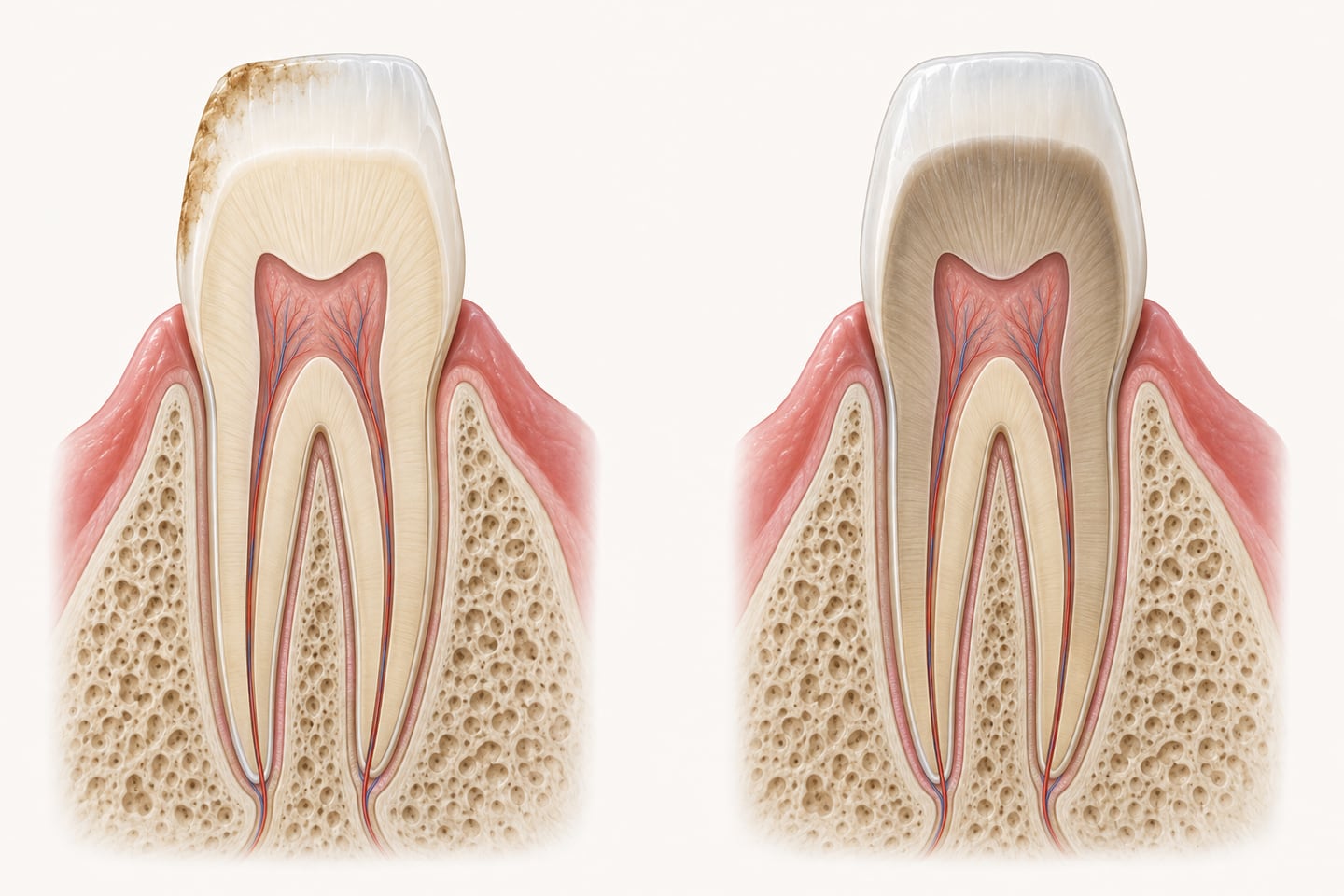
Four things differ, and only four: peroxide concentration, how evenly the gel is held against the tooth, whether your gums are protected from it, and whether anyone examined the teeth first. Drugstore strips genuinely work on mild surface staining. What neither strips nor professional gel will do is lighten a crown, a veneer or a filling, or shift discoloration that lives deep inside the tooth.
Difference one: how much peroxide is in it
Both categories use the same two active agents. The ADA notes that carbamide peroxide releases about one third of its content as hydrogen peroxide, puts take-home systems in a range of 10% to 38% carbamide peroxide, and says over-the-counter products contain these agents at lower concentrations than in-office or dentist-prescribed products. MouthHealthy, the ADA's patient site, puts it in one line: the concentration in store products is lower than what your dentist would use in the office.
Run the ADA's one-third figure across its own range and 10% carbamide peroxide works out to roughly 3% hydrogen peroxide, with the top of the range several times that. In-office gel is more concentrated again, applied for up to thirty minutes at a time in supervised rounds. Concentration buys speed and reach. It does not change which kinds of discoloration respond.
Difference two: a custom tray versus one size for everyone
MouthHealthy describes the dentist-dispensed route as a custom-made tray molded to your teeth, with out-of-office bleaching taking anywhere from a few days to a few weeks. The tray does more work than it looks like: it holds gel against every surface it covers, including the curves of the canines, instead of letting saliva wash it off within minutes.
Strips are cut for a flat run of front teeth. They sit well on the four incisors and less well on everything that curves away from the camera, which is why the classic store-kit result is bright front teeth with darker canines beside them. One-size trays cover more, but hold gel against gum as readily as tooth.
Difference three: whether your gums are protected
In the chair, protection is a deliberate step. MouthHealthy describes chairside bleaching, which usually requires only one office visit, as the dentist applying either a protective gel to your gums or a rubber shield before the bleach goes on. A custom tray is trimmed to the gumline for the same reason. A strip has no equivalent: it is a film of peroxide laid across teeth and whatever gum it reaches, which is part of why the ADA lists gingival inflammation alongside tooth sensitivity as the most common adverse effect.
Difference four: somebody looked at the teeth first
This decides whether whitening works at all. The ADA describes a clinical exam before bleaching begins, with radiographs and other diagnostic tests as appropriate, to work out what is causing the discoloration. MouthHealthy's advice is shorter: talk to your dentist before you begin. An exam catches what makes whitening fail or hurt: decay, which peroxide sits in rather than lifts; exposed root surfaces, where gel stings without whitening much; and discoloration whose cause means gel was never the answer.
Gums that bleed when you brush are a reason to sort that out before a whitening course rather than after. Why gums bleed and what to do about it covers the two-week test, and a cleaning and exam is where surface staining comes off anyway, which occasionally settles the question without gel.
What will not whiten, whatever you buy
Crowns, veneers, fillings and bonding keep the shade they were made in. MouthHealthy states it flatly: whitening will not work on caps, veneers, crowns or fillings. The ADA says the same in reverse, that only natural teeth can be whitened, not tooth-colored restorations. Lighten the teeth around a restoration and it reads darker by comparison, which is why the order of work matters. Whitening compared with veneers goes through that sequence.
Discoloration that lives inside the tooth
The ADA distinguishes extrinsic stains, colored compounds accumulating on the enamel surface from tobacco and pigmented food and drink, from intrinsic stains, which sit inside the tooth within the enamel or the dentin underneath. Causes it lists include genetic disorders, fluorosis, tetracycline use in childhood and aging. Store products are built for the extrinsic kind. The ADA notes that treating tetracycline or fluorosis staining can require three to four months of nightly treatment on average, and no drugstore box runs a supervised course that long.
MouthHealthy sets the expectation by tone: yellow teeth will probably bleach well, brown teeth may not respond as well, and teeth with gray tones may not bleach at all. That last clause deserves reading twice, because store packaging never carries it.
A single dark tooth
One tooth much darker than its neighbors is almost never a whitening problem. It usually means something happened to the tissue inside the tooth, and gel on the outside does very little. The ADA describes a separate procedure, intracoronal or internal bleaching, worked from inside the tooth once the inside has been treated. Root canal treatment compared with removing the tooth covers that assessment. The first step is a diagnosis, not more gel.
Decay, and chalky white spots
Whitening neither treats decay nor hides it, and a tooth that hurts during a course may be telling you something that has nothing to do with the peroxide. Chalky white patches do not disappear either, and can look more obvious at first while the enamel around them is dehydrated.
Sensitivity, told straight
The ADA describes temporary tooth sensitivity and gingival inflammation as the most common adverse effects of whitening vital teeth, both generally mild and transient, and reports sensitivity in up to two thirds of users during the early stages of bleaching, typically developing within two to three days and usually resolving by the fourth day after treatment. MouthHealthy explains the mechanism: the peroxide gets through the enamel to the soft layer of dentin and irritates the nerve of the tooth.
Two thirds is not a footnote. Sensitivity is not a sign the gel is working harder, so pushing through with more product is the wrong response. Slowing the schedule, shortening the wear time and using a sensitivity toothpaste are the usual adjustments, and a supervised course can be adjusted while a box of strips cannot.
The rest of that shelf
Seal-bearing products in this category include toothpastes and whitening strips, so a strip carrying the ADA Seal has been through a voluntary evaluation. The Seal is not a ranking against professional treatment: products dispensed by dentists are not eligible for it, so its absence on an office gel means nothing. Whitening toothpaste is its own category, lifting surface stains through polishing agents rather than changing tooth color.
On charcoal the ADA is short: there is no evidence that dental products with charcoal are safe or effective for your teeth. Its broader warning about homemade methods is that natural does not mean healthy. A scrub too rough wears enamel away, and the layer underneath, dentin, is softer and yellower, so an abrasive method can leave teeth looking more yellow. Acid does the same, and unlike a disappointing whitening course, it cannot be undone.
A reasonable order to try things in
- Find out what kind of discoloration you have before buying anything.
- For ordinary surface staining, an ADA Seal-bearing strip is a fair first move, on the schedule printed on the box rather than double it.
- Move to a dentist-dispensed tray or an in-office session when strips plateau or results come out uneven.
When to stop and book an exam
- One tooth is much darker than the others.
- A specific tooth hurts, rather than the general cold twinge that fades.
- Your gums are sore, red or bleeding after a course.
- The result came out patchy, or the canines stayed dark.
- You have crowns, veneers or front fillings and want to avoid a mismatch rather than discover one.
If any of those apply, request an appointment and ask two questions: what kind of discoloration is this, and is it the kind that responds. Professional whitening and cosmetic treatment generally describe what is involved, and each office quotes its own fees. An answer that whitening will not help is worth more than a course that was never going to work.