
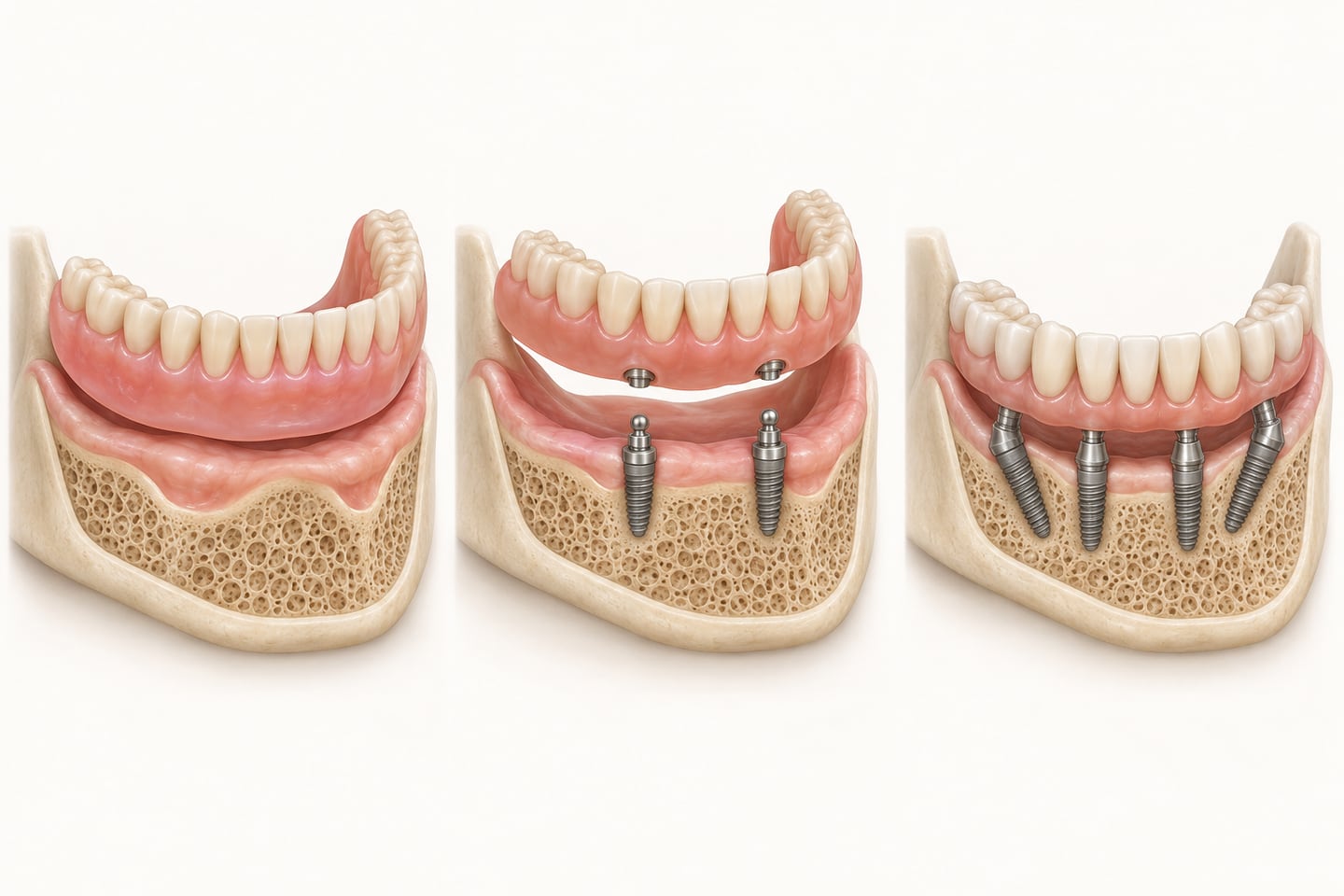
All-on-4 is a fixed full arch of teeth on four implants; an implant-supported denture is removable but snaps onto implants; a conventional denture rests on the gums with no implants at all. What separates them is what each asks of your bone, your budget, and your daily cleaning. The right one depends on how much bone you have, how healthy you are for surgery, and how much a moving denture bothers you.
The three options, one line each
- All-on-4. Four implants per arch at engineered angles carry a fixed bridge. No adhesive, no nightly removal. Only a dentist takes it out. See All-on-4 dental implants.
- Implant-supported denture. A small number of implants anchor a denture that snaps in and out. You remove it to clean it. It does not drift mid-meal.
- Conventional denture. Rests on the gums and holds by suction and adhesive. No surgery. The most accessible cost of the three. See dentures.
Side by side
Fixed or removable
- All-on-4: fixed. It stays in.
- Implant-supported denture: removable. It snaps on and off.
- Conventional denture: removable. It comes out at night and rests on the gums by day.
Surgery
- All-on-4: yes. Extractions if needed, four implants per arch, and months of healing. A genuine surgical recovery, more than a single implant.
- Implant-supported denture: yes, with fewer implants than a tooth-by-tooth approach. Healing time still applies.
- Conventional denture: none, beyond any extractions.
What it asks of your bone
- All-on-4: enough bone at the four anchor points. The angled placement is designed to use the strongest available bone, so many patients skip the grafting that individual implants would need. There is still a minimum, and imaging decides it.
- Implant-supported denture: enough bone at each implant site. Fewer sites than a full set of individual implants.
- Conventional denture: no minimum. Severe bone loss, especially in the lower jaw, makes it harder to stabilize.
Chewing
- All-on-4: restores far more biting force than a removable denture. Results vary, but this is the difference patients mention first.
- Implant-supported denture: substantially more stable and stronger than a conventional denture, because it is anchored.
- Conventional denture: works, with meaningfully less force than natural teeth. Lower dentures have less to hold onto and take more practice.
Bone over time
- All-on-4: loaded implants stimulate the bone they sit in, slowing the shrinkage that reshapes the face of long-term denture wearers.
- Implant-supported denture: the implants slow shrinkage at their sites.
- Conventional denture: the jawbone under it keeps shrinking because no roots stimulate it. This is why dentures loosen and need relines or remakes.
Daily cleaning
- All-on-4: must be cleaned under and around the bridge every day, in the mouth. A fixed bridge is harder to clean than natural teeth. A patient unwilling to commit to that routine is a poor candidate.
- Implant-supported denture: take it out, brush it, and clean around the implant attachments. The attachments wear and get replaced over time.
- Conventional denture: take it out, brush it, soak it at night, and brush your gums. Sore spots are fixed with adjustment visits.
Upfront cost and maintenance
- All-on-4: the highest upfront cost of the three. The bridge on top is a wear item that can need repair or eventual replacement.
- Implant-supported denture: more than a conventional denture, less than a fixed full arch. Snap attachments and relines are part of owning it.
- Conventional denture: the lowest upfront cost. Relines and adjustments over the years are routine.
No option is maintenance-free. We do not publish prices, because every case is itemized after imaging. What you should expect from any office is a written plan that names each part before treatment starts.
Who each one tends to fit
All-on-4 fits someone who has lost most or all of an arch, or is about to, wants teeth that stay in, has enough bone at the anchor sites, is healthy enough for oral surgery, and will do the cleaning. An implant-supported denture fits someone whose main complaint is a loose denture, especially a lower one, and who is fine with a removable appliance if it stops moving. A conventional denture fits someone who wants no surgery, needs the most accessible path, or has health reasons to avoid implants. It remains the medically sensible choice for some patients.
One more group: patients with several teeth that can still be saved. A thorough exam says so. Extracting salvageable teeth to fit a product is not a plan.
What imaging and health history decide
Imaging maps bone at the anchor sites and settles whether implants are possible at all. Health history matters: heavy smoking and unmanaged diabetes raise implant failure risk and prompt a direct conversation. Budget and the number of visits you can manage shape the sequence. Outcomes vary by patient, and the consultation should end with your specific risk profile discussed openly.
Longer surgical visits are where sedation earns its place. Ask what each office offers for full-arch cases when you book.
Which offices list full-arch options
Beachside Dental Group, Huntington Beach; Marina Dentistry, Marina del Rey; and Rio Hondo Dental Group, Downey — each list All-on-4 and dentures on their own treatment menus. Request an implant consultation at whichever is nearest. Bring your questions about cost; financing partners differ by office and approval is subject to credit review. If you are weighing single-tooth options instead, start with dental implants.