
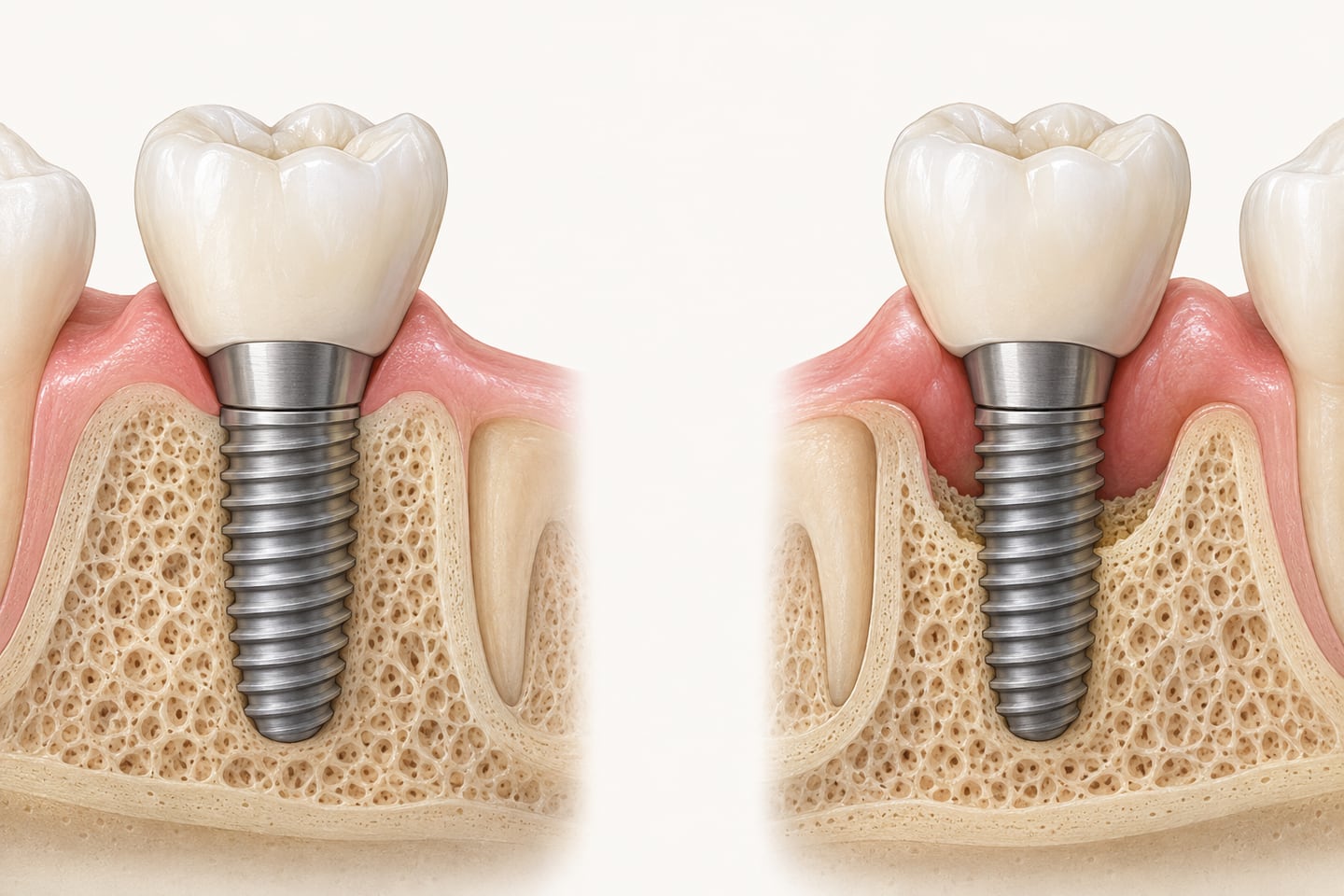
An implant post that has fused to the bone can last for decades, often the rest of a patient's life, while the crown attached to it is a wear part that typically needs repair or replacement at some point along the way. No dentist can promise a number of years for your implant, and you should be wary of one who does. What is predictable is the list of things that end implants early: infection of the gum and bone around the post, overload from grinding, smoking, unmanaged diabetes, and missed maintenance. Most of that list is within your control.
Three parts, three lifespans
A dental implant is a titanium post in the bone, a connector called an abutment, and a crown on top. The post is the long-lived part; once integrated, it has no decay to fear and no nerve to die. The crown chips, wears, and loses its polish the way any crown does, and it is replaced on the same post. The abutment screw can loosen over years of chewing, which is a small fix when caught at a checkup and a bigger one when the loose part is ignored until something cracks.
Early failure and late failure are different problems
An implant that fails in the first months never fused to the bone. The usual causes are infection at the surgical site, movement before the bone had set, smoking through the healing period, or simply too little bone. It is caught at the follow-up X-rays, the post is removed, and the site is often re-treated later. A late failure happens years after a post that fused perfectly, and it is almost always infection around the post or overload from the bite. The first kind is mostly about surgery and healing. The second kind is mostly about maintenance, which is the subject of the rest of this article.
The threat that ends most implants: infection around the post
Implants do not get cavities, but the gum and bone around them get the same disease natural teeth do. Plaque collects where the crown meets the gum. Left there, the gum inflames (a stage called peri-implant mucositis) and, if it continues, the bone supporting the post starts to recede (peri-implantitis). The early stage is reversible with professional cleaning and better home care. The late stage is hard to treat and is the usual reason an otherwise healthy implant is lost years after placement.
The warning signs are the same as gum disease: bleeding when you brush around the implant, redness or puffiness at the gumline, a bad taste, and, late, a crown that feels slightly loose. None of it hurts at first. That is why the checkup exists.
Grinding and bite overload
A natural tooth sits in a ligament that cushions force. An implant is fused directly to bone with no cushion at all, so clenching and grinding transmit full force to the screw, the porcelain, and the bone. The results, in order of severity, are a loosened abutment screw, chipped porcelain, and bone loss around the post. If you grind, a nightguard is part of owning an implant, and the bite should be checked at every visit so the implant crown is not taking more than its share.
Smoking and health conditions
Smoking is the single largest risk factor for gum disease, and peri-implantitis behaves like gum disease. Diabetes that is not well controlled slows healing and makes gum infection harder to treat. Both matter at placement and for every year afterward. If either applies to you, the candidacy conversation is worth reading before the implant goes in, and the maintenance schedule after it goes in will be tighter.
Daily care that actually protects it
- Brush twice a day, including the gumline around the implant crown, with a soft brush.
- Clean between and under the crown every day. Floss, interdental brushes, or a water flosser all work; the gap where the crown meets the gum traps plaque that a toothbrush cannot reach.
- For a fixed full-arch bridge such as All-on-4, clean under the bridge daily with the tools the office shows you. This is the maintenance commitment that decides whether a full arch lasts.
- Wear the nightguard if one was prescribed.
- Do not chew ice or use the implant tooth to open, tear, or crack anything.
The first year sets the pattern. Expect the office to check the implant more often during that period, to show you the cleaning technique for the specific shape of your crown, and to adjust the bite once the crown has settled. Habits formed in that year are the ones that last.
Professional care: what an implant checkup includes
Routine cleanings and exams continue at the interval your dentist sets, which for implant patients is often closer together than for someone with no history of gum trouble. The hygienist uses instruments suited to implant surfaces. The dentist checks the bite on the implant crown, checks the screw, and takes an X-ray periodically to compare the bone level around the post with the last image. A stable bone level on two X-rays a year or more apart is the best news an implant can get.
When something does fail
A chipped or worn crown is replaced on the existing post. A loose screw is retightened. Early infection is treated like gum disease, with deep cleaning and a closer maintenance schedule. If the post itself fails, it is removed, the site heals, sometimes with a graft, and in many cases a new implant can be placed later. Outcomes vary from person to person; the checkup schedule is what tilts them.
What to ask at your next checkup
- Is the bone level around my implant stable compared with the last X-ray?
- Show me how to clean under this crown. Am I doing it well enough?
- Do I need a nightguard?
- How often should I be seen, given my history?
If you already have an implant and cannot remember when it was last X-rayed, that is the appointment to book. Request a checkup and mention the implant in the notes, so the visit is planned to include the X-ray, the bite check, and the cleaning demonstration.