
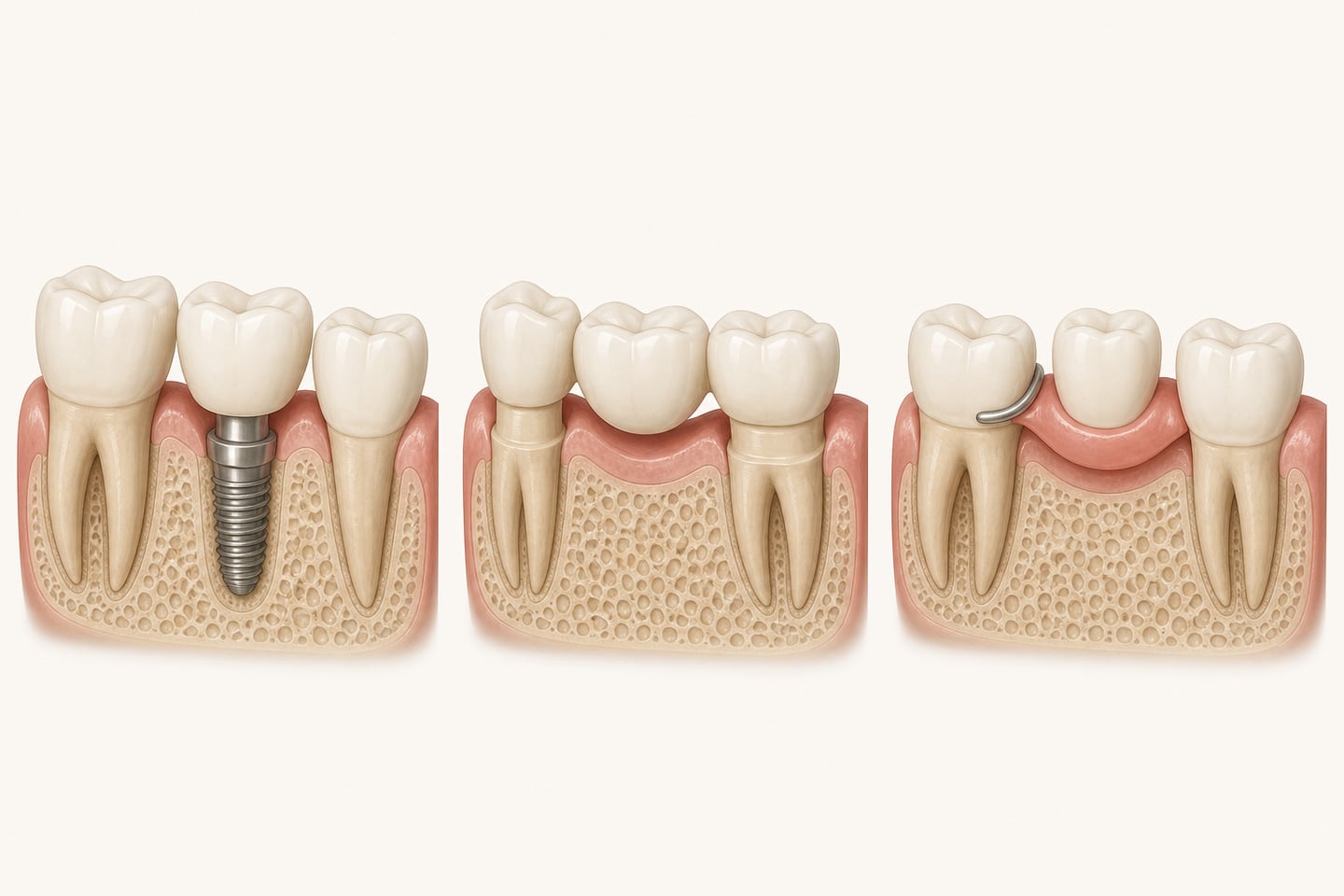
Here is the short answer: the longer a missing tooth goes unreplaced, the more the mouth changes around the gap — and the more involved replacing it tends to become. There is no universal deadline, and the pace of change differs from person to person. But the direction of change is predictable, and it helps to know what you are deciding when you decide to wait.
The bone under the gap changes first
Jawbone stays healthy by being used. Every time you chew, the root of a tooth presses into the bone that holds it, and that stimulation tells the body to keep maintaining the bone. When a tooth is lost, that signal stops in that one spot, and the bone there gradually shrinks — a little narrower, a little shorter, year over year.
You won't feel this happening. It doesn't hurt, and it is slow, which is exactly why it is easy to ignore. It matters most if you ever want a dental implant, because an implant anchors into that bone the way a root did. Wait long enough, and placing an implant can first require bone grafting — an added procedure, added healing time, and added cost.
Neighboring teeth start to move
Teeth hold each other in place. Remove one, and the teeth on either side of the gap tend to tilt and drift toward the open space. The tooth that used to bite against the missing one can also slowly rise out of its socket toward the gap — a change dentists call over-eruption.
These shifts change your bite, and tilted teeth are harder to keep clean, which raises the risk of decay and gum trouble in exactly the teeth you now rely on more. They also complicate your options: a dental bridge uses the neighboring teeth as its supports, so those neighbors need to be healthy and reasonably positioned. The longer they drift, the less straightforward that becomes.
Chewing shifts — and the rest of the mouth compensates
Most people quietly move their chewing to the other side of the mouth. That works, for a while. Over time it can mean uneven wear on the teeth doing double duty, a bite that feels different than it used to, and, for some people, jaw muscle soreness. A gap toward the front can also change how certain sounds form when you speak.
How waiting narrows your options
None of this means replacement becomes impossible. It means the menu shortens and the path lengthens. In practical terms:
- An implant may need a bone graft first, adding months and cost to the process.
- A bridge depends on the neighboring teeth — if they have tilted or weakened, they may need work before they can serve as anchors.
- A partial denture remains an option, but as the bone under the gap shrinks, fit and comfort change and adjustments become more frequent.
When waiting is reasonable
Not every missing tooth must be replaced — a removed wisdom tooth generally isn't, and your dentist may tell you a particular gap is low-stakes for your bite. A planned pause is also normal: after an extraction, the site usually needs time to heal before an implant can be placed, and that waiting is part of good treatment, not a delay.
If cost is the real reason you're waiting, say so at the exam. There is usually more than one way to sequence treatment, and financing and membership options can change the math. What rarely helps is waiting without a plan.
What replacement looks like at each stage
The same gap has different answers depending on how long it has been empty, because the bone and the neighbors keep changing. Roughly:
- Within the first months: the socket is healing and the neighbors have not moved. Every option is open, and the site may still accept an implant without grafting.
- One to a few years: the ridge has usually narrowed. An implant is often still possible, sometimes with a small graft at placement; a bridge depends on whether the neighbors have started to tilt.
- Many years: the ridge may be too thin for an implant without rebuilding it first, the opposing tooth may have moved into the space, and a bridge may need the neighbors reshaped more than it once would have. Nothing is ruled out, but the plan has more steps.
Those are tendencies, not a schedule. The point the American Academy of Periodontology makes is the one that matters here: an implant replaces the root as well as the tooth, so the bone around it is better preserved than under a bridge or a denture, neither of which loads the bone beneath it.
If you are between options for now
A gap does not have to be filled permanently to be protected. A removable partial, or at the front a bonded temporary tooth, keeps the neighbors from drifting and the space from closing while you decide or save. Ask whether a temporary holds your options open; for many people that is the practical middle step between doing nothing and doing everything.
What to do this week
Get an exam and an X-ray of the gap. That is the whole assignment — no commitment to treatment, just a clear picture of how much bone is there, what the neighboring teeth are doing, and which options are still fully open. Every mouth changes at its own speed, and the only way to know where yours stands is to look.
That first look is a routine visit. Request an appointment and put X-ray of the gap in the notes so the visit is planned around it. Bring the cost questions too.