
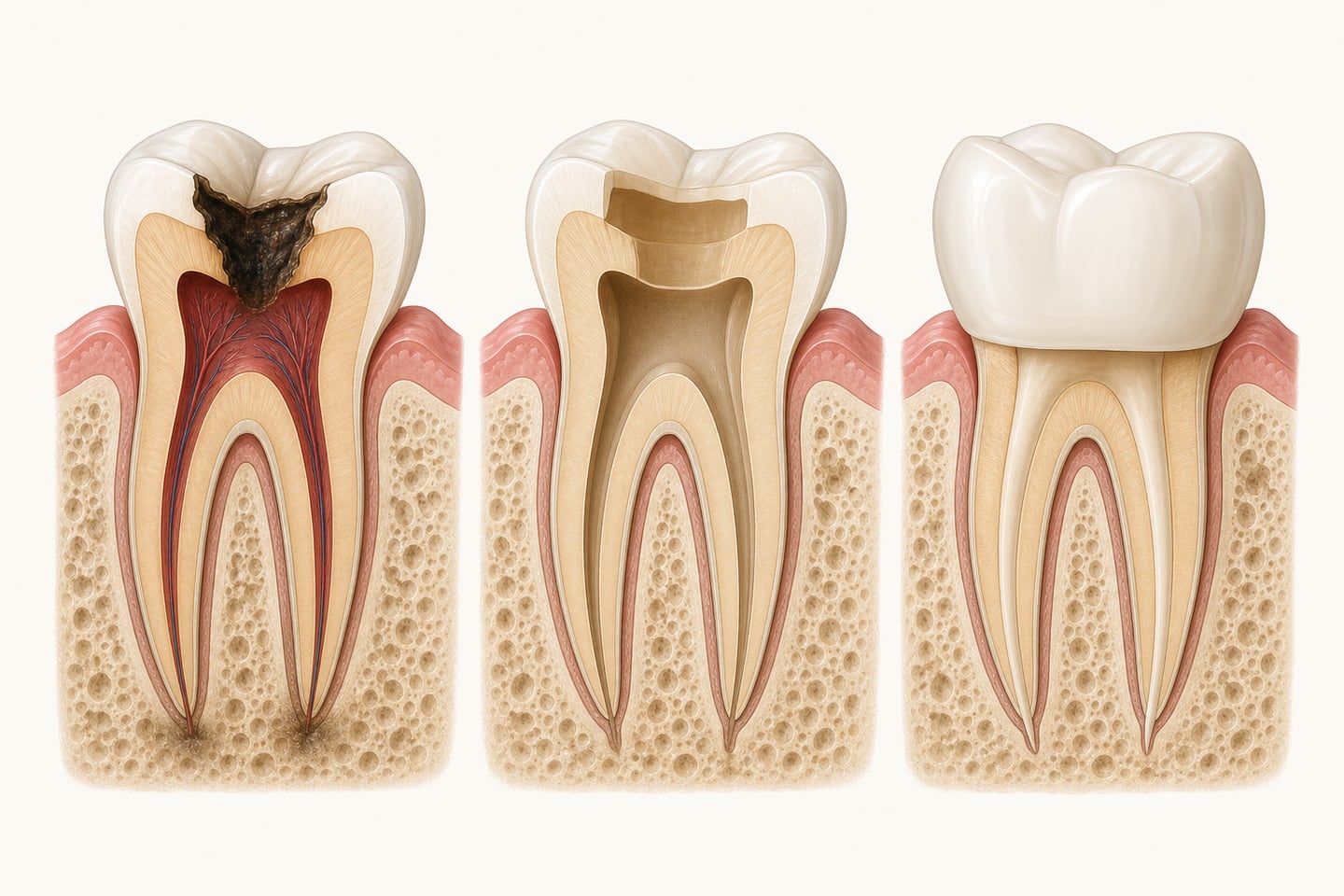
When the tooth can be restored, a root canal is usually the better choice than pulling it. A treated natural tooth keeps your bite, your bone, and your neighboring teeth doing what they already do. Extraction wins when the tooth cannot be rebuilt well enough to last: a crack running below the gum, too little structure left, or bone loss that has loosened it. The decision is about the tooth's condition, not about which procedure sounds easier.
What a root canal actually does
Inside each tooth is soft tissue, the pulp, which can become inflamed or infected from deep decay, a crack, or an injury. Root canal therapy removes that tissue, cleans and shapes the inside of the root, and seals it. The tooth stays in your jaw. It no longer has a live nerve, but it still has a root in bone, and it still chews.
Two things people get wrong. First, the procedure is done under local anesthetic; the pain most people associate with root canals is the toothache that came before it. Second, the root canal is usually only half the job. A back tooth treated this way is more brittle and almost always needs a crown afterward to keep it from fracturing. When you weigh costs, count the crown.
When saving the tooth is the right call
- Enough solid tooth remains above the gum to hold a crown.
- The root is intact and the bone around it is sound.
- The infection is confined to the tooth and can be cleaned out.
- The tooth matters to your bite: a molar that does heavy chewing, or a front tooth where a gap would show.
A tooth that meets these criteria tends to serve well for years after treatment. Outcomes vary. Some treated teeth need retreatment or eventually fail, but when the tooth is a good candidate, the odds favor keeping it.
When pulling it is the right call
- A crack that runs down the root. These cannot be sealed, and the tooth will keep hurting or reinfecting.
- Not enough structure left to rebuild. A crown needs something to hold onto.
- Advanced gum disease has destroyed the bone around the root and the tooth is loose.
- Infection has damaged the surrounding bone beyond what a root canal can resolve.
- A previous root canal failed and retreatment is unlikely to hold.
In these cases, doing a root canal anyway means paying for a tooth that will be pulled later. A good dentist tells you that plainly, even when the root canal would have been the larger procedure to bill.
The cost that doesn't show up on the first estimate
The common mistake is comparing the cost of a root canal plus crown against the cost of an extraction alone. That is not the real comparison. An extraction creates a gap, and the gap has its own costs.
Leave it empty and the bone at the site shrinks, the neighbors drift, and the opposing tooth moves. Replace it, and you are choosing between a dental implant (a post, abutment, and crown across several months) or a bridge, which uses the teeth on either side as anchors and requires shaping them. Either path usually costs more than the root canal and crown would have. Extraction is the cheaper option only on the day it happens.
That said, if the tooth truly cannot be saved, an implant is a strong replacement: a standalone tooth that keeps the bone under load. The order matters. Save the tooth if it can be saved. If it can't, replace it rather than leaving the gap.
Time and recovery
A root canal is typically one or two visits, with a crown visit after. Soreness for a few days is normal and is managed with over-the-counter pain relievers taken as directed on the label. An extraction is usually a single, shorter visit, followed by a few days of caring for the socket: no straws, no smoking, gentle rinsing. Then the waiting begins. If an implant is planned, the site often needs months to heal before placement, followed by more months while the post fuses to bone. The extraction path is faster on day one and longer overall.
If you are anxious about either one
Say so when you book. Both procedures are done with local anesthetic, and for patients who want more than that, sedation options are available and worth asking about. Fear of the procedure is a poor reason to pick extraction over a tooth that could be saved.
Questions to ask before you decide
- How much solid tooth is left above the gum?
- Is there a crack, and how far does it go?
- In your honest estimate, how likely is this root canal to hold long-term?
- If you pull it, what would you recommend to replace it, and what is the total cost of that path?
- What happens if I do nothing for now?
The last question matters because an infected tooth does not stay stable. Swelling, fever, or pain that keeps you up at night is an urgent visit, not a wait-and-see.
If the tooth is hurting now, request an urgent appointment at Beachside, Marina Dentistry, or Rio Hondo, the three offices that list root canal therapy. One exam and one X-ray settle most of the questions above, and you leave knowing whether the tooth is worth saving.