
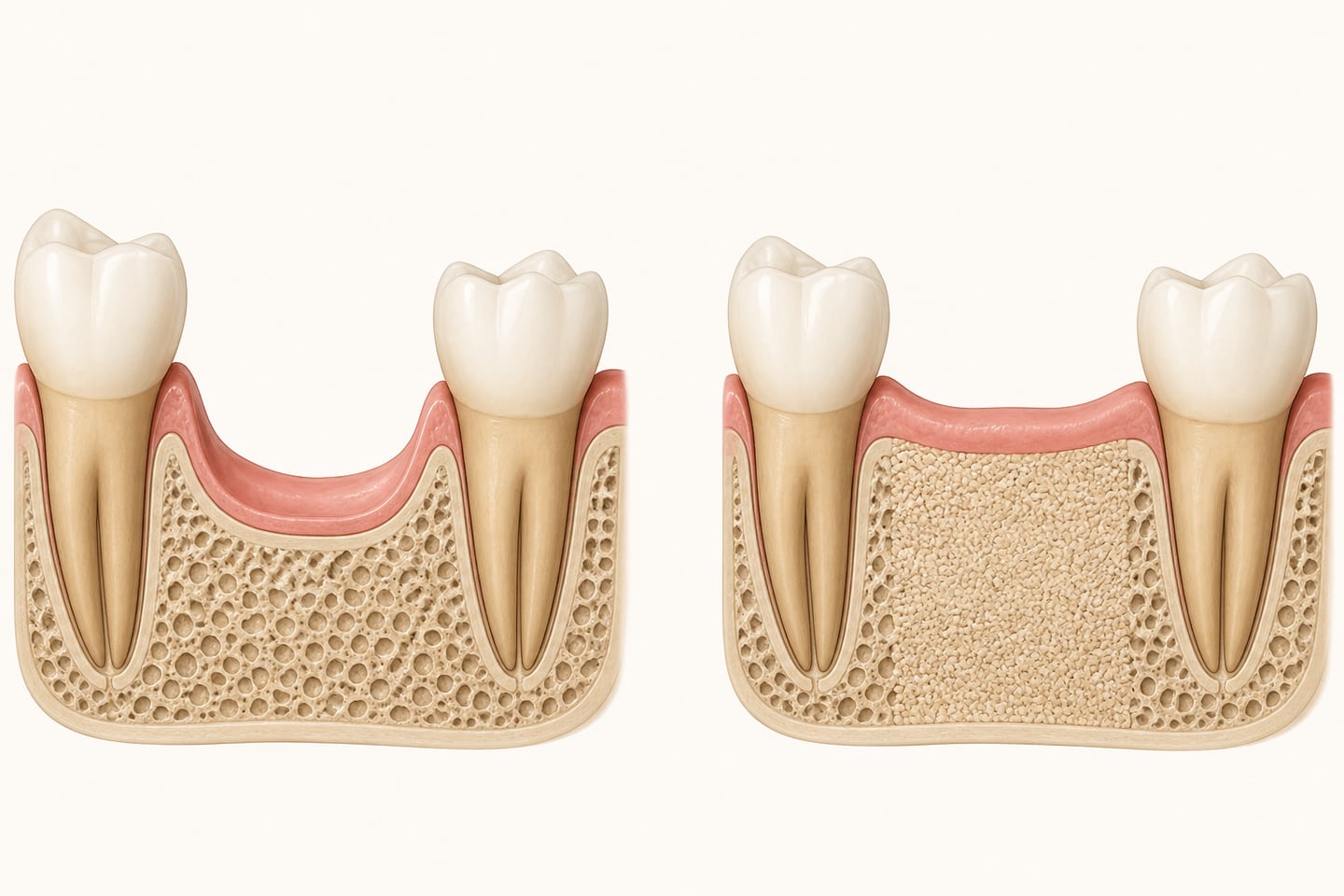
You need a bone graft before a dental implant when the jaw at the site is too thin or too short to hold the post securely, and you do not need one when it is not. That is the whole rule. Grafting is not a judgment on your candidacy. It rebuilds volume so the implant has something solid to anchor into. It adds a healing phase and a line on the estimate. The exam with imaging, not a phone call, is what decides whether it applies to you.
Why bone goes missing
Bone stays dense where a root loads it. Once the tooth is gone, that stimulus stops, and the ridge slowly narrows and shortens. Infection around a failing tooth, gum disease, years in a denture, and a difficult extraction all speed the loss. The change is gradual, and most people cannot feel it. This is why an implant that needed no graft a few years ago may need one now. We cover the sequence in what happens if you wait to replace a missing tooth and why a missing back tooth matters.
What a graft actually is
A graft is material placed where bone is lacking and held in place while your own bone grows through and replaces it. The material can be your own bone taken from elsewhere in the mouth, processed donor bone, animal-derived bone mineral, or a synthetic substitute. Your dentist picks based on the size of the defect and your preference. The graft is a scaffold. Your body does the building. That is why it takes months, and why the timeline cannot be shortened by wanting it to be.
The common types, by situation
- Socket preservation. Done at the time of extraction. The empty socket is filled with graft material so the ridge keeps its shape while it heals. It is the least involved graft and the one most likely to prevent a bigger graft later.
- Ridge augmentation. For a ridge that has already narrowed or lost height. Material is added to the side or top of the jaw and given time to integrate before the implant is placed. This is the graft most people mean when they say they need a bone graft.
- Sinus lift. Upper back teeth sit under the sinus. When the bone between the two is thin, the sinus floor is gently raised and graft material is placed beneath it. It is its own procedure with its own healing time.
- Graft at placement. Sometimes a small amount of material is added around the implant on the day it goes in. This adds little or nothing to the calendar.
What it changes about the timeline
A dental implant without grafting runs several months from placement to final crown, because the post has to fuse with the jaw before it carries load. A separate graft adds its own healing period before the implant can be placed at all. Think of it as two biology-paced phases instead of one. Socket preservation or a graft done at placement adds less. A sinus lift or ridge augmentation adds more. Ask your dentist to put the phases on a calendar so the total is visible before you start. Healing pace varies from person to person, and smoking slows it.
What it changes about cost
Grafting is an added procedure, so it is an added line on the estimate, along with the imaging that planned it and any extra visits to check healing. Ask for the quote itemized: graft, implant post, abutment, crown, imaging, and sedation if you choose it. Ask which items are certain and which depend on what the surgeon finds. Insurance treats grafting unevenly. Some plans that cover part of a crown cover none of the surgery, so get the breakdown in writing. Financing, subject to credit approval, is available through lenders that differ by office, and per-office membership plans apply discounts for patients without insurance. The wider list of factors is in what drives the cost of dental implants.
What the procedure is like
Most grafts are done under local anesthetic in the office. Expect pressure rather than pain during the procedure, then a few days of swelling and soreness managed with cold compresses and over-the-counter pain relief taken as directed on the label. A soft diet for a short period protects the site. Stitches and a protective membrane are common. If the surgery itself is the obstacle, say so when you book. Sedation options exist at every office and are priced separately.
When grafting is not the right answer
Grafting is not always the right route to a tooth. If the defect is large, or your health makes a long surgical sequence unwise, a bridge or a well-made denture can be the better recommendation. For people missing most of an arch, full-arch approaches such as All-on-4 are planned around the bone that exists, angling posts into denser areas, and can sometimes reduce or avoid grafting. Implant-supported dentures sit between the two. The point of the exam is to lay these side by side, not to steer you toward the most involved plan.
What the exam decides
A flat X-ray shows height. Three-dimensional imaging shows width, density, and the position of the nerve and the sinus. That scan is what tells the dentist whether the site can take a post today, needs a graft first, or needs a different plan. Two people with the same gap can get opposite answers because the bone underneath is different. Do not accept a grafting decision made without imaging, and do not assume you need one because a friend did.
Questions to ask
- Which type of graft, and why that one?
- How many months does it add before the implant, and how many after?
- What is the total across the whole sequence, with and without the graft?
- What is the alternative if I choose not to graft?
- What would you recommend if this were your tooth?
Request an implant consultation, ask for the scan, and ask for the phases on a calendar. The grafting decision should be made on the image, not on the phone.