
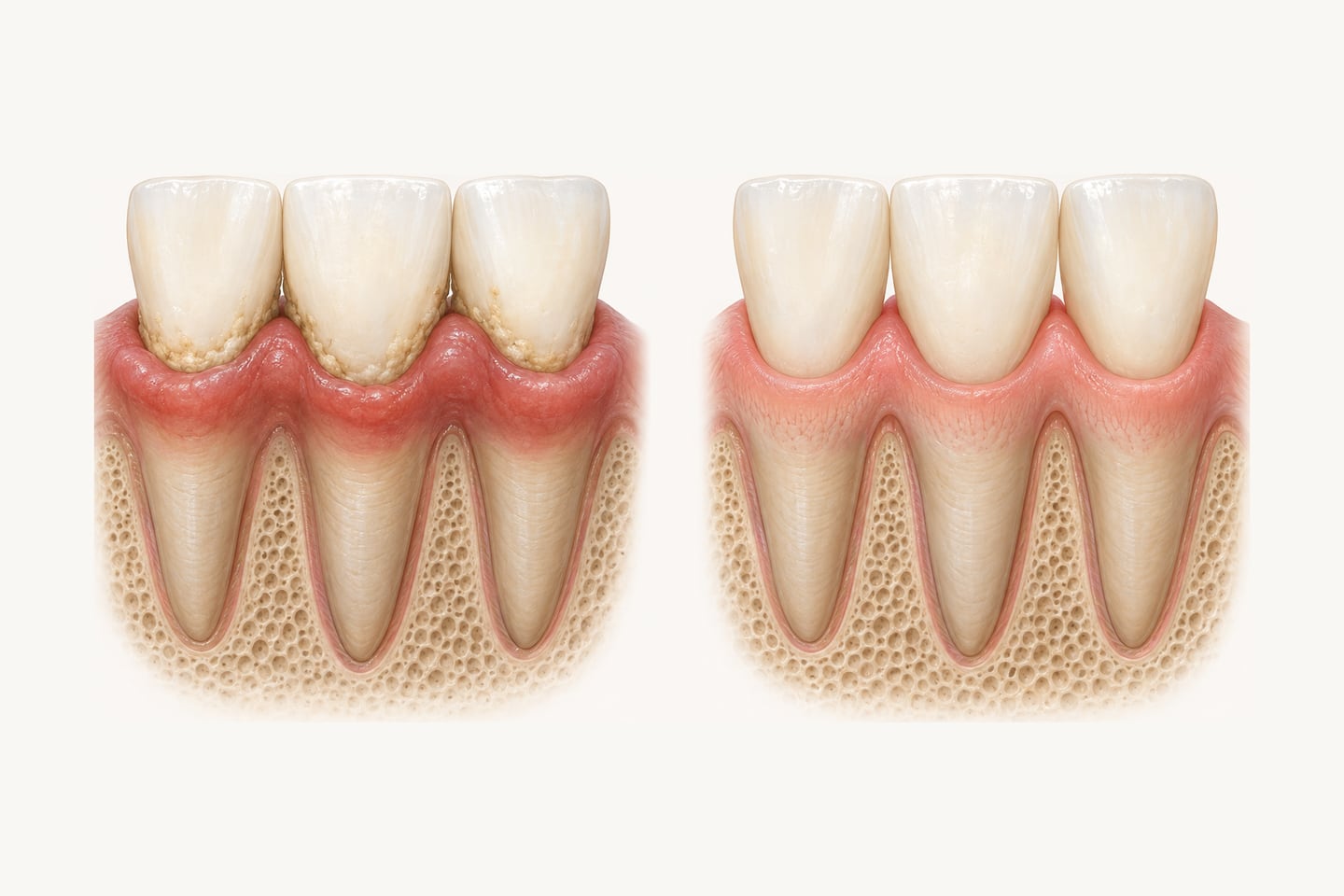
Gingivitis can be reversed completely. Periodontitis cannot. The line between them is bone: gingivitis is inflamed gum tissue with the supporting bone still intact, and periodontitis is what you call it once that bone has started to disappear. Destroyed bone does not come back on its own. What treatment can do is stop the loss and hold the mouth steady, sometimes for the rest of your life.
What separates the two stages
Gingivitis: inflammation, nothing lost yet
Plaque builds up along the gumline and the gums respond by becoming red, puffy and prone to bleeding when you brush. Nothing structural has been damaged. The American Academy of Periodontology puts it plainly: gingivitis is reversible with professional treatment and good at-home oral care. The NIH's dental institute says the same from the home-care side, noting that early gum disease caused by plaque buildup can often be reversed by daily brushing and flossing.
Reversed means what it sounds like. The inflammation resolves, the bleeding stops, and the tissue returns to health with no lasting record of the episode.
Periodontitis: the architecture starts going
If gingivitis is left alone, the AAP describes bacteria and their toxins working below the gumline until the tissues and bone that support the teeth are broken down and destroyed. The gums separate from the teeth and form pockets, and as the disease advances those pockets deepen and more gum tissue and bone are destroyed. Teeth can eventually loosen and either fall out or need to be removed. That destruction is why untreated periodontitis is a leading route to missing adult teeth.
Why the second stage does not reverse
A tooth is not set in your jaw like a fencepost in concrete. It hangs in a socket, suspended by ligament fibers that run from the root to the bone wall around it. Periodontitis eats that bone wall from the top down. The tooth does not get shorter, so every millimeter of bone lost is a millimeter of root that no longer has anything holding it.
Once that bone is gone, the body does not spontaneously rebuild it, and neither does any cleaning. Removing the bacteria stops the demolition. It does not run the demolition backwards. That is the difference between a wound that heals and a wall that has been knocked down, and it is why a promise to cure periodontitis should stop a conversation cold.
The one real exception, and its limits
A periodontist can sometimes rebuild bone surgically. The AAP describes regenerative procedures as an option when the bone supporting your teeth has been destroyed, and says these procedures can reverse some of the damage by regenerating lost bone and tissue, using membranes, bone grafts or tissue-stimulating proteins.
Read that carefully: some of the damage. Regeneration works in particular defect shapes, around particular teeth, in patients whose disease is already controlled. It is a surgical procedure, a general dentist who identifies a candidate refers the patient to a periodontist, and it is not a general reversal of periodontitis.
So what does treatment actually accomplish?
It stops the loss. The NIH's dental institute puts the goal in one line: to control the infection. In practice that usually starts with scaling and root planing, a cleaning that reaches below the gumline, followed by regular gum disease treatment visits at shorter intervals than the usual six months. The realistic outcome for a treated, maintained patient is a mouth that keeps its teeth. The bone lost before diagnosis stays lost, the bone that remains stays put, and people live like that for decades.
What "stable" means, in numbers
Stable is not a feeling and it is not the absence of pain. Gum disease is quiet, and plenty of people with active bone loss have no symptoms. Stable is a set of measurements that stop moving in the wrong direction:
- Pocket depths that hold. The space between gum and tooth is recorded at several points around every tooth. Numbers that stay the same visit after visit, or shrink after treatment, are the core of the picture.
- Bleeding points that stop bleeding. The hygienist notes which sites bleed when probed. Bleeding is inflammation, and a falling bleeding score is usually the first sign treatment took.
- Bone levels unchanged on X-rays. Comparing this year's images with those from two or three years ago is what confirms nothing new has been lost. It matters most and changes slowest.
- Teeth that are not getting looser. Mobility is graded and tracked. A tooth that has always been slightly mobile and stays that way is different from one moving more each year.
None of those numbers is available to you at home, which is the practical reason periodontitis needs a professional relationship rather than a better toothbrush. Ask to see the chart. A page of pocket depths next to the last set is the most informative document in dentistry, and it is yours.
What maintenance actually involves
The AAP is direct that most people who go through non-surgical treatment need ongoing maintenance therapy to sustain periodontal health. On interval, its patient FAQ says the schedule depends on how advanced the disease is, with exams every six months for mild periodontal disease and every few months for more advanced stages. That is why patients in periodontal maintenance are commonly scheduled every three to four months rather than the standard six-month cleaning most people are used to.
A maintenance visit is not a shorter regular cleaning. It generally includes:
- A fresh set of pocket measurements and bleeding points, set against the last set.
- Cleaning above and below the gumline at any site that needs it, which is what separates this from a routine cleaning.
- A close look at the sites that were worst last time, because relapse shows up there first.
- X-rays at intervals the dentist sets, to watch bone levels over years rather than months.
It does not end. That is the part people are least often told plainly. Skipping maintenance for a year or two is the most common way a patient who responded well gives the ground back, and the bone lost in that gap is lost the same way the first round was.
What makes gums respond well, or badly
Two people with the same measurements can respond very differently. The NIH's dental institute names smoking or tobacco use as the most significant risk factor for gum disease, and adds that tobacco use can delay healing and make treatment less successful. It lists older age, diabetes and genetics among the other risk factors, and those same variables return if a tooth is eventually lost and implant candidacy with smoking or diabetes comes up.
Genetics is the one nobody controls. Being told your disease is aggressive describes your biology, not your brushing.
Gum disease and the rest of your health
Periodontal disease has documented associations with several systemic conditions, and the AAP states the caveat in its own words: a causal relationship has not been conclusively established, though research suggests periodontal disease may contribute to the progression of other diseases. It describes the diabetes relationship as running both ways, and notes studies suggesting periodontal disease may increase the risk of heart disease.
Association is not treatment. Treating your gums keeps your teeth, and inflammation in your mouth is a health problem in its own right. It is not a therapy for diabetes or heart disease, and anyone selling it that way has left the evidence behind.
How to find out which stage you are in
You cannot tell from symptoms. Bleeding when you floss fits either stage. Only measurement and X-rays separate them, which is why the AAP recommends a periodontal exam covering your teeth, your plaque, your gums, your bite, your bone structure and your risk factors together. If periodontitis is diagnosed, the AAP describes it being classified by a stage, from initial to severe, plus a grade for the rate of progression and the expected response to treatment. Ask for both by name: they tell you how much has been lost and how fast it has been moving.
Claims that should slow you down
- "We can reverse your gum disease." Accurate for gingivitis. Not accurate for diagnosed periodontitis, unless the conversation is specifically about regenerative surgery at specific sites.
- A deep cleaning proposed without measurements. The numbers come before the recommendation. Ask what the pocket depths were and where.
- Rinses, toothpastes or supplements sold as a cure. Nothing you buy reaches the bottom of a deep pocket, and nothing you buy replaces bone.
If you are reading this because your gums bleed
Bleeding is the earliest reliable signal and often the only one. Caught at the gingivitis stage, the whole problem can go away. Caught after bone loss has begun, the same visit changes the trajectory instead of the past. Request an appointment and ask for a full periodontal charting rather than just a cleaning. If you had scaling years ago and drifted off maintenance, say so, because that history changes what the numbers mean. What that treatment appointment involves is covered in what scaling and root planing actually is.