
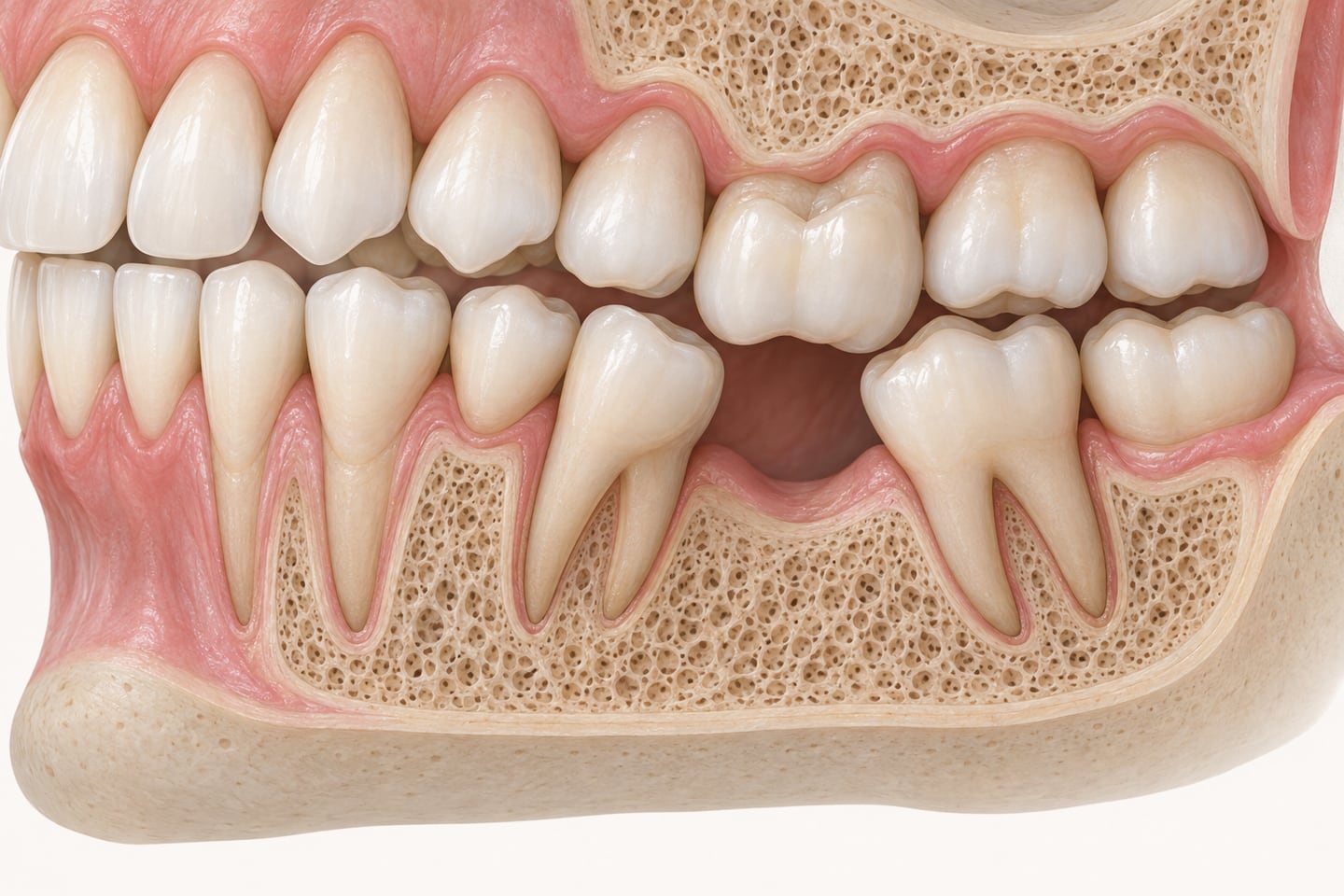
A missing back tooth matters because molars do the heavy chewing. When one is gone, the teeth beside it start to lean, the tooth above or below it drifts into the space, the bone under the gap shrinks, and the rest of your mouth quietly takes on the load. None of this is visible in a mirror, which is exactly why back teeth are the ones people leave unreplaced. The changes are slow, and the pace differs from person to person. The direction does not.
Why people skip it
A missing front tooth gets replaced quickly because it shows. A missing molar does not show, usually stops hurting once the extraction heals, and chewing adapts within weeks. From the inside, it feels resolved. The decision to wait is rarely a decision at all; it is the absence of one. It helps to know what waiting costs, so that if you wait, you are choosing to.
What back teeth actually do
Front teeth cut. Back teeth grind. Molars have broad surfaces and multiple roots because they take the largest forces in the mouth. Losing one removes a large share of the chewing capacity on that side, and the work gets handed to the premolars in front of it, smaller teeth with fewer roots, built for lighter duty. Over years, those teeth can wear, crack, or develop problems at the edges of old fillings from carrying a load they weren't built for.
The four changes that follow a gap
1. The tooth above or below moves
Teeth are held in position partly by the tooth they bite against. Remove a lower molar, and the upper molar opposite it has nothing stopping it. It slowly extends downward into the space. Dentists call this over-eruption. It is one of the most underrated consequences of a missing back tooth, because it makes later replacement harder: an implant crown or a bridge needs vertical room, and the over-erupted tooth has taken it. Sometimes that tooth has to be reshaped, crowned, or treated before the gap can be restored at all.
2. The neighbors tilt
The teeth on either side of the gap lean toward it. A tilted molar is harder to clean, traps food against the gum, and changes how the bite meets. If you later want a bridge, the tilted neighbor is a poor anchor. If you want an implant, the tilt can close the space the implant needs.
3. The bone shrinks
Chewing through a root keeps the bone around it dense. With the root gone, the bone in that area slowly loses height and width. This is the change that most affects dental implants, which need enough bone to anchor into. Wait long enough and grafting comes first: added surgery, added healing, added cost. We cover this in more detail in what happens if you wait to replace a missing tooth.
4. The bite redistributes
Most people shift chewing to the other side. That side now does everything, and its teeth wear faster. Some people notice jaw muscle soreness or a bite that feels off. Others notice nothing for years and then crack a tooth on the overworked side.
How back teeth are replaced
Back teeth are the strongest case for an implant. An implant stands on its own, leaves the neighbors untouched, and keeps the bone at the site under load. It handles chewing force well. The trade is a minor surgical procedure and a timeline of months while the bone fuses to the post.
A bridge is the faster route. It anchors a false tooth to the teeth on either side, which must be shaped for crowns. For a back gap, the questions are whether those neighbors are healthy (shaping two sound teeth to replace one is a real price) and whether there is a tooth on both sides at all. A gap at the very back, with no tooth behind it, cannot hold a conventional bridge.
A partial denture is the removable option. It is the least invasive and the least expensive up front, and it does nothing to stop the bone loss under it. Fit changes as the bone changes, so expect adjustments over time.
When a missing back tooth is fine to leave
Not every back gap needs filling. Wisdom teeth are removed precisely because they are not needed. A second molar at the very back, with no tooth behind it and a stable tooth opposite, can sometimes be left if your dentist judges the bite is stable, though the opposing tooth still needs watching. The point is not that every gap must be closed. It is that the decision should be made with an X-ray and a look at the bite, not by default.
What to do now
Get the gap examined. An X-ray shows how much bone is there and whether the opposing tooth has started to move, two things you cannot judge yourself. If you are choosing to wait, ask what the dentist expects the gap to look like in two years, and whether a simple step now keeps your options open. Cost concerns are worth saying out loud: financing, subject to credit approval, and per-office membership plans change how the math works. Request an appointment and ask for the X-ray of the gap first; every decision in this article starts there.