
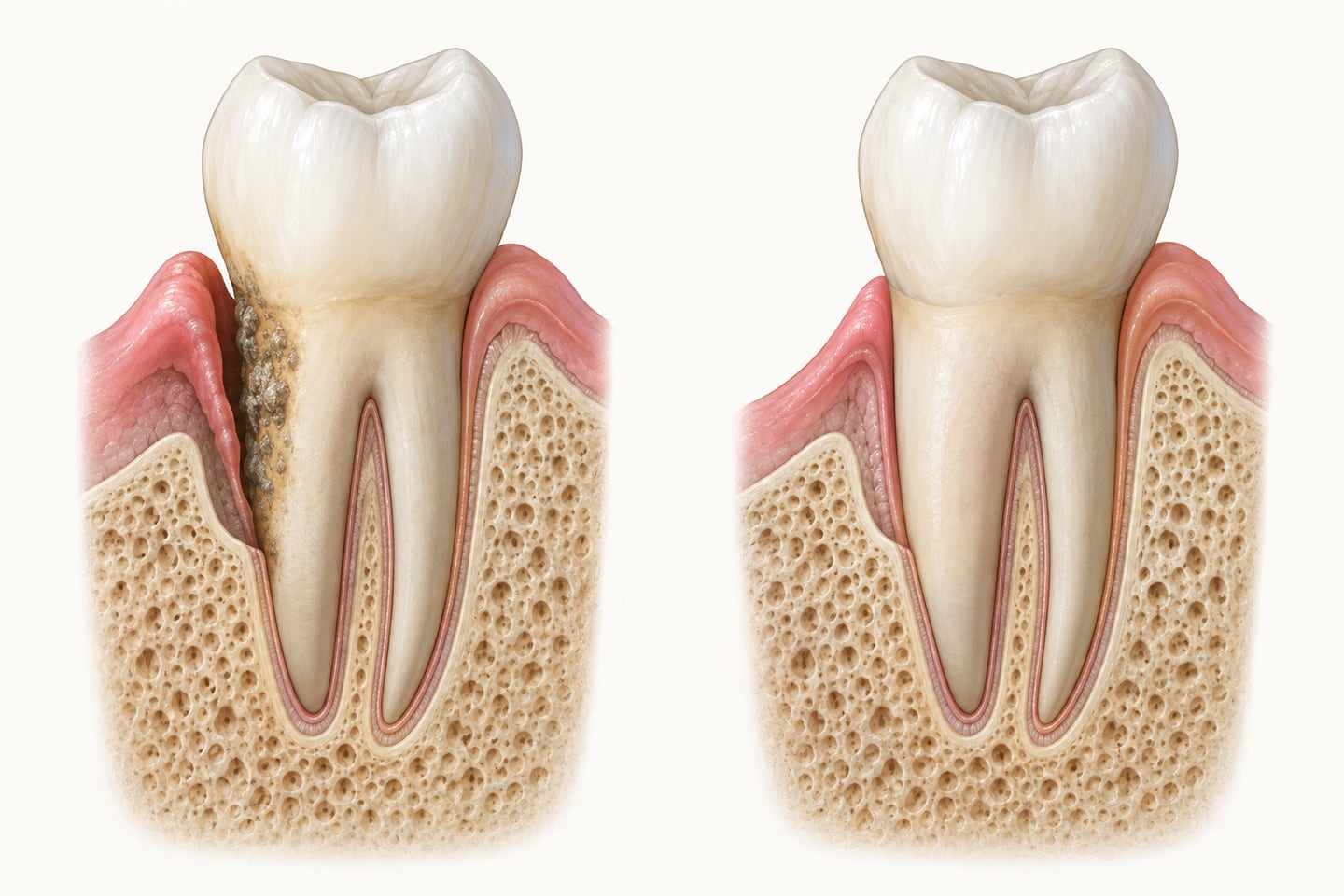
Scaling and root planing is a cleaning that goes below the gumline. The American Academy of Periodontology describes the two halves precisely: scaling reaches beneath the gumline to remove plaque and other bacterial toxins from periodontal pockets, and root planing smooths the tooth root to prevent future plaque or toxins from adhering. The area is numbed, the mouth is usually treated in sections over two or more visits, and the gums are re-measured a few weeks later.
What the procedure actually is
Scaling
In a healthy mouth the collar of tissue around each tooth sits a millimeter or three deep. Once gum disease has progressed, that collar detaches into a pocket and hardened deposits build up on the root surface inside it. Scaling removes those deposits from inside the pocket, using hand instruments shaped to follow the curve of a root, an ultrasonic tip that vibrates them loose under water spray, or both. The instrument is working in a space you cannot see into and cannot reach with a toothbrush.
Root planing
The root under those deposits is rough once disease has been at work on it. Root planing shaves it back toward smooth, so plaque has less texture to grab and the gum tissue has a clean surface to reattach against. This is the half that separates the procedure from a cleaning.
How is it different from a regular cleaning?
A routine cleaning is preventive. It removes plaque and tartar from the surfaces you can reach and the shallow area just under the gumline, and it is what a healthy mouth gets on a six-month schedule. Scaling and root planing treats a diagnosed infection. It targets specific pockets, involves numbing, and is prescribed off a chart of measurements rather than off the calendar.
So a deep cleaning recommended without pocket measurements behind it is one you can ask questions about. The AAP's comprehensive periodontal evaluation covers your teeth, your plaque, your gums, your bite, your bone structure and your risk factors, and that evaluation is what belongs between the exam and the plan.
Why does it take more than one visit?
- Numbing works by region. Anesthetic is delivered to one area at a time. Treating the whole mouth at once would mean numbing all of it, which makes the rest of your day difficult.
- It is slow work per tooth. Instrumenting several surfaces of every root in a quadrant thoroughly takes far longer than polishing a crown. Rushed scaling leaves deposits behind, and deposits left behind are why a treated pocket fails to respond.
- You walk out functional. Half a numb mouth lets you talk and drink on the other side, and it leaves one tender section rather than four.
The common pattern is two quadrants per appointment across two visits, or one quadrant across four. Lighter cases are sometimes done in one. Ask which plan applies to you and why.
What numbing is involved?
Local anesthetic. The ADA's patient guidance describes a topical anesthetic that numbs the surface of the gums, and injectable anesthetics used in procedures such as filling cavities, preparing teeth for crowns or treating gum disease. In practice the topical gel goes on first to take the edge off the injection, then the injection numbs the section being worked on. You should feel pressure, vibration and water, not sharpness. If you do feel sharpness, say so during the appointment rather than after, because more anesthetic is a routine adjustment.
Numbness usually outlasts the appointment by a couple of hours, so be careful chewing or drinking anything hot until it wears off. If anxiety is the reason you have been putting this off, sedation is a separate conversation from anesthetic and worth raising when you schedule rather than on the day; the sedation options and what each is like covers the differences.
What do the days after feel like?
Expect the treated side to be tender for a few days. The usual pattern, with plenty of individual variation:
- Sore gums for two to four days. A dull ache rather than sharp pain, worst on the first day. Over-the-counter pain relief is the standard approach; ask the office which one suits your health history.
- Cold sensitivity, sometimes for weeks. The most common complaint and the most surprising one. Clearing deposits off a root exposes surface that had been covered, and root has no enamel to insulate it. Sensitivity toothpaste helps most people, and it usually settles over several weeks.
- Some bleeding when you brush the treated areas. Expected early on. Keep brushing them gently rather than avoiding them, because avoiding them is how inflammation stays.
- Teeth that look slightly longer, or new gaps. Swollen tissue shrinks as it heals and stops hiding what is underneath. That is inflammation resolving, and a measure of how much support the disease had already taken.
- Soft food for a day or two. Not required, just more comfortable. Crunchy, very hot and very cold are the ones people regret.
What is not part of the normal picture
Pain that increases after day two or three instead of easing, swelling that grows, a fever, a bad taste with pus, or a tooth that becomes noticeably loose are all reasons to call the office that treated you rather than wait for the next appointment. If you are unsure how urgent something is, how to handle a dental emergency sorts what needs a prompt call from what needs urgent care.
What is re-evaluation?
Re-evaluation is a separate appointment, commonly a few weeks after the last treatment visit, where the point is measuring rather than cleaning. The same sites are probed again and the new numbers set against the old. How your mouth feels does not substitute for this, because gum disease is quiet and comfort is not evidence.
There are three ways it goes, and all three are normal results:
- The pockets responded. Depths have shallowed, bleeding has dropped, and you move into maintenance. The AAP notes that many patients do not require additional treatment after scaling and root planing.
- Most responded, a few did not. Isolated stubborn sites get re-treated, sometimes with a locally applied antimicrobial, and are watched closely.
- Deep sites remain. Pockets that stayed deep are ones no instrument reaches cleanly from outside, and that is where a referral to a periodontist for surgical options belongs. Being referred is not a sign the first round failed. It is what the first round was designed to find out.
Why do cleanings come more often afterward?
Because the pockets are still deeper than a toothbrush reaches, and bacteria repopulate them. The AAP states that the majority of patients will require ongoing maintenance therapy to sustain periodontal health, and its patient FAQ describes a schedule built around how advanced the disease is: exams every six months for mild periodontal disease, and every few months for more advanced stages. Patients in periodontal maintenance are commonly scheduled every three to four months for that reason.
The interval is set to get back into those pockets before the bacteria rebuild to the level that was destroying bone. Periodontal maintenance is a different service from a routine cleaning and is billed differently, so how your plan handles it is a question for the front desk before you commit to the schedule. If the ongoing cost is the obstacle, raise it early: each office works with third-party financing (approval is subject to credit review; lenders differ by office), and each has its own membership plan, which is not insurance.
What scaling and root planing does not do
- It does not rebuild bone. It stops the process that was destroying it. Bone already lost stays lost unless a periodontist can regenerate specific defects surgically.
- It does not cure periodontitis. It converts an active infection into a managed condition.
- It does not replace home care. Instruments reset the pockets. What keeps them reset is what you do at the gumline daily.
- It does not save every tooth. A tooth with too little bone left is beyond what any cleaning reaches, and hearing that early beats treating around it for two years.
The full version of the first two points is in can gum disease be reversed, which covers the gingivitis and periodontitis split and what stable means in measurements.
On the tray systems marketed for treating gum disease at home, the AAP notes the FDA clearance process did not determine that any specific medication delivered that way has been proven safe or effective for gum disease. Cleared and proven are different words.
What to ask before you agree to it
- What were my pocket depths, at which teeth, and can I see the chart?
- How many visits is this, and how is my mouth being divided up?
- When is the re-evaluation, and what numbers would tell us it worked?
- What is my maintenance interval likely to be afterward, and for how long?
- If some sites do not respond, what is the next step and who does it?
If you have been told you need a deep cleaning and you are not sure why, that list is the appointment. Request an appointment and ask for the periodontal charting to be walked through with you before anything is scheduled. Measurements first, then the plan.