
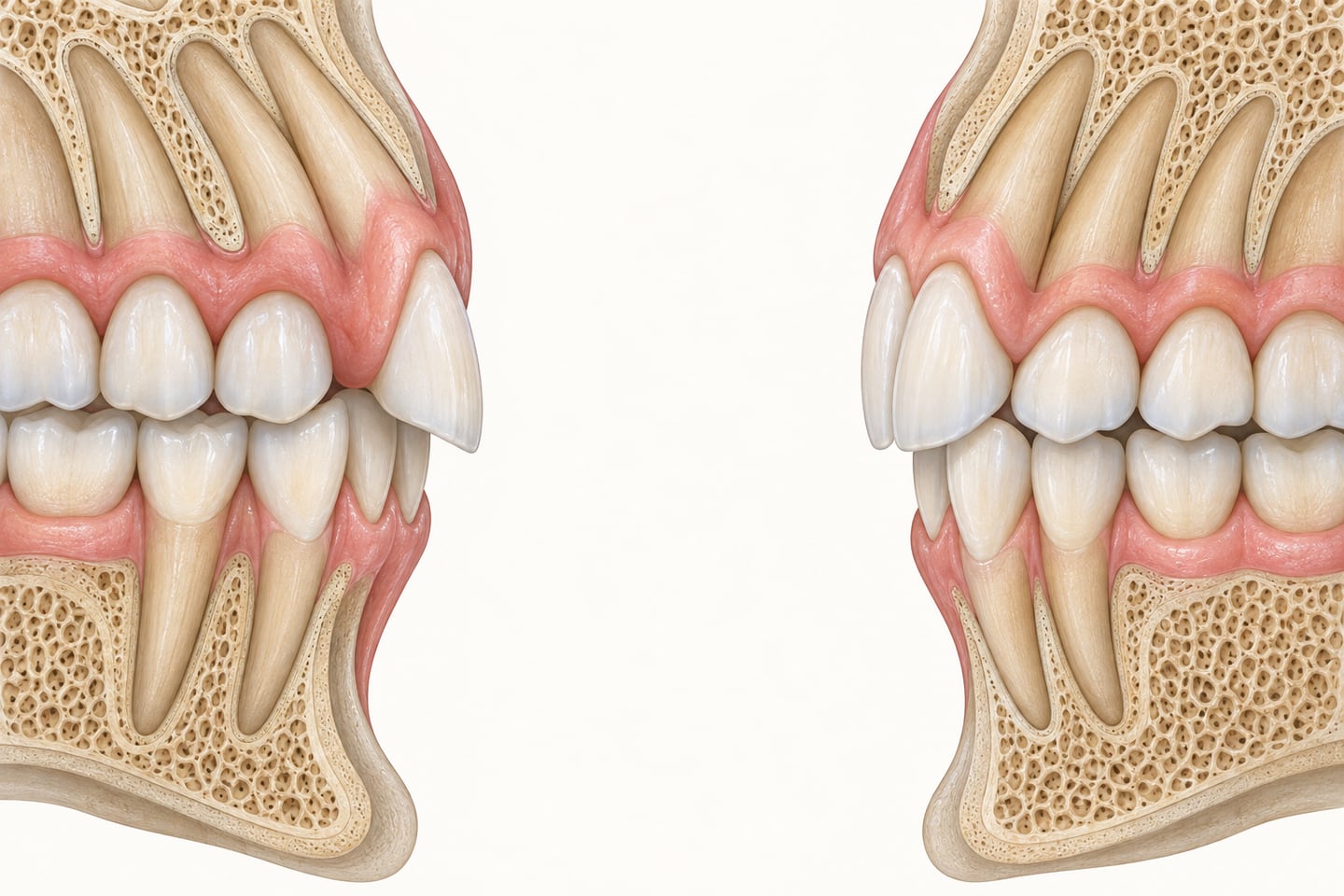
Often, yes. Invisalign can improve many mild to moderate overbites, especially when the problem comes from the position of the teeth themselves. When the overbite comes from the way the jaws grew, aligners alone may not be enough. The only way to know which kind you have is an exam — but here is what the answer hinges on, so you walk in knowing what to ask.
First, what an overbite actually is
An overbite is vertical: how far the upper front teeth overlap the lower ones when you bite down. Some overlap is normal and healthy. People often say overbite when they mean overjet — upper teeth that stick out horizontally ahead of the lowers. The two are different problems that sometimes travel together, and they respond to treatment differently, which is why the exam starts by measuring exactly what your bite is doing.
Tooth problem or jaw problem?
This is the question that decides everything. A dental overbite comes from where the teeth sit — front teeth that erupted too far, back teeth that don't provide enough height, crowding that pushed things out of position. Aligners move teeth, so dental overbites are their home turf.
A skeletal overbite comes from the size or position of the jaws themselves. In adults, aligners cannot reshape jawbones — no aligner can. Skeletal cases may call for other orthodontic mechanics, and severe ones sometimes involve an orthodontic specialist or, rarely, surgery. Most overbites sit somewhere on a spectrum between the two, which is why the answer to "can Invisalign fix it?" is measured case by case, not promised in a blog post.
How Invisalign works on an overbite
Invisalign moves teeth with a sequence of custom clear trays, each one nudging teeth a small step further. For bite correction, trays rarely work alone: small tooth-colored attachments bonded to certain teeth give the trays something to grip, and many overbite cases use elastics that run between upper and lower teeth to guide the bite into position. It is a genuine orthodontic treatment that happens to be nearly invisible — not a cosmetic shortcut.
When braces or another approach may be better
Deep overbites, strongly skeletal cases, and bites needing complex tooth rotations can be better served by braces or other orthodontic treatment, which give the dentist more control for certain movements. This isn't a downgrade — it's matching the tool to the job. A provider who offers both and tells you which your case needs is more useful than one who fits every case to the product they prefer.
What treatment actually asks of you
Aligners only work while they're on your teeth. Plan to wear them essentially all day and night, taking them out only to eat, drink anything other than water, and brush. This is the catch with Invisalign: the trays are removable, and removable means skippable. Patients who wear them as directed tend to track their plan; patients who don't, don't. Treatment length varies with the complexity of the case and your consistency — your dentist will give you a range after the assessment, and it will be an estimate, not a guarantee.
What the bite assessment measures
The exam that decides this is more specific than a look. Expect the dentist to measure how far the upper front teeth overlap the lowers, check whether the lower front teeth are biting into the gum behind the uppers, look at the height of the back teeth, and take a scan or impressions and photographs. A side-profile X-ray is common when the jaws themselves are in question, because it shows the bones' relationship rather than only the teeth.
How aligners actually reduce an overbite
Two movements do most of the work. The lower back teeth can be moved upward slightly, which raises the bite and reduces the overlap; and the upper and lower front teeth can be moved a fraction up into the gum — dentists call it intrusion. Aligners manage both when the amounts are modest, using attachments and sometimes elastics. What they do not do well is large intrusion or moving a jaw, which is where the tooth-versus-jaw question above decides the tool.
What a deep overbite does if it stays
A deep overlap is not only cosmetic. The lower front teeth can wear the backs of the upper ones, the upper front teeth can wear their own edges, and in some people the lower teeth bite into the gum behind the uppers and irritate it. The American Association of Orthodontists lists excessive wear among the effects of bite problems, which is why an overbite that is already causing wear is a reason to treat rather than watch.
After treatment: retainers
Teeth drift back toward old positions after any orthodontic treatment — aligners or braces alike. Retainers are how the result is kept, and they are a long-term commitment, not a few-month epilogue. If you're not prepared to wear retainers as prescribed, you're not finished deciding about Invisalign yet.
The starting point is a bite assessment: measurements, photos, and a scan, followed by a straight answer about whether aligners fit your case. Request an appointment and ask for the bite assessment by name. The answer for your own bite comes from the scan, not from this article.