
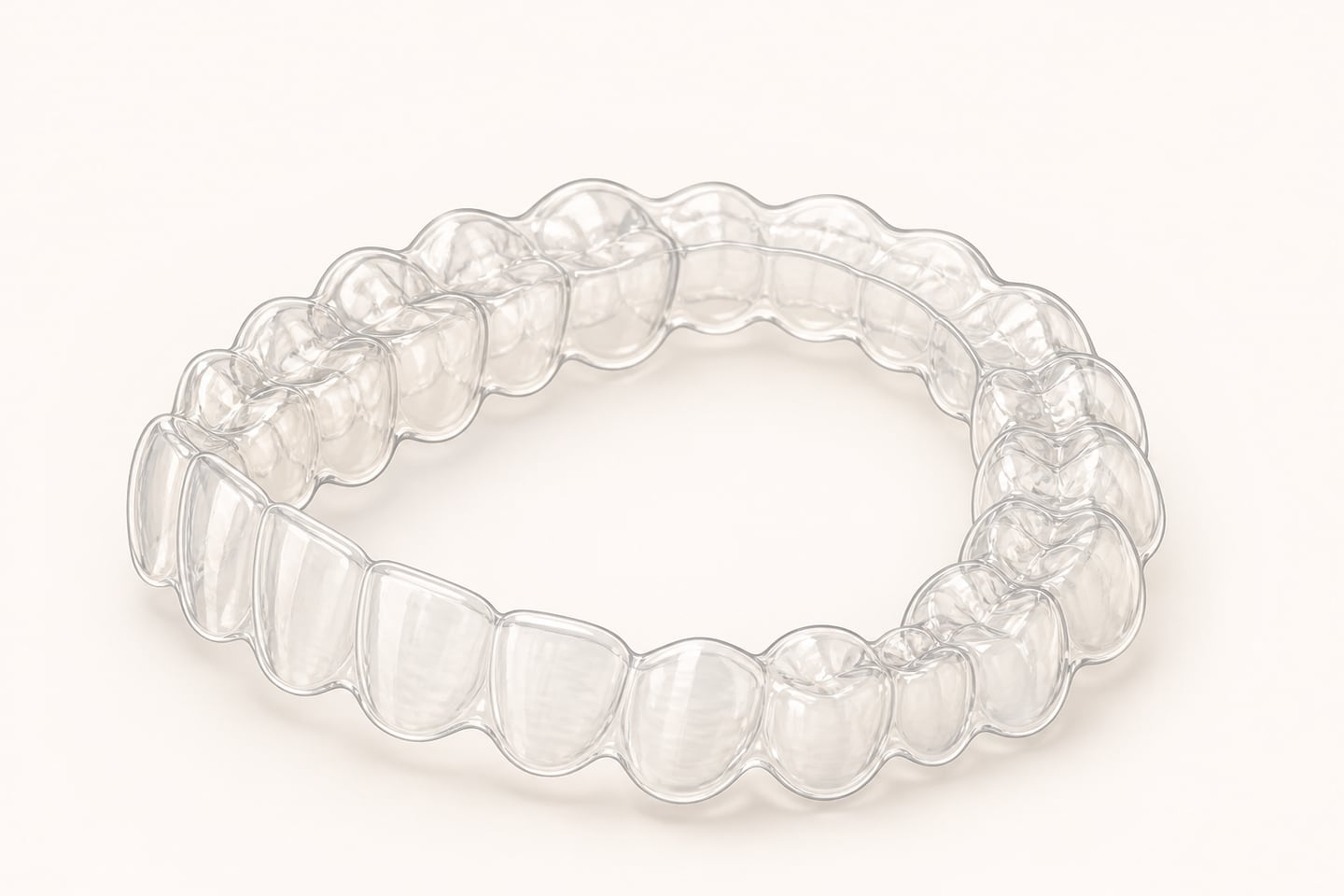
For most adults with mild to moderate crowding, spacing, or bite problems, Invisalign and braces can both reach a good result. The choice comes down to four things: how complex your case is, how disciplined you will be with removable trays, how visible you are willing for treatment to be, and cost. For complex tooth movements, braces still hold the edge in control. Here is how to weigh it for your own mouth.
How each one moves teeth
Braces are brackets bonded to each tooth, connected by a wire the dentist tightens and reshapes at regular visits. They work every hour of every day because you cannot take them off. Invisalign is a series of clear, removable trays. Each tray moves teeth a small step, and you switch to the next one on a schedule. Small tooth-colored attachments are often bonded to teeth to give the trays grip, and elastics may be added for bite correction.
Where aligners tend to win
- Appearance. Trays are hard to notice in conversation and in photos.
- Eating. You remove the trays to eat, so there is no list of forbidden foods.
- Cleaning. Brushing and flossing work the way they always have.
- Comfort. No wires or brackets to irritate lips and cheeks.
- Fewer surprise visits. There is no bracket to break or wire to poke loose.
Where braces tend to win
Control. Some movements are harder for trays: rotating rounded teeth such as canines and premolars, moving teeth up or down significantly, closing large gaps, and correcting severe crowding. Braces give the dentist more leverage for these, which is why orthodontics with braces remains the recommendation for many complex cases. Compliance is the other advantage. Braces work whether or not you remember them. For adults who are honest about being forgetful, that is not a small point.
Clear ceramic brackets are a middle path worth knowing about. They are less visible than metal and keep the control of conventional braces, at the cost of being a little bulkier and more prone to staining around the edges.
The compliance question
Aligners work only while they are on your teeth, which means most of the day and all night, removed only to eat, drink anything other than water, and brush. Removable means skippable. Think about your actual week, not your ideal one. Frequent snacking, coffee sipped across the morning, long meals out, travel, and a habit of losing small objects all work against trays. Patients who wear them as directed tend to track their plan. Patients who do not, do not, and the plan stretches or stalls. Braces remove that variable.
Daily life, side by side
- Speech: aligners can cause a slight lisp for the first days. Braces rarely affect speech but can irritate the inside of the lips until the mouth adjusts.
- Work and social settings: aligners are nearly invisible. Braces are visible, and for some adults that matters and for others it does not.
- Sports and music: trays can be worn under a mouthguard or removed briefly. Brackets need a guard, and wind instruments take adjustment.
- Check-ups: both require regular visits. Aligner visits are often shorter, and some offices monitor progress remotely between them.
Treatment length
Length depends on the complexity of the case and, for aligners, on how consistently you wear them. It does not depend much on the brand. Your dentist will give a range after the assessment. Treat it as an estimate. Refinements, extra sets of trays added near the end to fine-tune the result, are common with aligners and can extend the timeline. Ask whether they are included in the quoted plan.
What drives the cost
Complexity and length drive cost more than the choice of method. Within aligners, the number of trays and refinements matters. Within braces, metal, ceramic, and behind-the-teeth brackets are priced differently. Retainers at the end are part of the real cost either way. Adult orthodontic coverage varies widely between dental plans and is sometimes absent, so check your plan before comparing quotes. Financing can spread either option into monthly payments, subject to credit approval.
Retainers, either way
Teeth drift back toward old positions after any orthodontic treatment. Retainers hold the result, and they are a long-term commitment, not an afterthought. If you are not prepared to wear retainers as prescribed, neither option is finished in your mind yet.
Five questions for the consultation
- Can my case be done well with aligners, or would braces give a better result?
- Which movements in my plan are the hard ones?
- How many refinements are included, and what happens if I need more?
- What is the retainer plan, and what does it cost?
- What is the full cost of each option, in writing?
A provider who offers both and tells you which your case needs is more useful than one who fits every case to the product they prefer. If your main concern is a bite issue, our article on whether Invisalign can fix an overbite goes deeper on that question. Request an appointment and ask for the records visit: scan, photos, and a straight answer about which movements in your case are the hard ones.