
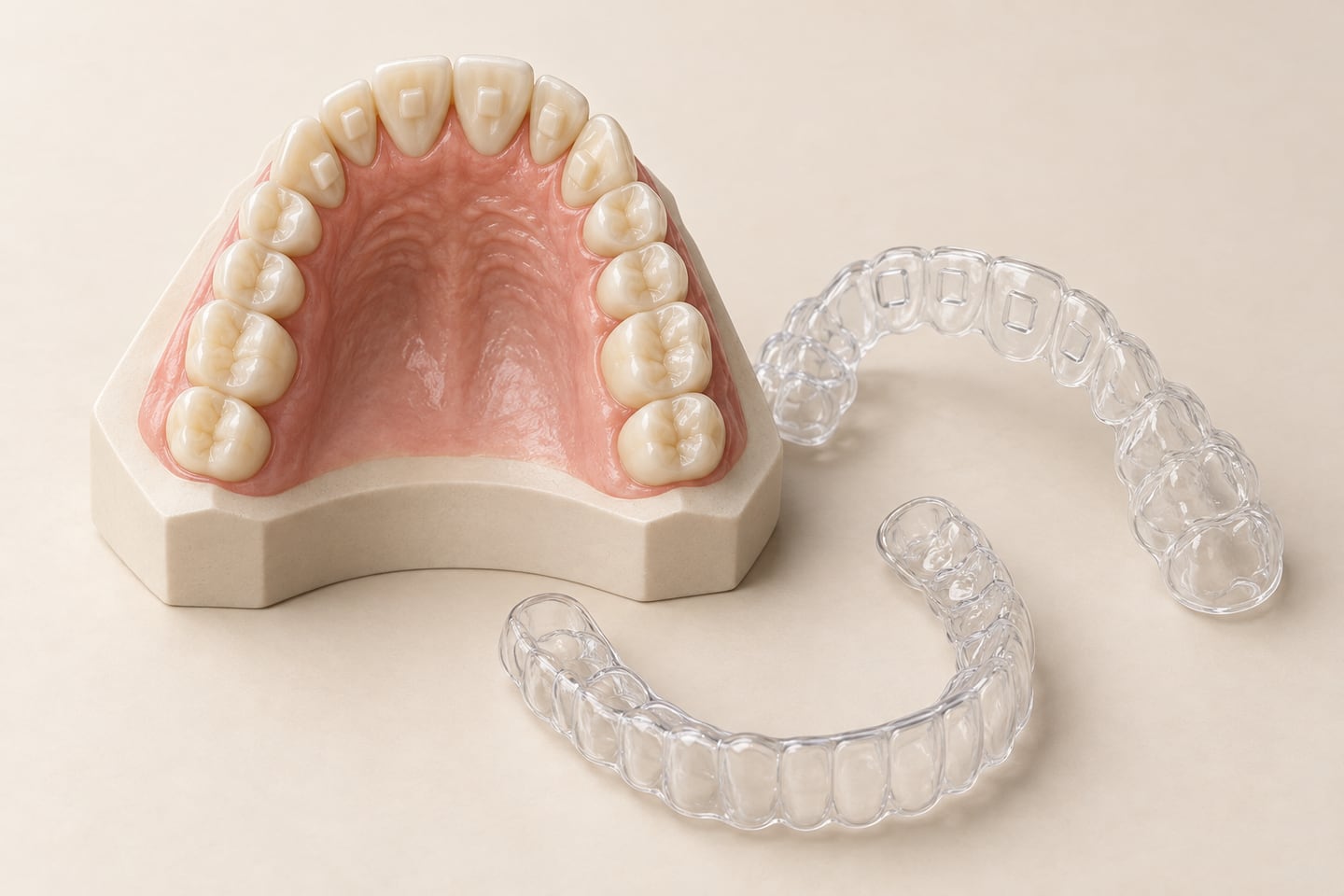
Attachments are small tooth-colored bumps bonded to certain teeth so the aligners can grip and turn them. Refinements are extra sets of aligners ordered near the end of treatment when some teeth have not moved as far as the plan projected. Retainers are the appliance you wear after treatment ends to keep teeth from drifting back, and that part is lifelong. None of the three means something went wrong. They are normal parts of most Invisalign plans, and the consultation should cover all three before you agree to a fee.
Attachments: why clear aligners are not quite invisible
An Invisalign tray is a smooth plastic shell. On its own it can push a tooth, but it struggles to rotate one, pull one down, or move a root. Attachments solve that. They are small shapes of the same tooth-colored material used for fillings, bonded to the front or side of specific teeth. The tray has a matching pocket, so when it snaps over the attachment it gets a handle to push against.
- They go on at the first aligner visit using a template tray. There is no drilling. The enamel surface is lightly conditioned and the material is bonded to it.
- How many you get depends on the movements in your plan. Simple spacing cases may have a few. Rotations and bite corrections usually have more.
- They are visible up close, and they can pick up stain from coffee, tea, or tobacco between cleanings.
- Trays fit tighter with attachments on, so getting them in and out takes practice for the first week.
- They are polished off at the end of treatment. Removal does not cut enamel.
Some plans also use small hooks or buttons for elastics, which correct bite relationships the trays cannot manage alone. Ask whether yours does, because elastics add a daily task.
The other small step: reshaping between teeth
Crowded teeth need room. When extraction is not warranted, the plan may call for interproximal reduction, which removes a very thin sliver of enamel between certain teeth with a fine strip or disc. It is done without anesthetic and is rarely felt. It appears on the treatment plan. Ask to see where.
Refinements: the trays you did not count
The digital preview you see at the consultation is a plan, not a guarantee. Teeth sit in living bone, and some movements track slower than the software projected. At the check-in visits, the dentist compares your mouth to the plan. If certain teeth lag, a new scan is taken and a refinement set of aligners is ordered to finish the job.
- Refinements are common, not a failure. Bite-correction plans need them more often than simple cosmetic cases.
- They add weeks to months, which is why a quoted treatment length is an estimate.
- The biggest cause of lagging teeth is under-wearing the trays. Aligners only work while they are on: about 20 to 22 hours a day, out only for meals and brushing.
- Ask before you start whether refinements are included in your fee, how many sets, and for how long. Offices quote this differently, and it is the line most likely to surprise you.
Outcomes vary. The final result can differ from the preview, and check-ins exist so the difference is caught and corrected early. If your case involves movements aligners handle less predictably, the consultation should say so; Invisalign vs. braces for adults covers where that line falls.
Retainers: the part that lasts the rest of your life
Teeth do not lock into their new position when the last tray comes off. The bone and ligament around them keep remodeling for months, and teeth drift back toward where they started for years afterward. Without retention, relapse is the norm, not the exception. Retainers are part of the treatment, not an accessory to it.
Two kinds
- Removable clear retainers. They look like a final aligner but are made of a sturdier material. Typically worn full-time for a period, then nightly long-term. They wear out and get lost, so budget for replacements over the years.
- Bonded retainers. A thin wire fixed behind the front teeth. Nothing to remember, but it needs flossing under it and periodic checks, and it can come loose without you noticing.
Many people end up with both: a wire behind the lower front teeth and a clear retainer at night. Your dentist sets the schedule. The short version: nightly, indefinitely. If a retainer stops fitting easily, call. That is the early sign of drift, and a new retainer made promptly costs far less than a new round of aligners.
How this changes the price conversation
Before you sign, ask the office to itemize: aligners, attachments, any elastics, the number of refinement sets included, retainers, and the replacement cost of a retainer. A low headline fee with refinements and retainers excluded can cost more over time than a higher fee that includes them. Financing through third-party lenders, subject to credit approval, and membership plan discounts differ per office, so read the terms for the office you will actually visit.
Where this is offered
All four of our offices list Invisalign: Beachside and Pacifica (Huntington Beach), Marina Dentistry (Marina del Rey), and Rio Hondo (Downey). On their own sites, Beachside lists Invisalign Gold Provider 2022, Marina Dentistry lists Gold Provider 2024, and Rio Hondo lists Gold+ Provider 2024. Conventional braces, for cases aligners handle less predictably, are listed by Beachside, Marina, and Rio Hondo. If the aligners are one part of a wider plan, with whitening or bonding afterward, a smile makeover consultation ties the pieces together.
Request a consultation and bring three questions: how many attachments, whether refinements are included, and what the retainers will cost to keep and replace.