
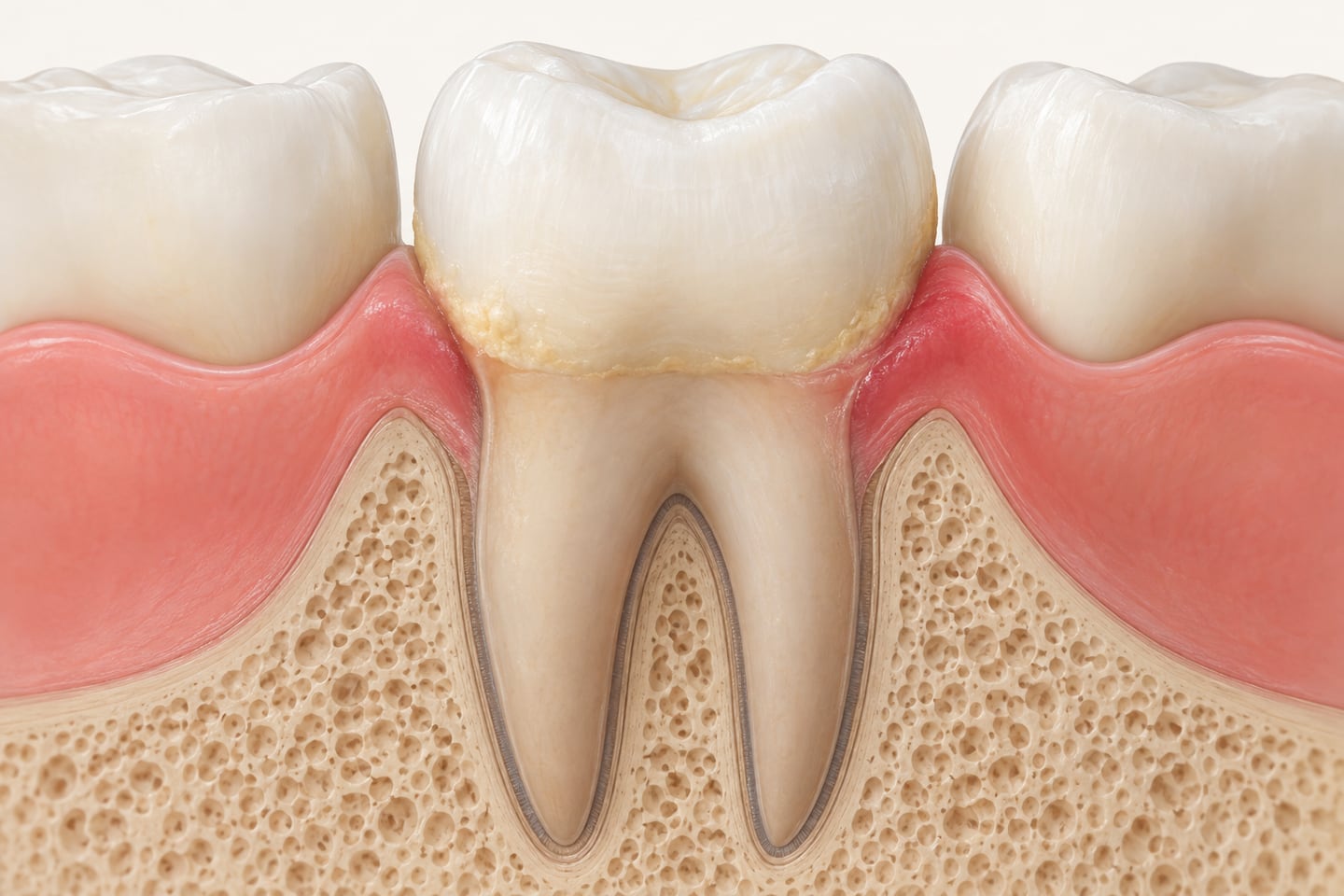
Gums bleed because plaque along the gumline has inflamed them. Healthy gums do not bleed from ordinary brushing or flossing. The American Academy of Periodontology describes the mildest stage of gum disease, gingivitis, as gums that become red, swollen and bleed easily, usually with little or no discomfort, and it says that stage is reversible. The fix is more thorough cleaning, not harder cleaning.
What is actually happening when a gum bleeds
The American Dental Association is blunt about the cause: gum disease is caused by plaque, the sticky film of bacteria constantly forming on teeth. Where that film sits undisturbed against the gum for a day or two, the tissue responds. Blood vessels in the gum widen, the tissue swells, and it becomes fragile enough that a bristle or a strand of floss opens it. The blood is your immune system's response showing up, not evidence that you injured yourself. That is why the place that bleeds is almost always the place you clean least well, and why a cleaning and exam often finds the bleeding sites before you do.
It also explains the counterintuitive part. The spot that bleeds needs more attention, not less. Inflamed tissue calms down once the plaque against it is removed daily, and it stays inflamed as long as the plaque stays.
Why brushing harder makes it worse
Plaque is soft. It comes off with contact and time, not with force. Pressing harder does not clean the one place that matters, which is the narrow line where tooth meets gum, and it does two things you do not want: it abrades already inflamed tissue, and over years it can wear notches into the softer root surface near the gumline. Neither of those stops bleeding. Both give you a new problem.
The ADA's instructions run in the opposite direction from force. Brush twice a day with a soft-bristled brush. Place it at a 45-degree angle to the gums. Move it back and forth in short strokes about the width of one tooth. Replace it every three or four months, or sooner if the bristles are frayed. That last line is a useful diagnostic: bristles splayed out on a two-month-old brush usually mean you are pressing far harder than the job requires.
Why stopping flossing is the exact wrong move
Blood on the floss reads like an injury, so people quit. Quitting leaves the plaque exactly where the inflammation already is, the tissue stays swollen, and the next attempt weeks later bleeds again. That loop is the single most common reason a two-week problem becomes a two-year one.
The technique is gentle, not forceful. Guide the floss between the teeth with a rubbing motion, curve it into a C shape against the side of one tooth, and rub up and down. Never snap it down into the gum. If floss is awkward for you, interdental brushes, a water flosser or floss picks all clean between teeth, and the one you will use every night beats the one that scores best in a study you will never repeat. The ADA's framing of the gingivitis stage is that it can usually be eliminated by a professional cleaning at your dental office, followed by daily brushing and flossing. Note the order. The cleaning comes first, because hardened deposits do not come off with a brush.
How long should bleeding take to settle?
For bleeding caused by plaque alone, with daily cleaning that actually reaches the gumline, most people notice less blood within a few days and little to none by the end of the second week. That is the ordinary course. If you restarted flossing after a long gap, expect the first several days to bleed and expect it to fade. Fading is the whole test.
Two weeks is a fair ceiling for a home experiment. Clean thoroughly every day, including the site that bleeds, and pay attention on day fourteen. If a spot is still bleeding then, it is telling you that something is sitting under the gum where your brush and floss do not reach, and no amount of additional home effort will remove it.
What else makes gums bleed
- Hardened deposits under the gum. Plaque that stays put mineralizes into a rough deposit that holds more plaque against the tissue. It is removed with instruments, not with a brush, and it is the most common reason bleeding survives a good two-week effort.
- Tobacco. The AAP calls tobacco use one of the most significant risk factors in the development and progression of gum disease. If you use tobacco, calm-looking gums are weaker reassurance than they would be otherwise, and the measurements at an exam matter more.
- Medications and medical conditions. The AAP lists oral contraceptives, antidepressants and certain heart medicines among the drugs that affect oral health. Blood thinners make a bleeding site bleed more without being the reason it started, and bleeding disorders show up in the mouth like anywhere else. Bring your actual medication list rather than trying to remember it, and mention gums that bleed alongside easy bruising to your physician too.
- Hormonal change. Gums can react more strongly to the same amount of plaque during pregnancy. Tell your dentist you are pregnant. It changes what gets scheduled and when, and it does not make daily cleaning less important.
- Stress, clenching and diet. The AAP lists all three as risk factors: stress makes it harder for the body to fight infection, clenching or grinding puts excess force on the tissues supporting the teeth, and a diet low in important nutrients works against the immune response.
- One tooth, and only one. Bleeding isolated to a single spot often has a local cause: a rough filling or crown edge, food packing into one contact, a cracked tooth, or a partial denture clasp. That is worth pointing at directly during the exam.
When bleeding needs an exam rather than another week
The AAP's list of warning signs is short and worth knowing, because several of them describe damage that has already happened rather than inflammation that will calm down.
- Bleeding still present after two weeks of thorough daily cleaning.
- Gums receding or pulling away, so a tooth looks longer than it used to.
- Loose or separating teeth, or a change in the way your teeth fit together when you bite.
- A change in how a partial denture fits.
- Pus between the gum and the tooth.
- Persistent bad breath or a bad taste that brushing does not touch.
- Sores in your mouth, or gums that hurt rather than simply bleed.
Facial swelling, or pain that wakes you at night, is a different situation and a faster one. Whether swelling means a dentist or an emergency room covers that, and emergency care is the route for it. Bleeding gums on their own are not an emergency; they are an appointment.
The reason not to wait it out indefinitely
The AAP states that gum disease is often silent, meaning symptoms may not appear until the advanced stages. Bleeding is one of the few early signals you get, and it is the one people are most likely to explain away. What waiting risks is not more bleeding. It is the crossing from inflammation of the gum, which reverses, to loss of the bone holding the tooth, which does not. Gingivitis versus periodontitis is the same distinction laid out properly, including how a dentist tells which side of it you are on.
What an exam adds that your bathroom cannot
Three things. A measurement around each tooth, taken with a small probe, which tells whether the gum is merely swollen or has detached from the root. X-rays, which show the bone level and are the only way to see what has actually been lost. And removal of the hardened deposits above and below the gumline that home care cannot reach. Where those measurements come back deep, treatment moves from a cleaning to gum disease treatment, and your dentist may refer you to a periodontist, a dentist with additional training in gum and bone problems. A referral is a normal step, not a sign that something went wrong.
How often you should be seen after that depends on what the measurements show rather than on a default. How often you actually need a cleaning goes through what moves that interval.
What to do over the next two weeks
- Clean between every tooth once a day, gently, including the sites that bleed. Floss, interdental brushes or a water flosser, whichever you will actually keep doing.
- Brush twice a day with a soft brush at a 45-degree angle to the gums, in short strokes, without leaning on it.
- Aim at the gumline rather than the middle of the tooth. That narrow line is where the plaque that matters sits.
- Track it. Note on day one which teeth bleed, then check the same teeth on day fourteen.
- Book the exam anyway if it has been more than a year since your last cleaning. The two-week test tells you whether home care is enough; it does not tell you what is under the gum.
If day fourteen still bleeds, request an appointment and say exactly that: which teeth bleed, how long it has been going on, and that two weeks of daily cleaning did not settle it. Ask for your pocket measurements to be read out to you and written down. Those numbers, not the bleeding, are what the next decision is made on.