
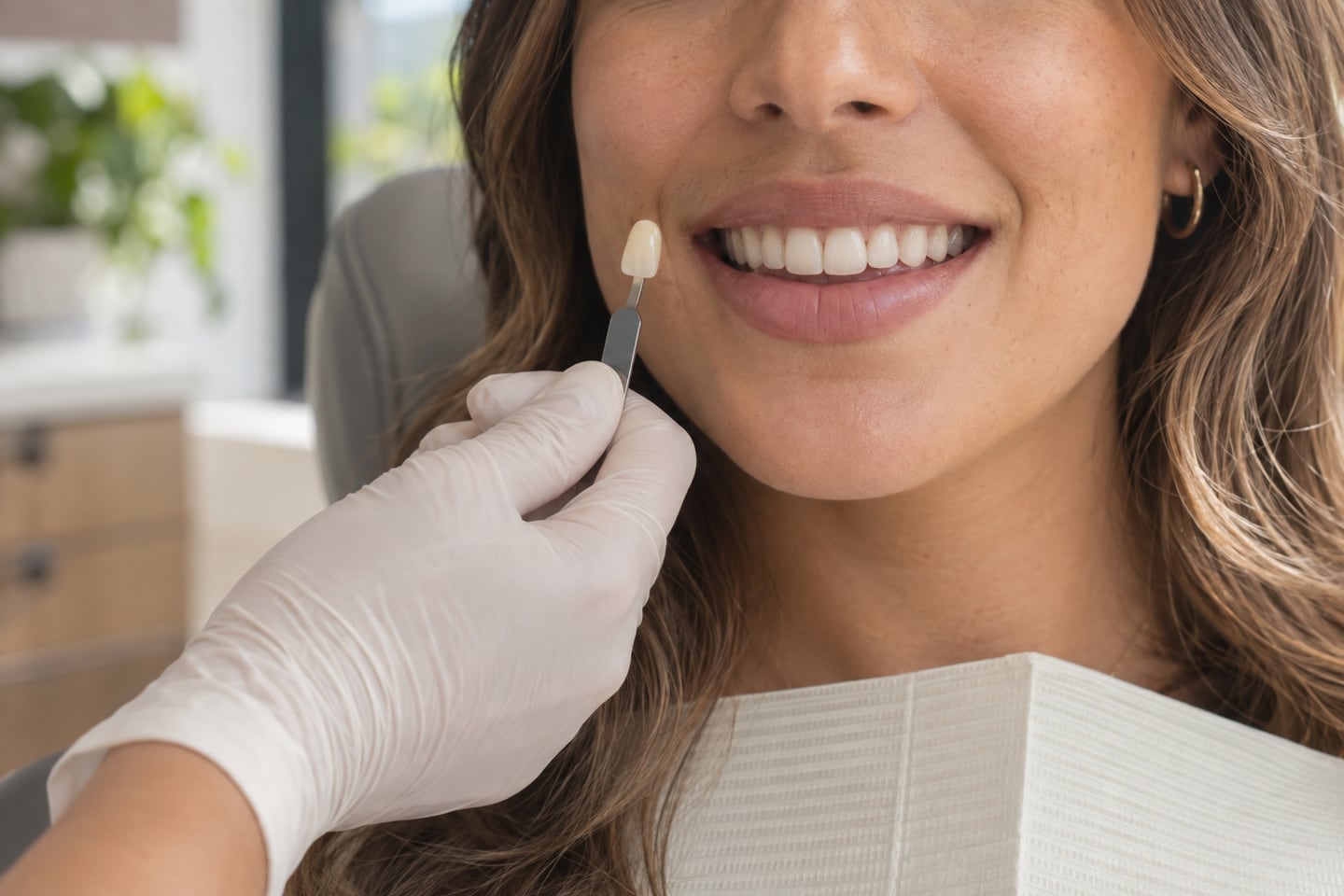
Whitening changes the color of natural enamel and nothing else. Veneers change color, shape, width and the way alignment reads, but enamel comes off to place them, and the American Dental Association says the treatment is not reversible because tooth enamel is removed. If the only thing bothering you is shade, whitening is the smaller intervention, and it is the one to try first.
That order matters more than any other decision in cosmetic dentistry, because one of these choices can be undone and the other cannot.
What each one actually changes
Whitening
- Changes: the shade of natural tooth structure.
- Leaves alone: shape, length, width, spacing, rotation, chips, and every crown, veneer, filling and bonded repair in your mouth.
- Removes: nothing. No drilling, no preparation, no enamel.
- Undoable: yes, in the sense that the shade drifts back and the tooth underneath is untouched.
Veneers
- Changes: shade, shape, length, width, the appearance of small gaps, and how straight teeth look without moving them.
- Removes: enamel. The ADA describes porcelain veneer preparation as removing a small amount of enamel from the front and sides of the tooth, and notes that composite veneers require less removal than porcelain.
- Undoable: no. The ADA describes the treatment as not reversible, because enamel is removed to place the veneer; the tooth needs a covering from that point on.
- Ongoing: the ADA notes a veneer can chip, crack, wear or loosen over time and then needs re-bonding, repair or replacement, and lists clenching or grinding, and a deep overbite, among the reasons veneers may not suit you.
Why whitening touches color and stops there
Whitening gels work by peroxide penetrating enamel and breaking up the colored compounds held in and just under it. The ADA separates stains into extrinsic, which accumulate on enamel from things like tobacco and pigmented food and drink, and intrinsic, which sit inside the tooth within the enamel or the dentin underneath. Peroxide reaches both to different degrees. What peroxide cannot do is change a shape: a chipped tooth is still chipped at the end of a whitening course, and a rotated tooth is still rotated. Professional whitening compared with the drugstore version covers which discoloration responds and which ignores the gel entirely.
This is the part people discover after they have paid. Someone unhappy with their smile assumes the problem is color, because color is the easiest thing to name. Whitening runs, the shade genuinely lifts, and they are still unhappy, because the real complaint was a short worn edge or one tooth sitting forward of its neighbors. Naming the complaint precisely before buying anything is most of the work.
Why a whitened smile can suddenly clash with your old dental work
Whitening changes natural enamel and leaves everything artificial exactly as it was. The ADA is direct about it twice over: whitening will not work on caps, veneers, crowns or fillings, and only natural teeth can be whitened, not tooth-colored restorations. A crown was made to match the shade your tooth was on the day it was made. Lighten the teeth beside it and the crown does not follow. It reads darker and yellower than before, not because anything changed about the crown, but because its neighbors moved and it did not.
The same happens with old white fillings on front teeth, with bonded repairs on chipped corners, and with existing veneers. A tooth-colored filling that was invisible for a decade can announce itself the week after a whitening course.
None of that is a reason to skip whitening. It is a reason to whiten before that work is made or replaced, rather than after, because restorations are matched to the shade in front of the dentist at the time. Doing it the other way around means paying twice for the same crown. If you already have front-tooth crowns or veneers, say so before whitening starts and ask what the plan is for the mismatch: sometimes the answer is that the restoration needs replacing to keep the smile even, and that cost belongs in the decision rather than in a surprise later. Veneers compared with crowns covers which of the two you actually have, since patients often are not sure.
Match the treatment to the complaint
Say out loud what bothers you, in one sentence, and the choice usually resolves itself.
- “They look yellow.” A color complaint, and whitening is built for it. The ADA notes yellow teeth will probably bleach well, brown teeth may not respond as well, and teeth with gray tones may not bleach at all.
- “One tooth is much darker than the rest.” A diagnosis, not a shade problem. A single dark tooth usually means something happened inside it, and gel across the whole arch will not touch it.
- “There is a chip on one front tooth.” One chip is a repair, not a redesign. Ask what the smallest fix is that closes it, and keep the other five front teeth out of the conversation.
- “They are crooked.” Veneers can make crooked teeth look straighter by changing the surface you see. They do not move anything, and the enamel is gone for good. Ask about orthodontic options first, because moving a tooth costs you no tooth structure at all.
- “There is a gap between my front teeth.” Aligners and bonding both close small spaces without removing enamel. Veneers are the largest of the three answers, not the only one.
- “My front teeth look short and worn.” Worn edges usually mean grinding or an acid problem that is still running. Placing porcelain over an unaddressed cause is how veneers break.
- “My old white fillings have gone dark.” A restoration problem. Whitening the enamel around them makes it more obvious, not less. Whiten first, then replace them to match.
What whitening cannot fix
Whitening has a ceiling. It does not change shape or alignment, it does not lighten restorations, gray-toned discoloration may not lighten at all, and every person's enamel has a natural shade limit that more gel will not push past. If your complaint survives a well-run whitening course, that is information rather than a failure: it tells you the problem was never color, and it tells you before any enamel has come off. At that point whether veneers are worth it and composite compared with porcelain are the right questions, on the smallest number of teeth that solves the problem.
The order that protects your enamel and your money
- Get an exam first. The ADA advises a clinical exam before bleaching, with radiographs and other diagnostic tests as appropriate, because decay, exposed roots and gum problems change what should happen and in what order.
- Treat disease before cosmetics. Nothing cosmetic should go on top of an untreated problem.
- Write the complaint down in one sentence, then check that the treatment being proposed is aimed at that sentence.
- Try whitening if color is any part of it. It removes no tooth structure, so a course that disappoints you has cost you nothing you cannot get back.
- Let the shade settle, match any restorative work to the finished shade rather than the starting one, and consider veneers last, for whatever is still standing.
Questions worth asking before you agree to veneers
- How much enamel comes off, and on which teeth?
- Which of my complaints does this fix that whitening would not?
- Can we whiten first and then decide how many teeth actually need veneers?
- What can you show me before any enamel is removed?
- What happens when one chips or comes loose, and what does replacement involve?
If nobody has answered those, the appointment to book is a consultation rather than a procedure. Request an appointment and say you want to know whether your complaint is a color problem before you commit to anything irreversible. From there, whitening, veneers and a sequenced cosmetic plan describe what each treatment involves, and each office quotes its own fees.