
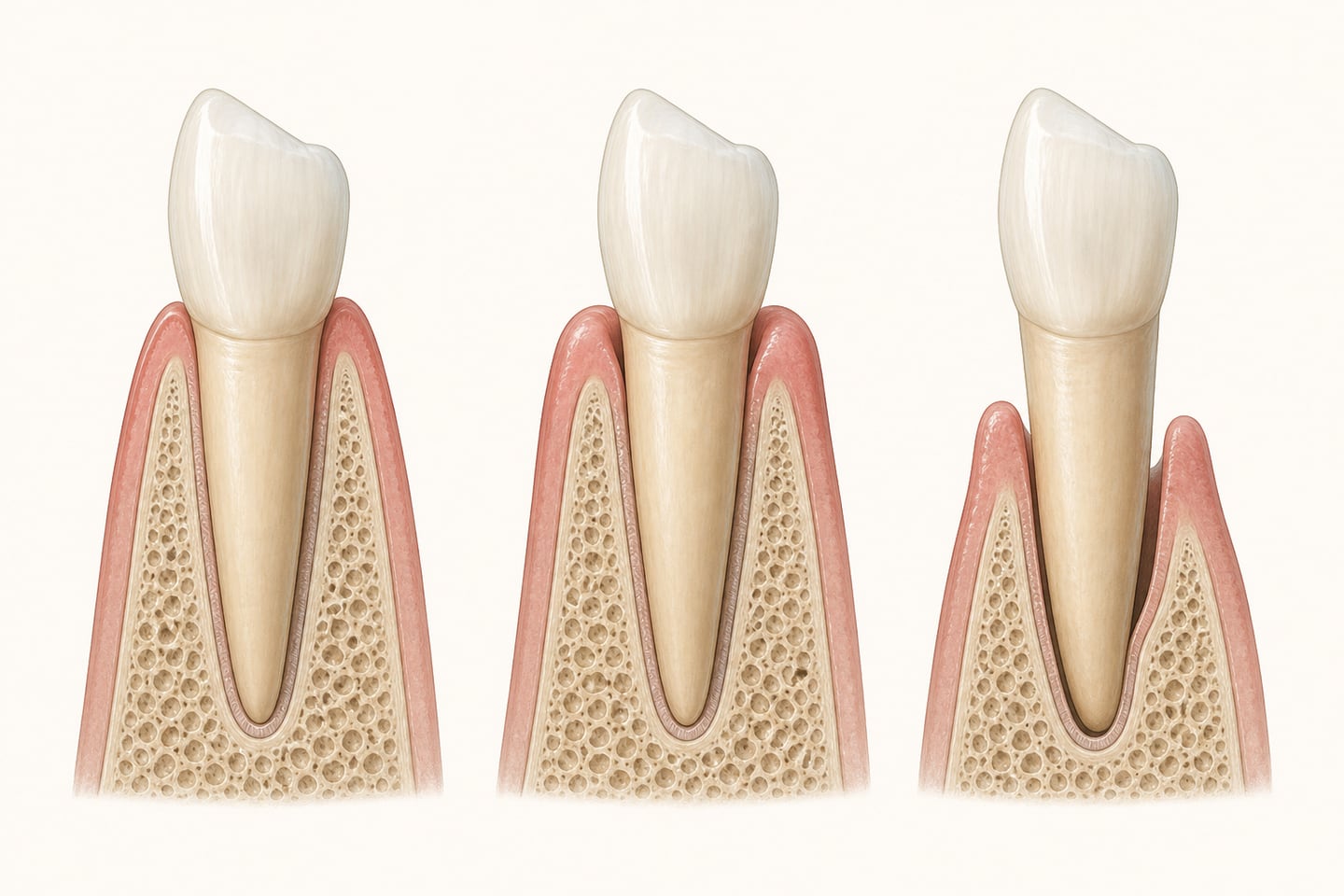
Gingivitis is inflammation of the gum, and it reverses. Periodontitis is inflammation that has reached the bone holding the tooth, and the bone already lost does not grow back. That is the whole distinction, and it is the most useful sentence in gum health. Periodontitis can be stopped and managed for decades; it is not cured. A dentist separates the two by measuring around each tooth and looking at bone level on an X-ray.
What gingivitis is
The American Academy of Periodontology calls gingivitis the mildest form of periodontal disease. Its description: the gums become red, swollen and bleed easily, there is usually little or no discomfort at this stage, and gingivitis is reversible with professional treatment and good at-home oral care.
Nothing structural has been lost yet. The fibers attaching gum to tooth are intact and the bone underneath is where it has always been. Take the plaque away and the tissue heals, the way any inflamed tissue heals once the irritant is gone.
The signal is bleeding, and it is the signal people ignore. Why gums bleed and what to do about it covers the two-week test that tells you whether you are dealing with plaque alone.
What changes when it becomes periodontitis
The AAP's description of the next stage is worth reading slowly. Untreated gingivitis can advance to periodontitis. Plaque spreads and grows below the gumline. Toxins produced by the bacteria irritate the gums and provoke a chronic inflammatory response in which, in the AAP's own phrasing, the body essentially turns on itself, and the tissues and bone that support the teeth are broken down and destroyed. Gums separate from the teeth, forming pockets that can become infected. As it progresses, the pockets deepen and more gum tissue and bone are destroyed. Teeth can eventually become loose and may fall out or need to be removed.
Three words in that passage carry the difference: bone, destroyed, pockets. The damage is no longer to the soft tissue you can see. It is to the socket the tooth stands in.
The NIH's dental institute puts the consequence plainly: in advanced gum disease, the bone supporting the teeth is destroyed, which may cause looseness and shifting of teeth. Take away a third of the bone and the tooth still works. Take away most of it and it does not, regardless of how healthy the tooth itself is. That is how people lose teeth that never had a single cavity, and what a missing back tooth sets off is the part that comes after.
Why the irreversibility matters, stated plainly
Bone that has resorbed away from a tooth does not regenerate on its own, and no cleaning, rinse, toothpaste or laser puts it back. The AAP describes gingivitis as reversible. It makes no equivalent claim anywhere about periodontitis. That silence is not an oversight.
Treatment aims at stopping further loss and keeping what remains cleanable, and where non-surgical treatment does not get a site healthy, the AAP describes gum surgery as the next step. A periodontist assesses whether a particular defect can be rebuilt, which is a repair at specific sites rather than a return to the bone level you had at twenty-five. What gum treatment can and cannot reverse goes through that in full, including the one narrow exception. Anyone offering a cure for periodontitis is describing something gum disease treatment does not support, and that is a reason for a second opinion before you pay for anything.
The right framing is that the goal changes. With gingivitis the goal is to restore. With periodontitis the goal is to hold the line, and holding the line for thirty years while keeping your own teeth is a genuinely good outcome. It is just a different one.
It is a threshold, not a switch
There is no day on which gingivitis becomes periodontitis. Inflammation persists in one area, works below the gumline, and at some point attachment and bone begin to go. It moves at different rates in different mouths and in different parts of the same mouth, which is why measurements are taken tooth by tooth rather than as one verdict. Gingivitis also does not always advance: plenty of people carry mild inflammation for years without losing bone. Nobody can tell you in advance which category you are in, and the AAP notes that gum disease is often silent, with symptoms sometimes not appearing until the advanced stages.
How a dentist tells which one you have
Pocket measurements
The NIH's dental institute describes the method: the dentist uses a tiny ruler called a probe to measure the spaces around the teeth. The probe is slid gently into the crevice between gum and tooth at several points around each tooth, and how far it goes before it stops is recorded. Those are the numbers you hear called out during a cleaning and exam while somebody writes them down.
Small numbers mean the attachment is still sitting where it should. Larger numbers mean the probe travels further down the root, either because the gum is swollen and sitting higher or because the attachment has moved. Whether a site bleeds when it is measured gets recorded next to the number, since that is what says how active the problem is now. Ask your own office which readings they treat as healthy and which they treat.
X-rays
This is the part that settles the diagnosis. The NIH's dental institute describes X-ray images being taken to assess bone loss. Pocket depth alone can mislead, because a swollen gum can produce a deep reading with the bone underneath untouched. The bone level on the X-ray is the record of what has actually gone. If you have moved between offices, ask the previous one to send your old images: a dentist comparing this year to four years ago sees direction rather than a snapshot.
Recession is not the same thing
Gums can recede for reasons that have nothing to do with periodontitis, including years of heavy brushing, and a tooth can look longer without the bone underneath having changed. The AAP does list receding gums among the warning signs, so recession is a reason to have measurements and images taken. It is not, on its own, a diagnosis.
What treatment looks like at each stage
Gingivitis
A professional cleaning that removes the deposits above and just below the gumline, then daily cleaning that genuinely reaches the gumline. The AAP describes gingivitis as reversible with professional treatment and good at-home oral care, and the NIH's dental institute says early gum disease caused by plaque buildup can often be reversed by daily brushing and flossing. Then a recheck, so somebody measures again instead of assuming it worked.
That is the entire treatment. It is unglamorous, it is inexpensive relative to everything on the other side of the line, and it is the last point at which the problem simply goes away.
Periodontitis: scaling and root planing
The AAP describes scaling and root planing as a deep cleaning of the tooth root surfaces: scaling goes beneath the gumline to remove plaque and other bacterial toxins from periodontal pockets, and root planing smooths the root so future deposits have less to adhere to. It is done with the area numbed, usually over more than one visit, and it is performed in general practices as well as by periodontists. What the appointments are actually like covers the chair-side version.
The AAP's account of what follows is the part patients are least often told: many patients do not require additional treatment after scaling and root planing, but the majority will require ongoing maintenance therapy to sustain periodontal health. The NIH's dental institute frames the objective the same way, saying the main goal of treatment is to control the infection, and notes that surgical treatment may be required in advanced cases. Control, not cure. That word choice is doing real work in both documents.
Maintenance is the treatment, not the follow-up
After periodontitis has been treated, cleanings move to a shorter interval than a standard checkup schedule, because the bacteria repopulate treated pockets and deeper pockets are harder for home care to keep clean. Drifting back to a routine schedule is the most common way treated periodontitis quietly starts moving again. What actually sets your cleaning interval covers how that decision is made. Your interval should come from your measurements, and you are entitled to ask why it is what it is.
Side by side
What the exam shows
- Gingivitis: shallow measurements that bleed; bone level on the X-ray unchanged.
- Periodontitis: deeper measurements and visible bone loss on the X-ray. The X-ray is what separates them.
What treatment is
- Gingivitis: a cleaning plus daily home care, then a recheck.
- Periodontitis: scaling and root planing, surgery at sites that do not respond, and ongoing maintenance therapy that does not end.
What the outcome is
- Gingivitis: reversible. The tissue returns to health.
- Periodontitis: manageable. Lost bone stays lost, further loss can be stopped, and keeping your teeth is a realistic goal rather than a promise.
Who is more likely to cross the line
This is not a list of blame. The NIH's dental institute names smoking and tobacco use as the most significant risk factor, and lists older age, diabetes and genetics alongside it. Genetics is the one people find hardest to accept: some patients are more susceptible than their habits explain, and some with mediocre habits never cross the line. Risk factors change the odds without deciding the outcome.
The same two factors follow you past tooth loss, which is where untreated periodontitis eventually leads. How smoking and diabetes affect implant treatment covers that, and replacing a tooth with a dental implant does not exempt you from gum care: implants have their own version of this disease.
Gum disease and the rest of your health
This gets overstated in marketing, so here is the careful version. The AAP states that several studies have shown a link between periodontal disease and other systemic diseases, and adds, in its own words, that while a causal relationship has not been conclusively established, research suggests periodontal disease may contribute to the progression of other diseases. It describes diabetes as running both ways: people with diabetes are more likely to have gum disease, and gum disease may make blood sugar harder to control.
Practically: mention your gum diagnosis to your physician and your medical conditions to your dentist, because each changes what the other is looking at. What it does not mean is that treating your gums treats anything else. Periodontal therapy is not a treatment for diabetes or heart disease, and an office selling it that way has left what the evidence supports.
Questions worth asking at your next appointment
- What were my measurements, and how many sites were above the number you treat as healthy?
- Is there bone loss on my X-ray, and can you show me where you are seeing it?
- In one word, is this gingivitis or periodontitis?
- If it is periodontitis, what is the plan to stop it, and what maintenance interval does that put me on?
- When is the recheck, and what result would count as this having worked?
If you have never had gum measurements taken, or nobody has read you the numbers, that is the appointment to book. Request an appointment and ask for a periodontal charting and current X-rays, then ask which of the two words above applies to you. The answer determines whether you are trying to fix something or trying to keep it.