
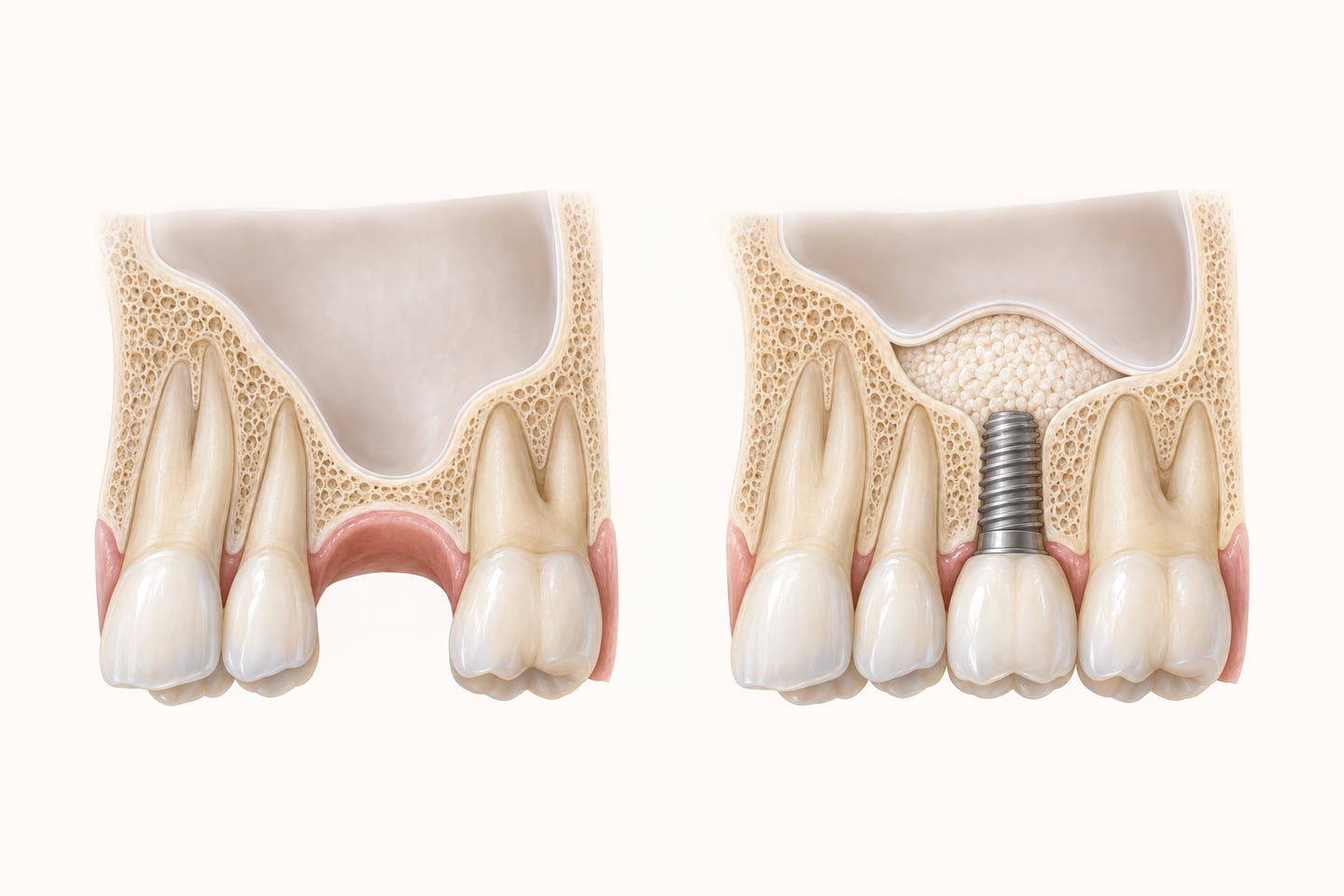
Being told you need a sinus lift before an implant sounds more alarming than it is. It does not mean something is wrong with your sinuses. It means the bone under an upper back tooth has become too thin to anchor an implant, and the fix is to build that bone up from above. It adds a step and some months to treatment; for many people it is what makes an upper back implant possible at all.
Why the upper back jaw runs out of bone
The maxillary sinuses are air spaces inside the cheekbones, and their floor sits just above the roots of the upper premolars and molars. Two things thin the bone between the mouth and the sinus after a back tooth is lost: the ridge that held the tooth shrinks once no root is in it, and the sinus floor tends to settle down into the space. Some people simply have large or low-sitting sinuses to begin with. The American Academy of Periodontology describes the upper back jaw as one of the most difficult places to place implants for exactly these reasons — and why a missing back tooth matters explains what else the gap does while it waits.
What the procedure does
It is not an operation on the sinus in the sense of treating congestion or breathing. The membrane lining the sinus floor is lifted, carefully, and bone graft material is placed in the space created beneath it. Over the following months the graft acts as a scaffold while your own bone grows into it, giving the implant enough height to anchor.
Two approaches
From the side
Used when a lot of height is needed. A small opening is made in the outer wall of the upper jaw above the missing teeth, the membrane is lifted through it, and the graft material is placed. Dentists call this the lateral window.
Through the implant site
Used when only a modest amount of height is needed. The sinus floor is nudged upward through the same opening prepared for the implant, and graft material goes in beneath it. It is less extensive, and it is not suitable when a lot of bone is missing.
Which approach, and whether the implant can go in at the same visit, depends on how much bone there is to start with. If the remaining bone can hold the implant firmly, it can sometimes be placed during the lift. If not, the graft heals first and the implant follows later.
How the decision is made
A 3D scan settles it. A flat X-ray can suggest the bone is thin; the scan measures it and shows the sinus floor. Plenty of upper back implants go in without a lift — sometimes a shorter implant, a different angle or a different design avoids it — so it is fair to ask what the alternatives are and why a lift is the recommendation for your site. The wider picture of grafting is in bone grafting before dental implants.
Recovery: the rules that matter
Most people have swelling, tenderness and sometimes bruising for several days, managed with the medication the office recommends, cold compresses and a soft diet. The instructions that matter most are about keeping pressure off the graft in the first weeks:
- Don't blow your nose hard. If you have to sneeze, sneeze with your mouth open.
- Skip straws, which create suction.
- Don't smoke — it slows healing and is a common reason grafts do poorly.
- Hold off on strenuous exercise for as long as you have been told to.
- Call the office if swelling or pain gets worse instead of better after the first few days, or if you develop a fever.
How long it adds
The gum settles within a couple of weeks; the bone takes far longer. The AAP gives a range of four to twelve months for the grafted bone to develop before implants are placed, depending on the case. When the implant goes in at the same visit, that healing overlaps with the implant fusing to the bone. Either way, ask for the whole calendar — lift, healing, implant, healing, crown — before you begin. How long implant treatment takes shows how the phases stack.
Risks worth knowing
Like any surgery, a sinus lift carries risk. The membrane can tear during the procedure; a small tear is often repaired on the spot, while a larger one may mean stopping and trying again after healing. Infection and a graft that doesn't take as well as planned are the other main complications. Smoking, uncontrolled diabetes, active gum disease and untreated sinus problems all raise the risk, and an active sinus infection is usually a reason to postpone. Tell the office about any history of sinus trouble before the plan is made.
Cost is its own line
A sinus lift is usually priced separately from the implant and the crown, and its cost varies with the technique and how much graft material is needed. Ask for an itemized plan that shows imaging, the graft, the implant, the abutment and the crown as separate lines; what drives the cost of dental implants explains why each is priced on its own.
Bring the scan you were given
If another office has already told you there isn't enough bone, bring that scan — or ask them to send it — so the conversation starts from the image rather than from scratch. Needing a graft usually means one more step, not the end of the road. Request an implant consultation and mention the upper back tooth in the notes; the visit can be planned around the imaging.