
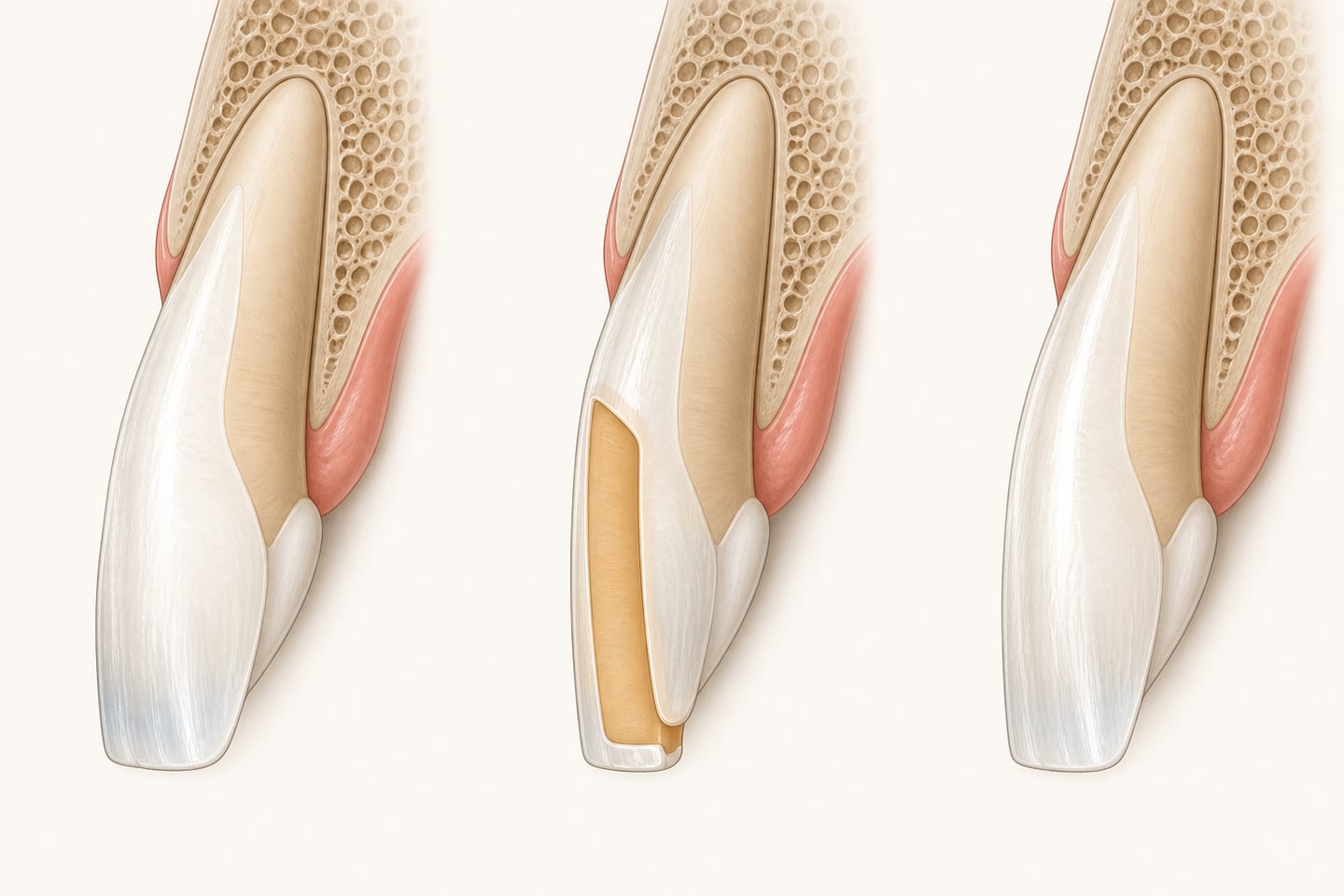
Traditional porcelain veneers remove enamel from the front of the tooth, and enamel does not grow back. The American Dental Association puts it in one sentence: treatment is not reversible because tooth enamel is removed to place a veneer. So the answer is that veneers do not damage a tooth by accident. They change it on purpose, once, and the tooth stays covered from then on.
What people mean by damage, and what actually happens
Damage suggests something went wrong. A veneer preparation appointment is deliberate: the tooth is numbed and a layer is shaped off the front, usually including the biting edge, so the shell sits flush rather than standing proud of its neighbors. Nothing breaks. Something is removed, and that removal is the price of the result. A veneer does not weaken a tooth the way decay does. It converts a tooth that needed nothing into a tooth that will always need something.
How much enamel comes off
The ADA describes it as a small amount of enamel removed to accommodate the shell. How small depends on the tooth and on the size of the change: a tooth set back in the arch, or darker than the shade you have chosen, needs more than one already close to where you want it, because the porcelain has to make up the difference. The size of the change and the amount of tooth removed are the same question asked twice, which is why a plan that never mentions preparation is not a gentler plan. It is a less complete conversation.
Enamel does not grow back, and the exception you have heard about is a different thing
You may have read that enamel repairs itself, which sounds like it should undo this. It does, in one narrow sense. The NIH's dental institute describes enamel repairing itself using minerals from saliva and fluoride, whether from toothpaste or applied by a dentist. That is remineralization: minerals moving back into enamel that is still there.
It is not regrowth. Once a layer has been shaped away there is no enamel left in that space for minerals to move into, and an adult tooth cannot build a new one. That is precisely why the ADA calls veneer treatment irreversible, and separating the two ideas is the difference between an informed decision and a reassuring one.
What the tooth is committed to afterward
- Something covers it from now on. A prepared tooth does not go back into service bare. When a veneer fails, what replaces it is another veneer, or a crown if too little structure remains.
- Its shade is fixed. The ADA's position is that whitening does nothing for caps, veneers, crowns or fillings. Once bonded, that tooth stays the shade the lab made it, and if your untreated teeth drift darker over the years, only they respond to whitening.
- Sensitivity for a period is normal. Preparation brings the surface closer to the layer beneath the enamel, and cold sensitivity afterward is common. Pain that does not settle is a reason to call the office rather than wait it out.
- It can still decay. The ADA's care instructions for veneers include flossing daily, because cavities can still develop underneath. The porcelain does not get a cavity; the tooth behind it can, and treating one usually means the veneer comes off.
No-prep and minimal-prep veneers, and what they still commit you to
Thinner veneers that need little or no enamel removed do exist, and on the right tooth they are the most conservative option available. The ADA notes that composite veneers, made of tooth-colored filling material bonded to the tooth, need less enamel removed and fewer visits than porcelain, though they resist staining less well. Composite versus porcelain veneers covers that material choice in full. The limits below are the part left out of the marketing.
- They add, they do not subtract. A shell on unprepared enamel makes the tooth slightly thicker and more forward. On a tooth that is already full or prominent, that reads as bulk rather than a correction.
- They cannot hide a dark tooth. Thin and translucent travel together. A veneer thin enough to skip preparation is usually too thin to block a deep internal stain, which is often why people wanted veneers to begin with.
- The edge has to sit somewhere. Where no enamel is removed, the margin rests on the tooth surface instead of in a shaped seat. That line can show, and it can collect plaque at the gum.
- No-prep is often decided in the chair. A case planned as no-prep can become minimal-prep once the dentist sees how your teeth sit. Ask what happens then, and get the answer before you are numb.
Ask about these by product name rather than by category, since what is offered differs by office. Pacifica Dental in Huntington Beach lists Lumineers, a branded thin veneer, on its menu. What preparation a product needs on your teeth is a different question from what it needs in general.
What happens when a veneer is replaced
The ADA is direct about how veneers end: a veneer may chip, crack, wear down or loosen over time, requiring your dentist to re-bond, repair or replace it. Replacement is where the one-way decision compounds. A bonded shell has to be cut off, and separating porcelain from cement without touching the tooth beneath is not something anyone can promise, so a little more enamel goes each time. Across two or three cycles, a conservatively prepared tooth can end up with little enough structure that a crown is the sensible restoration instead, and veneers versus crowns sets out where that line sits.
That argues for doing the arithmetic on age, not against ever having veneers. A veneer placed in your twenties is a different commitment from one placed in your fifties, because the number of cycles ahead of it is different.
Who should think twice
- Anyone whose complaint is color alone. The ADA notes that yellow teeth probably bleach well, brown teeth may not, and gray tones may not bleach at all. A whitening trial costs enamel nothing and tells you where your teeth land first.
- Anyone who grinds or clenches. The ADA associates grinding with chipped or cracked teeth and worn edges, and says a dentist may recommend a night guard to protect teeth during sleep. Grinding shortens the life of porcelain as it does enamel, so a guard belongs in the plan from the start.
- Anyone being sold veneers as a fix for crooked teeth. Covering misalignment with porcelain means preparing teeth harder to fake a straight line, the most enamel-expensive version of the treatment. Invisalign and orthodontics move the tooth instead, which can reduce the preparation a veneer needs afterward.
- Anyone with untreated decay or gum disease. Both are treated first. A shell bonded onto an unhealthy foundation does not hold, and the foundation does not improve underneath.
- Anyone deciding from a photograph. A result on someone else's teeth was built on their tooth positions, gum line and bone. Yours are different, and no photograph carries across.
Questions to ask before any tooth is touched
- How much enamel comes off each tooth, and which teeth need the most?
- Is there a version that removes less, and what would I be giving up?
- Would whitening or orthodontic treatment first reduce the preparation this needs?
- Can I see a mock-up or a trial shape on my own teeth before anything is prepared?
- If I change my mind after the preparation appointment, what happens to my teeth?
That last question is the real test of a plan, and the answer is the same everywhere: after preparation, the teeth need covering. So the plan belongs on paper before anything is removed. A cosmetic consultation is where it gets built, and are veneers worth it covers candidacy. Otherwise, request an appointment and ask for the veneer preparation plan in writing, including what bonding would do instead.