
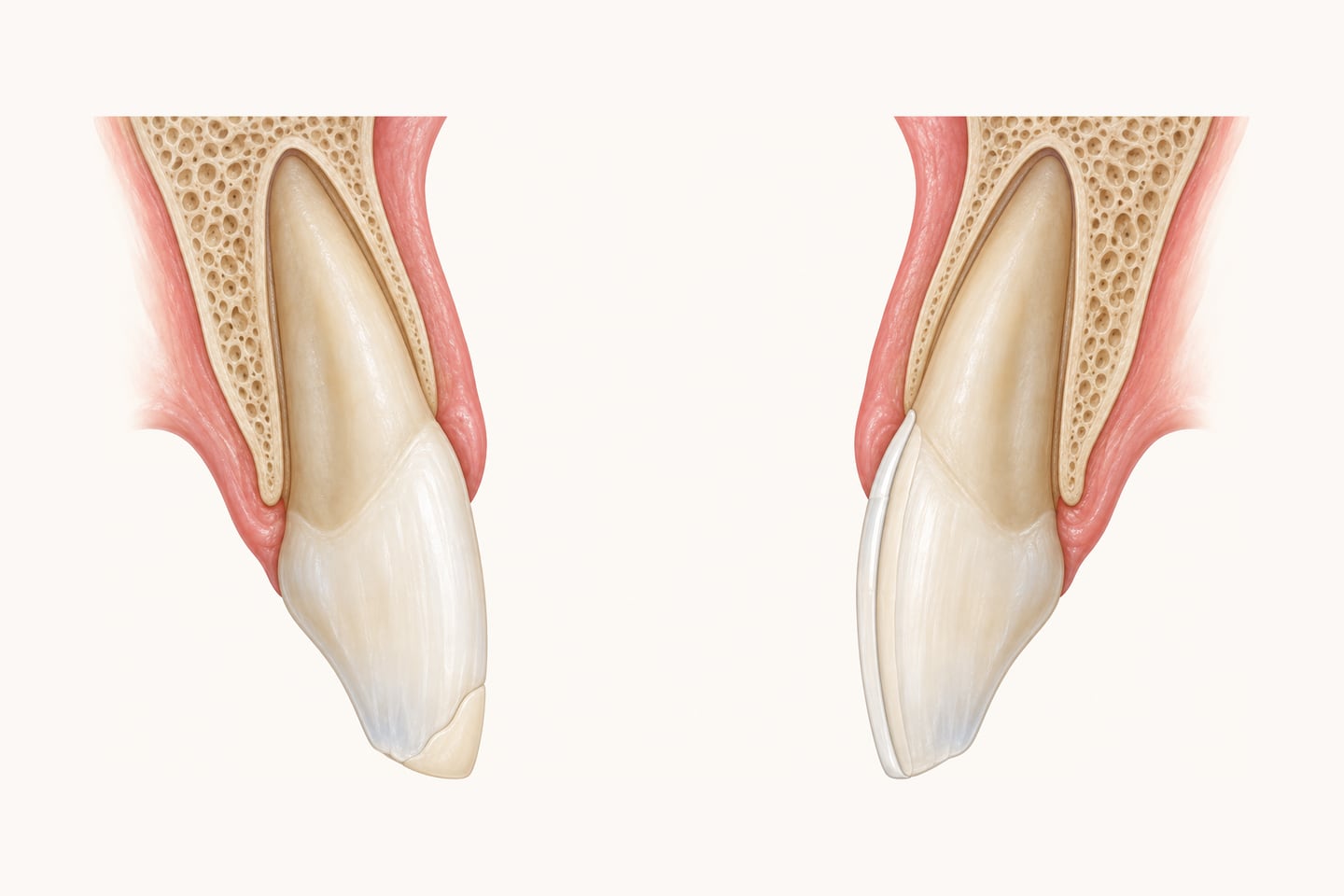
Bonding adds tooth-colored resin to the front of a tooth, usually with little or no enamel removed, so it can generally be undone. A veneer is a lab-made shell, and the American Dental Association classes the treatment as irreversible, since enamel is removed to place the veneer. Bonding costs less, takes one appointment and is repaired in the chair, but it stains and chips sooner. Veneers hold their shade and last longer, and they commit the tooth.
What bonding is
The ADA's description is plain: bonding is a process where the dentist attaches, or bonds, materials directly to your tooth. In practice that means composite resin, the same family of material used for tooth-colored fillings, shaped by hand onto the tooth, hardened with a light and polished. No laboratory is involved, and the tooth needs one appointment.
What a veneer is
A porcelain veneer is a thin shell made outside the mouth, to a shade and shape agreed in advance, then bonded to the front of the tooth. It takes at least two appointments: one to prepare the tooth and take an impression or scan, one to try in and bond the finished piece. Temporaries cover the teeth in between.
Where the two blur
Composite veneers are bonding done across a whole tooth face rather than on one chipped corner. The ADA describes them as tooth-colored filling material bonded to the tooth, needing less enamel removal and fewer visits than porcelain but resisting stain less well. If your question is which material to have your veneers made from, composite versus porcelain veneers answers it. This article is about the decision before that: add material to the tooth you have, or commit the tooth to being covered.
Tooth structure removed
This axis outranks the rest, because it is the only comparison you cannot revisit. The ADA's smile guide draws the line in one sentence: for a veneer, it is necessary to remove a small amount of enamel to accommodate the shell. For bonding, it is not. Bonding on an intact tooth usually needs no anesthetic and no drilling, only a light etching so the resin grips, and taking it off years later leaves broadly the tooth you started with. A prepared tooth is a different story, and what veneers take from the tooth goes through what that commits you to.
Chair time and visits
- Bonding: one appointment. The shaping happens in your mouth while you sit there, so the result depends heavily on the hand doing it. There is no try-in: you approve it as it happens.
- Veneers: at least two, plus laboratory turnaround. Preparation under local anesthetic with an impression or scan, roughly a couple of weeks of laboratory time, then a try-in and bonding appointment. The shape is decided before the piece exists, which is what makes the try-in possible. Add a planning consultation first, and more visits if decay or gum treatment comes first.
Stain resistance
Porcelain wins this clearly. It holds its shade better than natural enamel does. Composite does not: it picks up color from coffee, tea, red wine and tobacco, and the edges where resin meets tooth show it first. Polishing lifts surface stain, but resin darkened through its thickness is replaced rather than cleaned. One caution covers both: the ADA states that whitening has no effect on caps, veneers, crowns or fillings, so any whitening you want should happen before the shade is chosen. Getting that order wrong is the common way a cosmetic result stops matching two years later.
Repairability and how each one fails
- Bonding chips: usually patched. New resin is bonded to the old and polished at the same visit. The repair is rarely invisible up close, and repeated repairs in one spot eventually mean redoing the surface.
- A veneer chips: often replaced. The ADA's account is that a veneer can chip, crack, wear or come loose, and then has to be re-bonded, repaired or replaced. A small edge chip can sometimes be patched with composite, at some cost to the shade match. A crack through the porcelain means a new one.
- Either can come loose. A veneer that debonds intact can sometimes be re-bonded; one that comes away in pieces cannot.
Longevity
Bonding is the shorter-lived option, and good planning treats it as maintenance rather than a fixture. The ADA describes composite resins as providing good durability and resistance to fracture in small to mid-size fillings, and says plainly that no dental filling lasts forever. Porcelain lasts longer and fails differently: bonding dulls and stains before it chips, so you get warning; a veneer holds its look and then fails as an event.
Nobody can give you a number of years for either, and be wary of anyone who does. Bite force, how many teeth are treated and whether you grind all change it. The ADA associates grinding with chipped or cracked teeth and worn edges, and notes that a dentist may recommend a night guard to protect teeth during sleep. If you grind, that guard is part of the plan either way. How long dental crowns last covers the same ground for crowns.
What drives the cost
No prices here, and treat any website that gives you one before an exam with suspicion. Both are quoted per tooth, so the number of teeth is the largest single factor. Bonding is lower per tooth because there is no laboratory: you are paying for chair time and skill. Porcelain carries a laboratory fee on top of two appointments, and treating decay or gum disease first is its own cost.
Then there is the cost you meet later. Bonding redone every few years and porcelain replaced less often land in different places over the long run, so the cheaper option per visit is not the cheaper one per decade. Cosmetic work is rarely covered by insurance, which is why financing (subject to credit approval) is the common route for larger cases. Ask for the figure per tooth, in writing, first.
Who each one suits
Bonding is usually the better fit for
- One chipped corner or a worn edge on an otherwise sound front tooth.
- A narrow gap you want closed without moving teeth, or a single discolored spot rather than a dark tooth.
- Someone who wants to live with a new shape before committing. Composite can be built up, worn a while, then removed.
- Anyone expecting their teeth, gums or plans to change, where a revisable decision has obvious value.
Veneers are usually the better fit for
- Deep internal staining that whitening will not lift, where the shell has to block color rather than tint it.
- Several front teeth brought to one shade and shape at once, or reshaping that changes length and proportion across the smile.
- Someone who wants the color to hold for years, accepts the enamel trade, and would rather not be back for touch-ups.
Neither is the right tool for
- Teeth that are genuinely crooked or crowded. Invisalign and orthodontics move teeth; resin and porcelain only cover them.
- A tooth with a large filling, a crack, or root canal treatment behind it. A crown holds a weakened tooth together in a way neither of these does; veneers versus crowns draws that line.
- Active decay or gum disease, both treated before any cosmetic work begins.
- Teeth that are otherwise fine and simply not as light as you would like. A whitening trial tells you where yours land, and costs the tooth nothing.
The tie-breaker
When both would genuinely work, choose the reversible one. Bonding keeps the veneer decision available to you later; a prepared tooth does not keep the bonding decision available. That asymmetry is the only thing on this list that never reverses.
All four offices list veneers on their treatment menus, and the sorting happens at a cosmetic consultation rather than on a web page. Bring a photograph of the tooth that bothers you and say which matters more: walking it back later, or lasting longer. Request an appointment, or read are veneers worth it if you are still weighing whether to have them at all.