
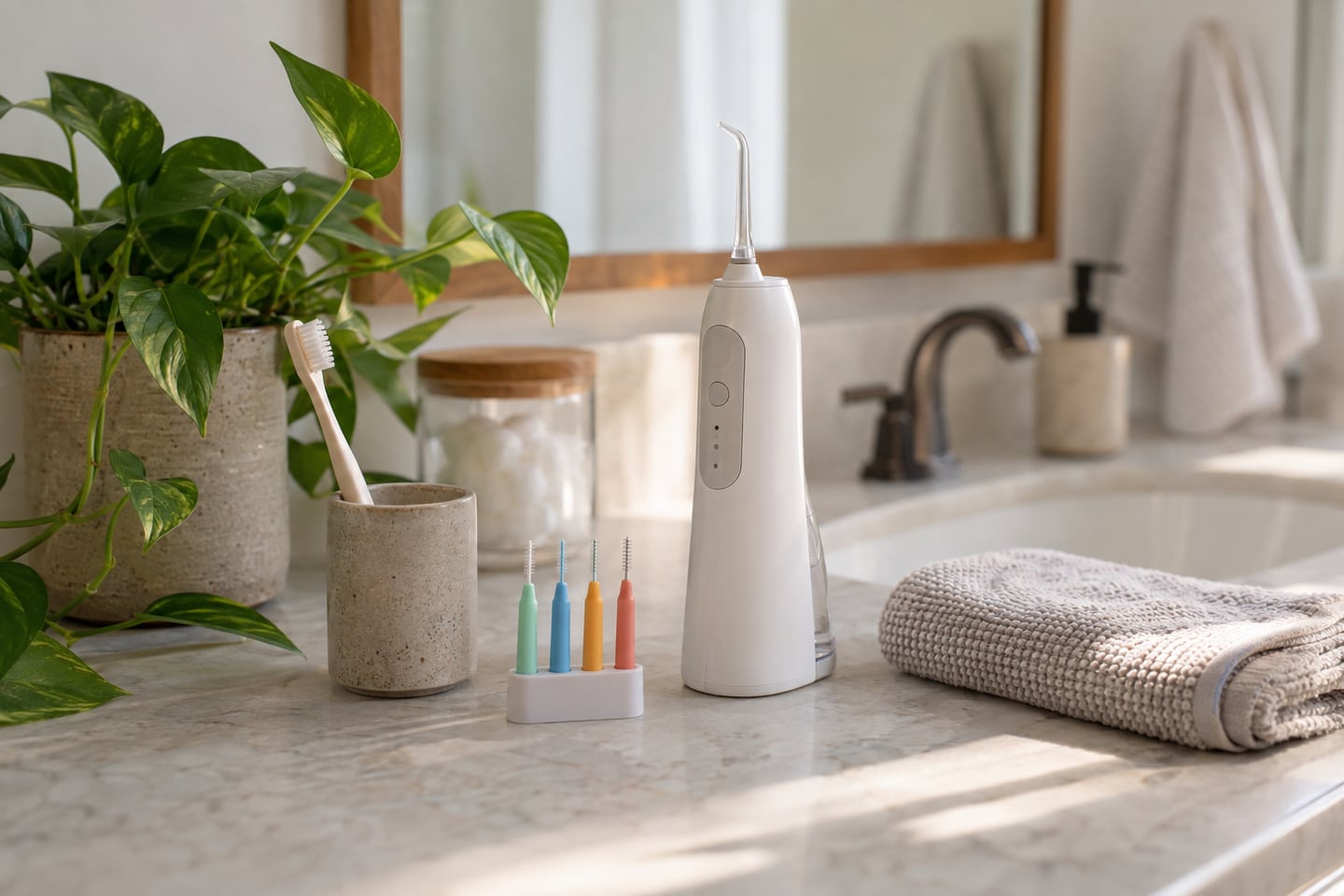
Brush your implant twice a day like any other tooth, and clean under and around the crown where it meets the gum every day without skipping. An implant crown cannot get a cavity; there is no enamel or dentin in it for acid to dissolve. What it can get is an infection of the gum and the bone holding the post, and that is the failure that turns up years later, long after everyone has stopped thinking about the implant. The cleaning you do is not protecting the implant from decay. It is protecting the tissue the implant is standing in.
Can dental implants get cavities?
No. Decay starts when bacteria feed on sugars and starches, produce acid, and the acid pulls minerals out of the tooth's outer surface until it breaks down. NIDCR describes it exactly that way: an acid attack on enamel. A titanium post has no enamel. Neither does a porcelain or zirconia crown. There is no living tooth structure in the restoration for the acid to work on, so no amount of sugar will put a hole in it.
Three qualifications keep that from being the whole answer.
- The teeth beside it still decay. The contact between an implant crown and its natural neighbor is one of the easiest spots in the mouth to skip, and the neighbor is not immune to anything.
- Plaque still collects at the margin. Where the crown meets the gum there is a junction, and bacteria gather there whether or not anything under them can rot.
- Not every implant restoration is a single crown. If a fixed bridge is anchored partly to natural teeth, those anchor teeth can decay at the edges, somewhere you cannot see.
And the qualification that matters most: cannot decay is not the same as cannot fail. The failure mode simply moved from the tooth to the tissue.
The disease that actually ends implants
The American Academy of Periodontology splits it into two stages. In peri-implant mucositis, inflammation is found only in the soft tissue around the implant, with no sign of bone loss. In peri-implantitis, the inflammation is joined by deterioration of the bone supporting the implant. The AAP describes mucositis as generally a precursor to peri-implantitis, and says it may be successfully treated and is reversible if caught early. Peri-implantitis, by contrast, usually requires surgical treatment.
That line between the two stages is the whole point of daily cleaning. The AAP names the risk factors that push people across it: a previous diagnosis of periodontal disease, inadequate plaque control, smoking, and diabetes. NIDCR calls smoking the most significant risk factor for gum disease generally. If any of those apply to you, the candidacy conversation about smoking and diabetes is worth rereading after placement, not only before it.
Here is the uncomfortable part. The early stage does not hurt. The gum bleeds slightly when you brush, looks a little red or puffy, and otherwise behaves. You cannot feel a bone level changing. That is why the appointment interval, not the symptom, decides when this gets caught.
The daily routine
Brushing
Soft bristles, twice a day, two minutes, manual or powered as you prefer. Angle the bristles toward the gumline where the crown comes out of the gum, rather than scrubbing across the biting surface. An implant crown is often shaped a little wider at the gum than a natural tooth, leaving a small ledge that a straight-on stroke sails past. Ask the hygienist to show you where that ledge is on your crown. Most people clean the visible part well and the junction not at all.
Cleaning under and beside the crown, every day
This is the part that decides the outcome, and the part people quietly drop. The ADA's reading of the research is that floss or interdental brushes used in addition to brushing may reduce gingivitis or plaque, with interdental brushes possibly doing better than floss. Any of these works, and the one you will actually use daily beats the one that is technically best.
- Floss. Wrap it in a C shape against the side of the crown and slide it just under the gum edge, rather than snapping it straight down. Floss made for implants has a stiffened end for threading under a bridge.
- Interdental brushes. Let the hygienist size them; too small does nothing and too big hurts. Buy the implant version: the ADA notes that brushes made for cleaning around implants use coated wire, so the wire cannot scratch the implant surface.
- A water flosser. Useful, with a caveat: the ADA describes the evidence for oral irrigators as limited and inconsistent. Treat it as something you add to floss or interdental brushes, not something you swap them for.
Two habits that matter, and one thing that does nothing
- If you grind or clench, wear the nightguard. A natural tooth sits in a ligament that absorbs some force; an implant is fused straight to bone with no cushion, so the load goes into the screw, the porcelain, and the bone. How long implants last follows what a nightly grinding habit does to each of those three over years.
- Keep ice, nutshells, and packaging away from the implant tooth. The crown is the part that chips, and it chips long before anything under it complains.
- Whitening does nothing to the crown. Bleaching gels act on tooth enamel, so porcelain or zirconia holds its original shade while everything around it gets brighter. If whitening is in your plans, do it first and have the crown matched to the result, because the crown will not follow later.
A full-arch bridge is a different job
If your teeth are a fixed full-arch bridge on implants, such as All-on-4, you cannot clean between the teeth in the usual way, because they are one piece. The bridge sits slightly off the gum by design so that you can clean underneath it, and that gap is the entire maintenance plan: a threader with thick floss, a water flosser tip aimed under the span, or the brushes the office fits you with, daily. Neglected for months, the underside of a bridge is where peri-implant disease starts, and several posts are at stake at once rather than one. Ask at delivery whether yours is meant to be unscrewed and cleaned from underneath, and how often.
If you wear a removable implant-retained overdenture instead, take it out and clean both the denture and the attachments in your gum daily. Those attachments collect plaque exactly like a crown margin does.
Warning signs worth a call
- Bleeding when you brush or clean around the implant. The AAP lists bleeding on brushing among the signs of peri-implant disease.
- Gum at that spot that looks red, shiny, or puffy, or feels tender.
- A taste or smell that keeps returning after you clean.
- More metal showing than there used to be, or the gum sitting lower around the crown.
- A crown that feels different: slight movement, a click, or a change in how it meets the tooth opposite.
- Pressure or an ache when you bite on that tooth.
- Pus, or swelling in the gum or cheek. That one is a call today, not next week.
None of these means the implant is finished. Most mean the next visit should be sooner than the one already on your calendar. Waiting is the variable that changes the outcome, because the treatable stage is the quiet one.
How often should an implant be checked professionally?
There is no single interval that fits everyone, and an interval handed to you without a look at your history is a default rather than a plan. Six months is the common default for someone with healthy gums and no history of periodontal disease. Patients carrying the risk factors above are often put on a tighter schedule, three or four months, because that is what catches a problem while it still answers to a cleaning. Regular cleanings and exams continue for the rest of your teeth either way.
What the visit should include, and what to ask for by name:
- Instruments suited to implant surfaces, rather than the steel scaler used on enamel.
- A check of the gum around each implant, gentle probing included, so mucositis is found while it is still mucositis.
- A bite check on the implant crown. Bites shift as other teeth wear, and an implant taking more than its share is a slow problem.
- A periodic X-ray compared against the image taken at placement. The comparison is the point: one X-ray shows a bone level, two a year apart show a direction.
If you have already let it slide
Book the visit before deciding how bad it is. Early inflammation is treated much like gum disease: cleaning below the gumline, a look at what your home routine is missing, and a tighter recall for a while. Later disease is harder, and the AAP is direct that peri-implantitis usually requires surgical treatment. Outcomes vary. Some cases are arrested rather than reversed, lost bone does not reliably come back, and some implants are removed and the site rebuilt before anything can be replaced. That is a reason to make the appointment now, not to avoid it.
What to do next
The visit worth booking is the one where somebody probes the gum around each implant and puts a new X-ray beside the one taken at placement. If nobody has done that within the last year, that is the appointment. Request an appointment and mention the implant in the notes, so the visit is booked with time for the X-ray, the bite check, and someone showing you how to clean your particular crown. If your implant surgery is still ahead of you, the other half of this is what to eat while the site heals.