
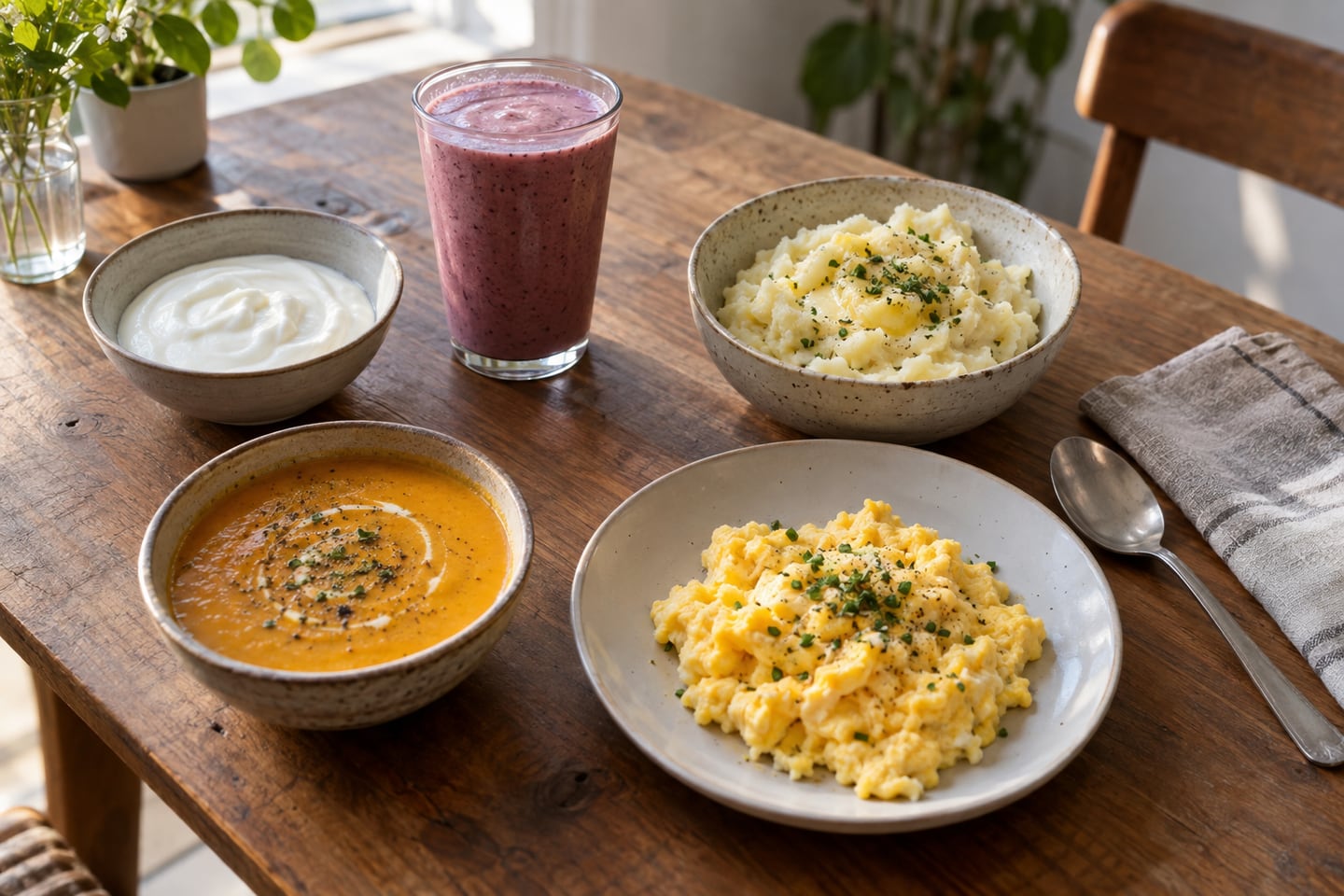
For the first 24 to 48 hours after implant surgery, eat cool or lukewarm food that needs no chewing, drink from a cup rather than a straw, and keep everything on the opposite side of your mouth. From there you move forward by texture rather than by the calendar: soft food you can flatten with a fork for roughly the first week, then back toward normal as the site stops being sore. Hard, crunchy, seedy, and sticky food waits, and if a bone graft was placed at the same time, every one of these windows gets longer. The written instructions from the office override this article, because they describe what was actually done to you.
The first 24 hours: cool, soft, and no suction
Three rules do most of the work on day one. Keep food and drink cool or lukewarm rather than hot. Do not use a straw. Do not chew anything on the surgical side.
The straw rule is not folklore. MedlinePlus is explicit that after a tooth is removed you should not drink from a straw for at least 24 hours, because the suction can disturb the blood clot in the socket and cause bleeding and pain, the condition called dry socket. The ADA gives the same 24-hour instruction and describes dry socket as the clot over the socket being displaced, leaving bone and nerves exposed. An implant site is a surgical wound sealed by a clot in the same way, and if a tooth was extracted at the same visit, the socket rule applies directly. Suction is suction, so the same caution covers dragging on a cigarette or a vape.
Heat is a comfort rule with a practical edge. Warmth increases blood flow to an area that is still trying to stop bleeding and still swelling. There is a duller reason too: your lip, cheek, and tongue may still be numb, and a numb mouth is easy to burn without noticing.
What to actually eat on day one: yogurt, applesauce, cottage cheese, pudding, ice cream, blended soup cooled to lukewarm, mashed potato, hummus, refried beans, ripe avocado, banana, soft scrambled eggs. A smoothie is fine, eaten with a spoon. Sit up while you eat, and drink steadily through the day, because dehydration is what turns a sore afternoon into a headache and a bad night.
Days 2 and 3: keep the texture, add real food
Swelling and stiffness usually peak here, so the texture rules do not change yet. The nutrition should. The common mistake in this stretch is under-eating for two days on broth and ice cream, then feeling shaky and slow to recover. Wounds heal on protein and fluid.
Soft food that is actually food: oatmeal, Greek yogurt, scrambled or poached eggs, silken tofu, ricotta, well-cooked pasta with a smooth sauce, soft-flaked fish, ground meat simmered until it falls apart, lentils cooked soft, canned or thoroughly steamed vegetables, protein shakes from a cup. Chew on the far side. If warm salt-water rinses were part of your instructions, tip your head and let the water fall out rather than swishing and spitting.
MedlinePlus puts the target plainly for the extraction version of this: soft foods such as yogurt, mashed potatoes, soup, avocado, and bananas until the wound heals, and no hard or crunchy food for a week. That is the shape of the first week for an implant too. The week-by-week recovery picture covers what the swelling and soreness should be doing over the same days.
The first week: what to avoid, and the actual reason
- Hard and crunchy food. Nuts, chips, raw carrot, crusty bread, popcorn, ice. Two separate problems: force landing on a post that has not fused to bone yet, and sharp fragments driving into a stitched gum.
- Seeds and small grains. Sesame, poppy, quinoa, rice, strawberry seeds, popcorn hulls. The ones people forget. They lodge in the suture line and under the gum edge, where you cannot see them or easily flush them out, and a trapped particle is an irritated site.
- Sticky and chewy food. Caramel, taffy, chewy bagels, and pizza crust. They pull at sutures and at a healing cap, and they are the classic way people discover something has come loose.
- Spicy and acidic food. Hot sauce, citrus, vinegar, heavy tomato. Not dangerous, simply unpleasant against an open wound. Most people work this out on the first bite.
- Alcohol. It dries the mouth and it interacts with prescription pain medication and antibiotics. Read the labels you were given, or ask the pharmacist, rather than guessing.
- Smoking and vaping. The ADA is direct that tobacco use delays healing and lists avoiding it as part of preventing dry socket. Add the suction of an inhale, and it is the straw problem repeated several times an hour.
- Chewing on the site. Not for a snack, not to test it. If a temporary tooth is sitting over the implant, it is there for appearance and is not built to chew.
Every rule on that list protects the same thing. A dental implant post spends these weeks fusing to the bone around it, and none of that is visible or noticeable while it happens. You are not protecting a crown you do not have yet. You are protecting a join you cannot feel.
How a bone graft changes all of this
A graft changes both the rules and the calendar, and it is the variation most aftercare pages skip. Graft material is granular. For the first days it is held in place by the clot and often by a membrane and sutures, and it has not yet been replaced by your own bone. Anything that applies suction, pressure, or repeated poking can move it. That makes the straw rule, the no-spitting rule, and the leave-it-alone rule stricter rather than optional, and it is why your tongue should stay away from the area no matter how interesting it feels. A few gritty particles in your mouth in the first days is common enough that offices mention it; a steady loss of them, or a sense that the site is emptying, is a phone call.
The soft-food window also stretches. Where a straightforward placement might have you back to most textures in a week or two, graft sites are frequently kept on soft food for several weeks, and the implant itself may be months away. The AAP notes that after a sinus augmentation the bone is usually allowed to develop for four to twelve months before implants can be placed. What bone grafting involves sets out those timelines in full.
If your graft was a sinus lift, the office will add sinus precautions on top of the food rules. These commonly include not blowing your nose, sneezing with your mouth open, and avoiding straws and smoking, because pressure changes act directly on the graft. The exact list varies by surgeon and by technique, so follow the sheet you were handed rather than a general rule from anywhere, including here.
If you wear a denture or a temporary over the site
A removable temporary tooth, sometimes called a flipper, restores the look of the gap and nothing else. Ask whether yours should come out while you eat, because many should. A full or partial denture sitting over a healing implant or graft site is a bigger question: it can press directly on the area, and it usually needs relining or adjusting before you wear it again. A sore spot under a denture during healing is a reason to call for an adjustment, not something to push through. Some full-arch patients leave surgery with a fixed temporary bridge instead, and are given a long, specific soft-food period for it because the whole arch is healing at once. Ask for that period in writing.
When can you eat normally again?
In stages, and later than most people assume. MedlinePlus describes the socket itself taking roughly one to two weeks to heal, which matches how the soft tissue usually feels: comfortable enough for most textures within a couple of weeks. The bone is still growing onto the post for months after the gum looks finished, and until the final crown is fitted there is nothing on the implant designed to chew with.
So the sequence is soft for the first week, mostly normal on the other side within two or three weeks, and full chewing on the implant only once it has been restored and the bite on it has been checked. Testing it early is how a healing cap loosens. Nobody can give you an exact date, because it depends on what was placed, whether anything was grafted, and how your own healing goes.
Signs the problem is not the food
- Bleeding that does not settle after fifteen minutes of steady pressure on fresh gauze.
- Swelling or pain that climbs after the third day rather than easing, or a fever, or a bad taste.
- A healing cap, a temporary, or a piece of the site that comes away while you are eating.
- A lip or chin still numb the day after surgery.
Any of those is a call to the office that did the surgery, not a reason to eat more carefully. If breathing or swallowing is affected, go to an emergency room first. What the ordinary version of the soreness feels like, so you can tell the two apart, is set out in does getting a dental implant hurt.
The shopping list, bought before surgery day
Buy it beforehand. Numb and sore is a poor state to shop in, and you may not be the one driving that day.
- Greek yogurt, cottage cheese, ricotta, pudding
- Eggs, silken tofu, canned lentils or refried beans
- Instant mashed potato, oatmeal, small pasta shapes, and a smooth sauce
- Ripe avocado, bananas, applesauce
- Soup you can serve lukewarm, plus broth
- Protein powder or ready-made shakes, and plenty of water
- Ice cream, for the first evening, when nothing else appeals
At the planning visit, ask the office to walk you through the food timeline for your case and to put it in writing with the number to call. If you are still deciding, request an implant consultation and ask what your recovery would look like, including whether a graft is likely. Once the implant is healed and restored the routine changes completely, and how to clean and care for a dental implant picks up there.