
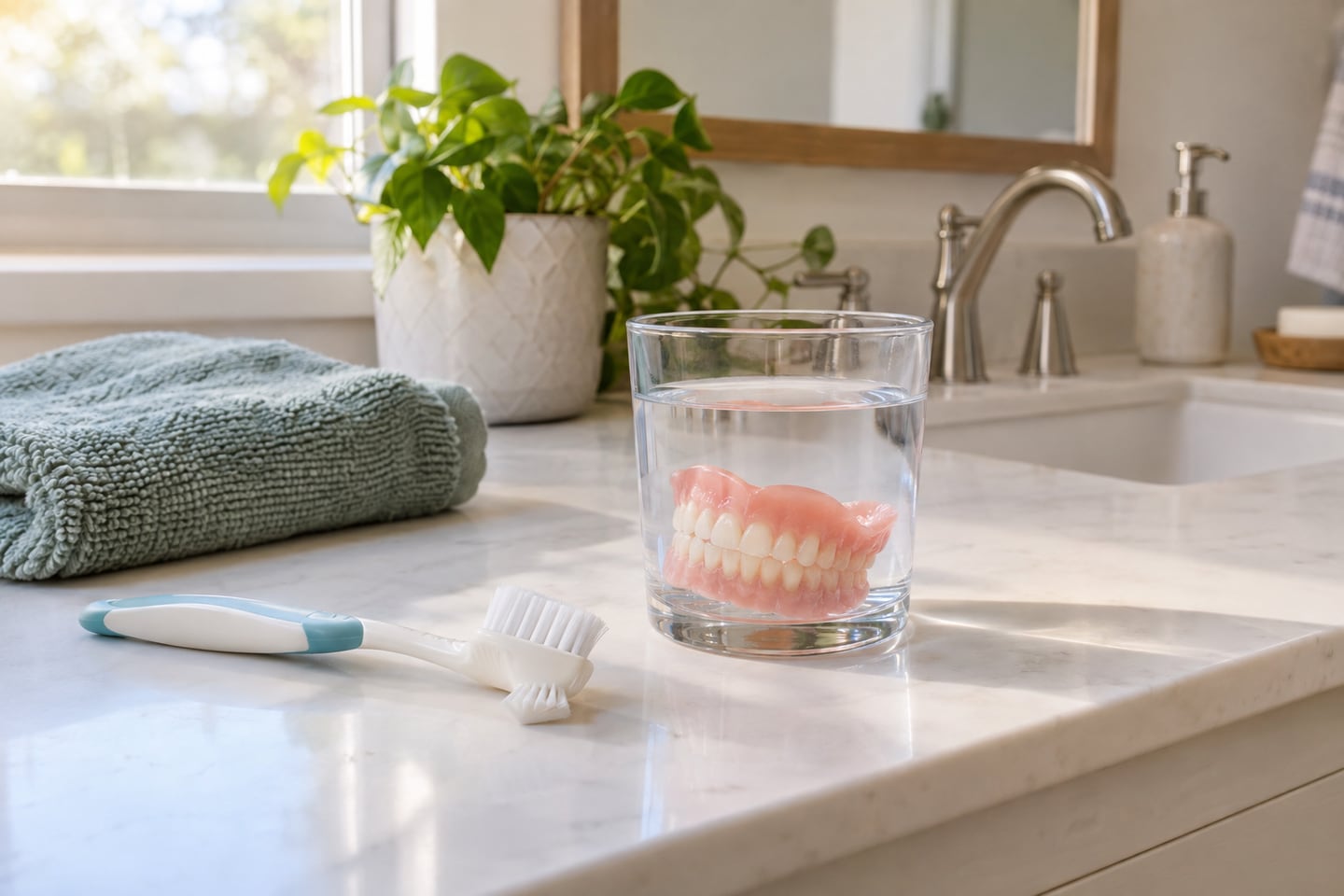
Brush your dentures every day with a soft brush and a cleanser made for dentures, rinse them after meals, take them out overnight, and store them in cool water. Skip toothpaste, which scratches them. Skip hot water, which warps them. And when the fit changes, that is a question for a dentist, not for a thicker layer of adhesive.
The whole routine runs about five minutes a day. What follows is what each part of it is for, because the reasons are what keep people doing it after the first month.
What should you actually clean dentures with?
Rinse first, then brush. The American Dental Association's patient guidance is to rinse dentures before brushing to clear loose food and debris, then use a soft bristle toothbrush and a non-abrasive cleanser to gently brush all the surfaces so they don't get scratched. Look for a cleanser carrying the ADA Seal of Acceptance, which means the product has been evaluated for safety and effectiveness. A brush sold as a denture brush works, and so does an ordinary soft-bristled toothbrush. Hard bristles do damage, so the stiff brush in the back of the drawer is the wrong tool for this, the same way it is the wrong tool for natural teeth.
Brush every surface, including the pink fitting surface that sits against your gums. That surface is where film collects, and it is the one people skip because it is the one nobody sees.
Why not toothpaste?
Toothpaste is built to polish enamel, the hardest material in the body. A denture base is acrylic resin, and the teeth set into it are plastic or porcelain. The ADA's guidance for partial denture wearers is direct about it: avoid toothpaste, because it is too abrasive, and hand soap or mild dishwashing liquid is acceptable instead. Whitening pastes are the most abrasive of all and the worst choice here.
The problem is not that the denture looks dull. It is that scratches give bacterial film somewhere to hold. The ADA notes that accumulated biofilm can contribute to problems in the mouth such as denture-related stomatitis, an inflammation of the tissue under the denture. A scratched denture is harder to get clean every day for the rest of its life.
Why hot water is worse than it sounds
The ADA is explicit: dentures should never be placed in hot or boiling water, because it can cause them to warp. Acrylic softens with heat and does not return to its original shape when it cools. A warped base cannot be bent back, cannot be adjusted true, and has to be remade.
This catches people who are trying to be thorough. Boiling to sanitize, a run through the dishwasher, a soak in water straight from the kettle, a denture left on a sunny dashboard or on a radiator to dry: each one is a reasonable-sounding instinct that ends in a remake. Lukewarm or cool water only.
Brushing or soaking? Both, and they do different jobs
Brushing removes film mechanically. Soaking loosens deposits and stains chemically and reaches surfaces a brush skims over. Neither replaces the other. A denture that is only soaked keeps its plaque; a denture that is only brushed stains and builds up hardened deposits in the fine detail.
Read the soaking product's label before you use it. Not every cleanser is meant for a denture with a metal framework, and the packaging says which are which. If your partial has metal clasps, that sentence on the box is the one to check.
Do you have to take them out at night?
For most people, yes, and there are three separate reasons stacked on top of each other.
- The tissue needs relief. The gum ridge under a denture has no periodontal ligament to cushion it, because the roots that used to load that bone are gone. It carries chewing pressure directly. A denture worn around the clock never gives that tissue a break, and sore spots and thinned, tender areas are the result.
- Saliva cannot reach underneath. The fitting surface seals tissue away from the saliva that normally rinses and protects it. The NIH's dental institute notes that when saliva is reduced, the risk of tooth decay or fungal infections rises. Hundreds of common medicines cut saliva production, including treatments for blood pressure, depression and bladder control, so many denture wearers are starting from a drier mouth than they realize.
- Film builds up. The ADA links accumulated biofilm to denture-related stomatitis. Under an upper denture it shows as a red, sometimes sore palate that maps the exact shape of the plate. It often causes no discomfort at all in the early stage, which is why it is usually found at an exam rather than noticed at home.
Overnight is also when the denture gets stored properly. The ADA's advice is to put a denture in water, or in a cleanser solution, whenever it is not being worn: that keeps it in shape, keeps it pliable, and stops it drying out. MouthHealthy puts the same instruction plainly, to keep dentures covered in water so they do not warp. A denture left on a nightstand in open air overnight is a denture slowly changing shape. Full instructions for a specific denture can differ from the general rule, and the most common exception is the first stretch after an immediate denture is placed over fresh extraction sites, when you may be told to leave it in and have it removed at a follow-up visit. Follow the instruction you were given for your own case.
How do you keep from dropping them?
Dentures break in bathrooms far more often than they break in mouths. Wet acrylic is slippery, and a sink basin, a tile floor and a hard countertop are all unforgiving.
- Clean over a folded towel, or over a basin with a couple of inches of water in it. Either one turns a fall into a bounce.
- Hold the denture by its bulk, not by the thin midline of an upper plate or the narrow bar of a lower. Those are where fractures run.
- Seat a denture with your fingers. The ADA warns never to force a partial denture into position by biting down, because that can bend or break the clasps.
- Keep it in its case when it is out of your mouth, not wrapped in a napkin. Napkins get thrown away, and that is a common way a denture is lost rather than broken.
If it does break, resist the repair kit. The ADA is blunt that do-it-yourself kits and over-the-counter glues are dangerous, and that adjustments and repairs belong with a dentist. Household adhesive contaminates the fracture surfaces, and a contaminated break is harder to bond properly afterward, so a home fix can turn a repairable denture into a remade one. Take the pieces in, including the small ones, and ask what your options are before gluing anything.
What is different about cleaning a partial?
A partial has clasps, and clasps sit right where a natural tooth meets the gum. That is already the highest-risk spot on that tooth, and a metal arm resting against it holds plaque there all day.
- Brush both sides of each clasp and the inner surface of the framework that contacts the tooth.
- Clean your natural teeth first, then seat the partial. Putting a clean partial onto unbrushed teeth just traps the plaque underneath it.
- Rinse the partial after meals when you can. Food lodges under the framework rather than washing away.
- Never bite it into place, however well it seems to line up.
The teeth holding a partial are doing extra work, and they are the ones you cannot afford to lose: losing an abutment tooth usually means the partial is remade or rebuilt. Decay at the gumline of those teeth is common, and a small filling caught early is a far smaller event than an extraction. The ADA also notes that crowns on natural teeth are sometimes needed to improve the fit of a removable partial, so a crown recommendation on an abutment tooth is not necessarily about the tooth alone. How a partial compares with the fixed alternative is covered in implant versus partial denture.
What about your gums, tongue and any teeth you still have?
Losing teeth does not end oral hygiene; it changes what you are cleaning. The ADA's instruction is to brush your gums, tongue and the roof of your mouth every morning with a soft-bristled brush before you insert your dentures, which stimulates circulation in the tissue and helps remove plaque. That takes under a minute and it is the step most often dropped. If you still have teeth, they need the full routine, and they need professional cleanings on whatever interval an exam sets, which is the subject of how often you need a dental cleaning. Gum disease around the remaining teeth is the usual reason a partial stops fitting, so treating it protects the appliance as much as the teeth.
A sore spot means an adjustment, not more glue
New dentures rub. Expect adjustment visits in the first weeks, and treat them as part of the process rather than as evidence something was made wrong. An adjustment is short: the dentist locates the pressure point, often with an indicator paste, and relieves a small area of the fitting surface.
- Wear the denture before the appointment. Several hours at least. If you leave a painful denture out for two days, the tissue looks normal by the time you arrive and the pressure point is invisible, which turns a precise adjustment into a guess.
- Do not file it yourself. A nail file or sandpaper removes material you cannot see the effect of, and changing one area changes how the whole base seats. Home adjustment is the most common way a fixable denture becomes an unwearable one.
- Sores that do not settle need looking at. An ulcer that is still there roughly two weeks after the denture has been adjusted or left out should be examined rather than watched, because at that point the cause may not be the fit. The ADA lists chronic irritation, including oral ulcerations and overgrown folded tissue along a denture edge, among the findings that mean a denture needs replacing.
Why the fit changes: relines
The ADA states it plainly for partials, and the same applies to full dentures: bone and gum ridges can recede or shrink, which leaves a denture fitting poorly. The ridge that supports a denture is bone that no longer has tooth roots in it, and bone that is not loaded through roots slowly remodels away. The change is fastest in the first year after extractions and continues at a slower rate indefinitely.
So a denture that fit exactly at delivery is sitting on a smaller ridge two years later. The denture did not change. The mouth did. A reline adds a new layer of material to the fitting surface so it matches the ridge again, keeping the same teeth and the same shape. Immediate dentures almost always need one within the first year, and that is expected rather than a defect.
The ADA's guidance is that ill-fitting dentures may need to be relined or replaced to prevent oral sores from developing. If loosening is a recurring problem, this is also the point where implant-retained options come up: posts placed in the ridge give a lower denture something to snap onto and keep load on the bone at those sites. Dental implants are not right for every ridge or every medical history, and how the full-arch options compare sets out the trade-offs. Because relines, repairs and remakes arrive on their own schedule, each office arranges third-party financing — each office's lending partners are listed there, and approval is subject to credit review.
The adhesive mistake
This is the expensive one, and it is common. Denture adhesive has legitimate uses. The ADA notes it may be useful for people with dry mouth, and describes three to four pea-sized dollops per denture as the amount. It can help through the settling-in weeks, on a flat lower ridge where anatomy limits how much retention is available, or on a day when you need to speak in public without thinking about it.
What adhesive is not is a fix for fit. The ADA says so directly: denture adhesives are not a remedy for ill-fitting dentures. The gap that adhesive fills is exactly the measurement a dentist would have used to decide a reline was due. Filling it does not stop the ridge from changing; it hides the one signal that the ridge is changing.
The pattern is predictable. A little more product, then more often, then a second tube in the car, then a thick gasket reapplied at lunch. Each step is small and each step postpones an exam, and a poor fit that runs for years is more likely to end in a remake than in the simpler reline it started as. Meanwhile the tissue underneath is carrying uneven pressure the whole time. If you are using more adhesive than you were a year ago, or you now need it when you once did not, that is the appointment trigger. And if you find an over-the-counter reline kit that promises to fix the fit at home, that is the category the ADA calls dangerous.
How long do dentures last?
Five to ten years is the realistic working range for a complete denture, with the important caveat that the appliance usually outlives its fit. The ADA lists more than five years since a denture was made as one of the reasons to evaluate it for replacement, alongside chronic irritation, poor fit, and worn or damaged teeth.
The things that end a denture's useful life are rarely dramatic:
- The acrylic or porcelain teeth wear flatter, so your bite closes further than it was designed to and your chewing changes.
- The ridge underneath has resorbed past what a reline can compensate for.
- Repeated repairs leave a base that is no longer as strong as it was.
- Staining and surface scratching reach the point where daily cleaning no longer restores it.
- Sore spots keep coming back in new places after adjustment, which usually means the base no longer matches the ridge anywhere.
None of these announce themselves. That is why an annual exam still matters with no natural teeth left: the visit checks tissue health, screens for oral cancer, and measures whether the fit still matches the ridge. The appointment does not disappear when the teeth do; it changes what is being examined.
What to ask at your next visit
- Does the fit still match my ridge, or is this a reline year?
- Am I using more adhesive than I should need for this denture?
- Are the teeth worn enough to have changed my bite?
- Is the tissue under the plate healthy, or is there inflammation I cannot feel?
- How old is this denture, and what would replacing it involve?
Come to that appointment wearing the denture, having worn it that morning, rather than carrying it in a case. A sore spot that has been rested for two days is a sore spot nobody can find, and rocking that only shows up under chewing pressure will not show up on a bench. Book an exam when the fit starts changing, not once the adhesive stops working.