
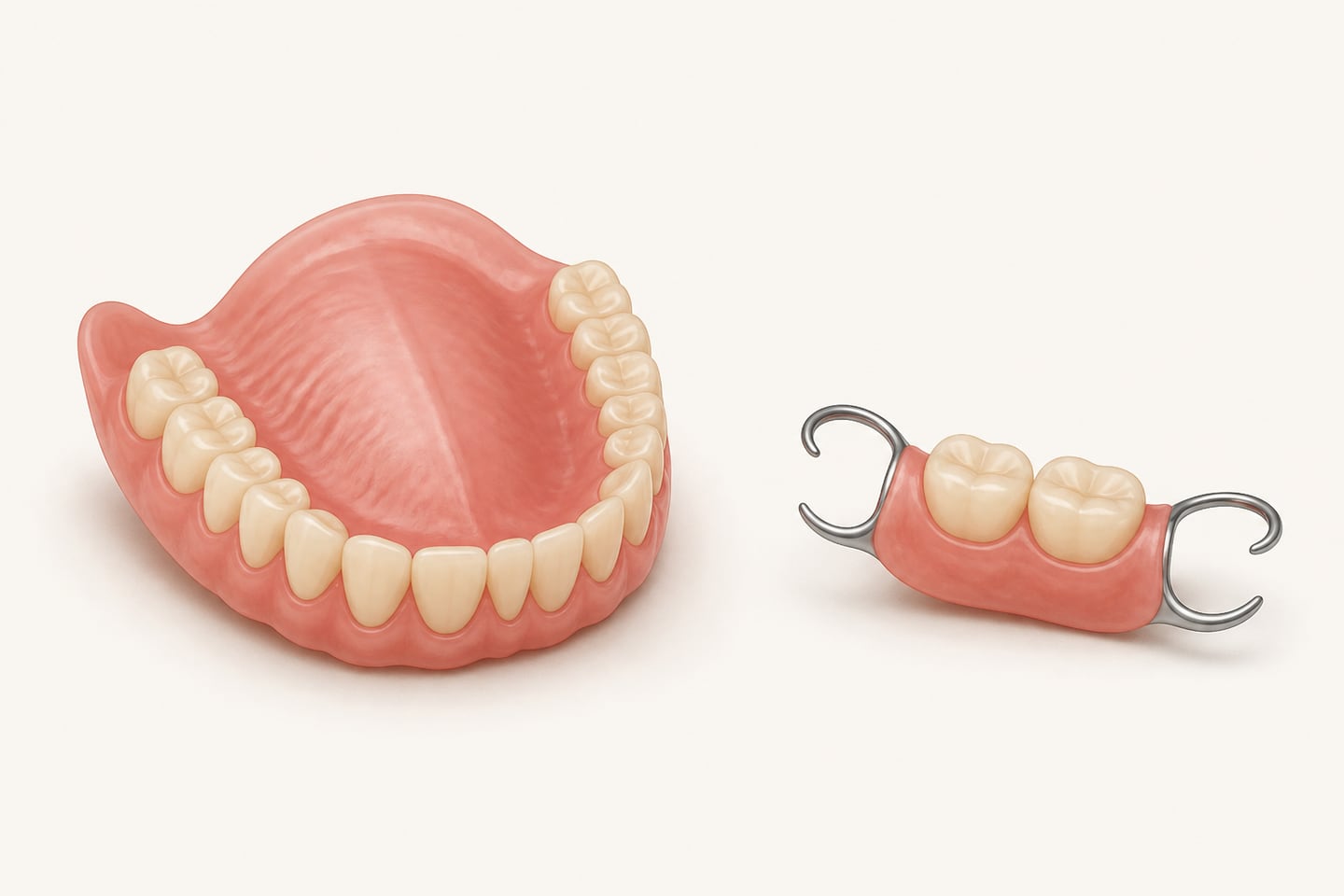
A full denture replaces every tooth in one arch and rests on the gum ridge underneath. A partial replaces some of them and hangs onto the natural teeth you still have. That single difference, whether there are roots left in the jaw to hold onto, drives everything else: how each stays in, how the first weeks feel, what happens to the bone over the years, and how much upkeep you sign up for.
Both are removable. Both come out to be cleaned. If what you actually want is teeth that stay in, that is a different question, and the implant-stabilised options are compared in their own article rather than restated here.
What each one replaces
The full denture
A full, or complete, denture replaces all the teeth in an arch. You can need one in the upper jaw, the lower, or both, and needing one above does not mean you need one below. The ADA distinguishes two routes to it. A conventional full denture is made and placed after the remaining teeth are removed and the tissues have healed, which the ADA says may take several months. An immediate denture is inserted on the day the remaining teeth come out, with measurements and models taken at a preliminary visit beforehand.
The immediate version means you are never without teeth in public. The trade is that the gums and bone underneath change shape a great deal while they heal under it, so it needs relining or remaking once the jaw has settled. Both of those are planned costs, not complications, and they should be itemized before you agree to the immediate route.
The partial denture
A removable partial replaces one or several missing teeth in an arch where natural teeth remain. The ADA describes it as replacement teeth attached to pink or gum-colored plastic bases, and notes that a partial may have a metal framework and clasps that connect to your teeth, or other connectors that are more natural looking. There is a third relative worth knowing about: an overdenture, which the ADA describes as fitting over a small number of remaining natural teeth after they have been prepared, and which exists specifically to keep some roots in the jaw. If your gap is a single tooth, the narrower comparison is an implant against a partial denture.
How each one stays in
A full denture: fit, suction, and saliva
Nothing grips a full denture. It is held by how precisely its base matches your ridge, by suction where it seals against the palate on an upper, and by your cheeks and tongue learning to hold it. The ADA's guidance puts the last piece bluntly: a film of saliva is often all that is needed to hold dentures in place. That is also why dry mouth, which many common medications cause, makes a full denture harder to wear. Bring your medication list to the consultation; it changes the forecast.
An upper full denture has a broad palate to seal against and usually holds well. A lower has a horseshoe of ridge, a tongue moving underneath it, and no seal. Lower fulls are simply harder to stabilise, and that is anatomy rather than a fault in the denture or in you.
Adhesives have a real but narrow role. The ADA says they provide additional adhesion for well-fitting dentures and may be only a temporary solution to the problem of an ill-fitting one, and suggests three to four pea-sized dollops as the amount. Needing steadily more of it is a signal to have the fit checked, not to buy a bigger tube. The ADA also cautions against overusing zinc-containing products.
A partial denture: clasps or attachments
A partial borrows retention from your own teeth. The common version uses a rigid framework with clasps that hook around abutment teeth and rests that sit in small prepared notches, so the appliance is held sideways and stopped from sinking into the gum. Clasps on visible teeth are the usual cosmetic complaint.
The alternative the ADA gestures at, connectors that are more natural looking, generally means precision attachments: a small connector built inside a crown on the abutment tooth, so the partial clips in with no visible metal. It looks better and it holds well. It also means crowning teeth that may not otherwise have needed crowning, which is real, irreversible tooth reduction and belongs in the decision. The same trade appears in the different bridge designs.
The adjustment period
New dentures feel wrong at first, and this is the part people are least warned about. The ADA says new dentures may feel awkward for a few weeks and may feel loose while the muscles of your cheek and tongue learn to keep them in place. For a partial, the ADA's wording is that it may feel awkward or bulky at the beginning, and that this is normal.
- Expect more saliva than usual for the first days, and a feeling of fullness.
- Expect sore spots. They are fixed with short adjustment visits, not by enduring them, and not by filing the denture yourself.
- Eat soft food cut into small pieces at first, and chew on both sides at once to keep the pressure even, which is exactly what the ADA advises for a new partial.
- Read aloud to get speech back. Repeat the words that give you trouble; the sounds return with practice.
- Never force a partial into place by biting down. That bends or breaks the clasps, and the ADA says so directly.
A partial generally takes less adapting to than a full denture, because your remaining teeth still tell your brain where your bite is. Going from natural teeth straight to a full lower denture is the biggest adjustment of any option on this page.
Chewing force with a full denture is meaningfully lower than with natural teeth. Most people get back to a broad diet, and biting into a whole apple or crusty bread with the front teeth stays awkward. Cutting food up is a habit that never fully goes away.
What each does to the teeth you still have
This is where the two diverge most, and it is the part that decides how the next ten years go.
- A partial loads its abutment teeth. Clasps grip them, rests transmit chewing force into them, and the framework holds plaque against them. Those teeth need better hygiene than they did before, not the same. Decay at the clasp line and gum inflammation under the framework are the usual reasons a partial stops working, and neither is the appliance's fault.
- A partial keeps your remaining teeth doing their job. Roots in the jaw hold bone. Natural teeth carry bite force that a gum ridge cannot. Keeping four sound teeth is worth more to the stability of a partial than any material choice made in the laboratory.
- A full denture has no teeth to protect. But an upper full denture opposing a set of natural lower front teeth concentrates force on the front of the upper ridge, which wears it down faster than the rest. If that is your arrangement, ask what the plan is for the lower arch too.
Active gum disease changes this arithmetic before anything else does. A partial anchored to teeth with failing support fails with them, so treating the gums comes first and the plan is drawn afterward. Being told to wait is not a delay tactic.
Bone change over the years
Neither appliance stops the jaw from shrinking under it. The American Academy of Periodontology states that with conventional dentures the bone that previously surrounded the tooth roots will begin to deteriorate. Bone that no longer holds a root gets thinner and lower, slowly and continuously. That is why a denture that fit beautifully at delivery is loose four years later, and why the ADA's own guidance notes that ill-fitting dentures can contribute to mouth sores or, with prolonged use, bone loss.
A partial slows this only where roots remain. Under the saddle that spans an empty area, the ridge keeps resorbing exactly as it does under a full denture. This is the real argument for keeping even a few compromised teeth if they can be made healthy, and it is why the ADA notes an overdenture is used over a small number of remaining natural teeth to preserve the jawbone and provide stability, adding that implants can serve the same function.
If the bone question is what worries you most, that is a reason to read about implant-supported and fixed full-arch options before committing to a conventional route, because switching later means starting the bone conversation from a worse position.
Maintenance, and what it actually costs in effort
- Brush the denture daily with a soft brush and a non-abrasive denture cleanser. The ADA is specific that toothpaste should not be used, because it is too harsh for denture surfaces.
- Brush your gums, tongue and palate every morning with a soft brush, and brush any remaining natural teeth normally.
- Take it out before bed and store it covered in water. Wearing a denture around the clock is how sore spots and fungal irritation start.
- Clean a partial standing over a folded towel or a basin of water, because a dropped denture on a hard floor usually means a repair.
- Expect relines. As the ridge changes, the base has to be refitted to it, and that is routine ownership rather than a failure.
How long each realistically lasts
No single number exists, because the appliance usually outlives its fit. The ADA's denture guidance passes along the American College of Prosthodontists' advice that a denture be evaluated for replacement once more than five years have passed since it was made. Read that as a review interval, not an expiry date: some are refitted and worn well beyond it, and some need remaking sooner because the ridge changed fast.
Partials tend to be ended by their abutment teeth rather than by wear. Lose a clasped tooth and the partial may be added to, or may need remaking. Full dentures tend to be ended by the ridge underneath them changing shape past what a reline can correct.
Which one applies to you
- Some healthy, stable teeth remain in the arch. A partial, almost always, and keeping those teeth is worth real effort.
- A few teeth remain but they are failing. A full consultation covers all of it: treating and keeping them, an overdenture over prepared roots, a partial now and a full later, or clearing the arch. Each has a different ten-year shape, and no one should pick for you without showing you all four.
- No teeth remain in the arch, or none can be saved. A full denture, immediate or conventional, with implant stabilisation as the separate question of whether it should snap onto something.
- A removable appliance is unacceptable to you. Say that out loud at the consultation. It changes the plan, and it is a legitimate thing to want.
Who does poorly with each
Not everyone is a candidate for the option they came in wanting, and the exam is what says so.
- A partial anchored to loose or heavily decayed teeth is building on sand. Those teeth get treated or removed first.
- A severe gag reflex makes an upper full denture with full palate coverage very hard to tolerate, and it is better raised before impressions than after delivery.
- Severe lower ridge resorption leaves almost nothing for a lower full denture to sit on. Adhesive does not solve this; implant anchorage often does, where the bone allows it.
- Anyone who will not take the appliance out and clean it daily will do badly with either one, and worse with a partial, because the teeth it grips pay the price.
- Dry mouth from medication undermines the saliva film a full denture relies on. It is manageable, and it should be discussed rather than discovered.
What to ask at the consultation
- Can any of my remaining teeth be saved, and what would that take?
- Am I being offered a partial, a full, or an immediate denture, and why that one?
- How many adjustment visits are included, and what happens after those run out?
- When would you expect the first reline, and is it in this quote?
- If I clasp this partial to that tooth, what is the plan if that tooth is lost?
- What would change if I added implant support later, and does that get harder if I wait?
Ask for a try-in before the finished denture is made, and say something at that appointment if the shade, the tooth position, or the fullness of your lip looks wrong. Changes are straightforward then and awkward afterward. Payment can run through third-party financing — lender rosters differ by office and approval is subject to credit review. When you are ready to have your own arch looked at rather than the general case, request an appointment and bring the medication list.