
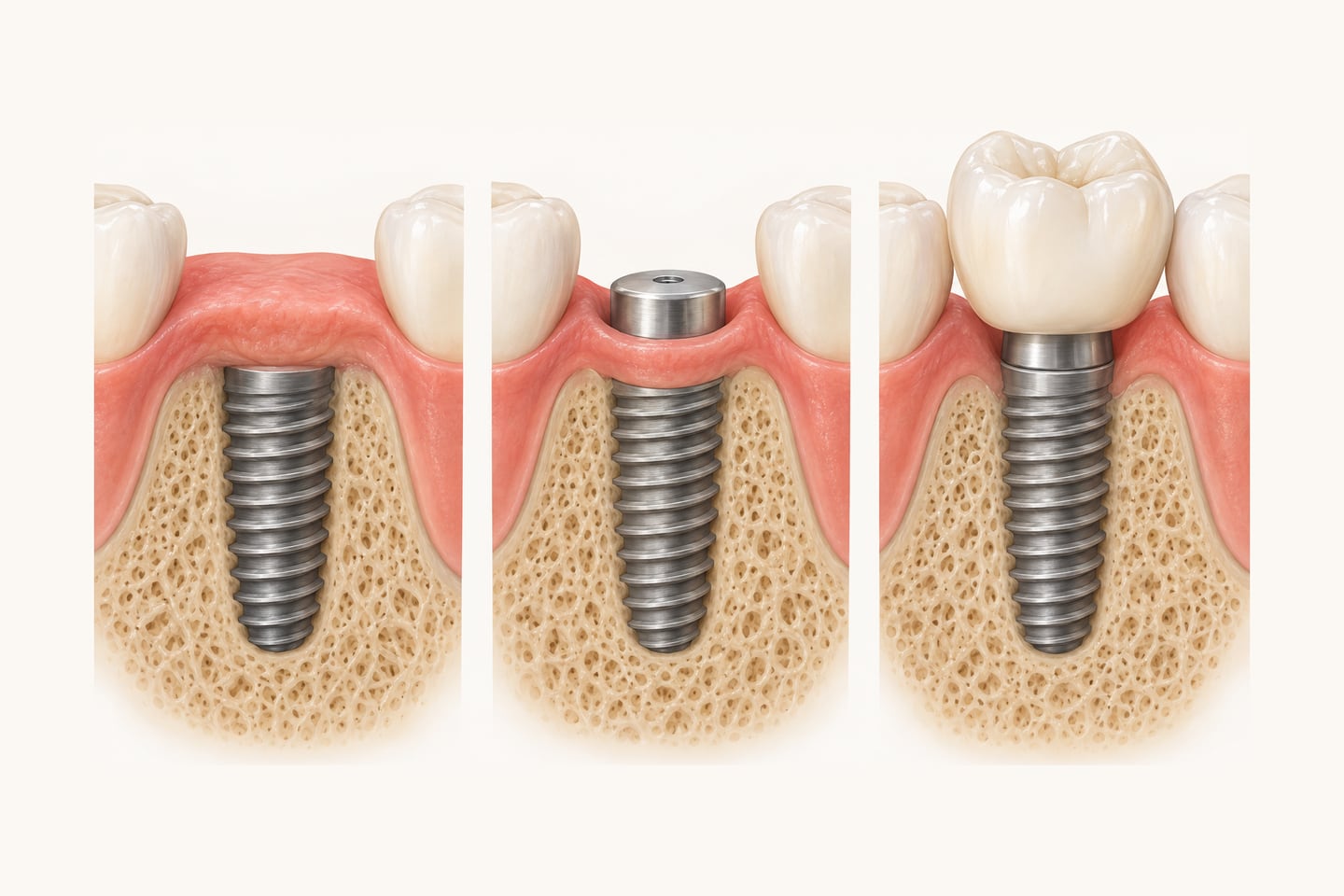
For a straightforward single implant placed into bone that has already healed, plan on roughly four to eight months from the consultation to the final crown. If the tooth has to come out first, six to twelve months is common. If a bone graft or a sinus lift is needed, a year or more is normal. Which of those three you are in is a fact about your jaw rather than about the office's calendar, and the X-ray at the consultation is what settles it.
Why a single number would be dishonest
Almost none of the elapsed time is appointments. Add up the chair time for a single dental implant and it is a few hours across the whole project. Everything else is waiting: for a socket to fill in, for graft material to be replaced by your own bone, for the post to fuse to the jaw, for a laboratory to build a crown. Those waits are biological, and they vary from person to person. So the useful form of the answer is a range with the reasons attached.
The part of the schedule nobody can negotiate
The post has to fuse to the bone before it can carry a tooth. The American Academy of Periodontology describes the implant and the bone bonding over roughly two to six months. The American Dental Association's patient guidance puts it as some patients waiting until the implant is fully integrated, up to several months, while others can have the implant and the replacement tooth placed in one visit.
That two-to-six-month spread is the core of your timeline. Where you land inside it depends on bone density at the site, how stable the post was the moment it was placed, and your own healing. It cannot be shortened by paying more or by asking.
A rough calendar for the simplest case
One tooth, bone already healed, no graft, no extraction:
- Week 0: consultation, X-rays, and a three-dimensional scan.
- Weeks 2 to 6: the post is placed. That gap is scheduling, not healing.
- Seven to ten days later: a short visit to check the gum and remove stitches.
- Months 2 to 6 after placement: the bone fuses. No appointments, or one brief check.
- In some plans: a short visit to uncover the post, then a couple of weeks for the gum to settle.
- Two to four weeks after the impression: the crown is fitted.
Four to eight months is the realistic window. The low end assumes fast integration and a one-stage plan; the high end assumes the two-stage version and a slower fuse.
What makes it longer
The tooth has to come out first
If the post can go into the socket at the extraction appointment, the extraction costs almost no extra time. If it cannot, the socket heals first, commonly for a few months, and that is the most common reason a four-month plan turns into a nine-month one. What decides which of those you get is a question about the socket, and part of it cannot be answered until the tooth is actually out.
A bone graft or a sinus lift
A small graft placed at the same time as the post adds little. A separate graft is different: the material has to be replaced by your own bone before an implant can anchor in it, which takes months on its own, and only then does the two-to-six-month fusing period begin. The AAP describes sinus augmentation for upper back teeth, raising the sinus floor and developing bone, and ridge modification, filling a jaw defect with bone or a substitute. After a large sinus graft, eighteen months from first consultation to final crown is not unusual. What grafting involves, and which type applies to which site is its own article.
Gum disease that has to be treated first
The AAP lists healthy gum tissue free of periodontal disease among the marks of a good implant candidate. If an exam finds active disease, treating it comes first and the site is re-evaluated afterward, usually a matter of weeks to a few months. That is time well spent: the same infection that loosens a natural tooth attacks the bone around an implant.
Smoking, and blood sugar that is not well controlled
The ADA notes that using tobacco can slow healing and that chronic conditions such as diabetes may interfere with it. The NIH's dental institute is blunt about the mechanism: people with poor blood glucose control get gum disease more often and more severely than people whose diabetes is well controlled. Neither is an automatic disqualification, and what actually gets assessed is worth reading if either applies to you. Both push the healing months toward the long end of every range here.
Which tooth, and which jaw
Lower jaw bone is generally denser than upper jaw bone, and denser bone tends to hold a post firmly sooner. Upper back teeth sit under the sinus and are the likeliest site to need extra bone. Front teeth rarely take longer to fuse, but they usually take more visits at the end, so the calendar runs longer anyway.
The laboratory and the calendar
Crowns are made by hand in a laboratory, usually over a couple of weeks, and a remake after a shade or fit issue adds another round. Holidays, a custom abutment, and your own availability all add days no clinical plan accounts for.
What makes it shorter
- Placing the post at the extraction appointment, when the site allows it.
- A one-stage plan, which skips the uncovering visit and the two weeks of gum healing after it.
- Dense bone and good stability at placement, which is what lets a dentist restore at the earlier end of the two-to-six-month window.
- Being a non-smoker in well-controlled general health.
A full arch runs on a different clock
Replacing every tooth in a jaw is not several single implants added together. All-on-4 and similar full-arch plans concentrate the surgery into one longer appointment and often fit a fixed temporary bridge within days, so you are not without teeth. The final bridge is made months later, once the posts have integrated. The AAP describes the same two-to-six-month bonding period for full-arch cases. You look finished early and are finished late. How the full-arch options compare covers the trade-offs.
If months are the dealbreaker, say so out loud
Time is a legitimate reason to choose something else. A dental bridge typically finishes in two to three appointments over a few weeks, at the cost of shaping the teeth on either side. A partial or full denture is faster still. Neither holds the bone at the site the way an implant does, which is the trade you are making. Implants versus bridges lays that comparison out properly.
This is a different question from two others
How long treatment takes is not how long recovery takes. Recovery is how you feel after the surgery: soreness peaking in the first days, back to routine in about a week, set out stage by stage in implant recovery week by week. Neither is how long an implant lasts, which is measured in years and depends almost entirely on cleaning and checkups. Treatment is months. Recovery is days to weeks. Lifespan is years.
When taking longer is the right call
Some delays are worth choosing: treating gum disease before placement, giving an infected socket real time to heal, letting a graft mature instead of pushing a post into soft bone, or waiting until a young patient's jaw growth has finished. Each trades months now against the chance of redoing the work later. A dentist who offers to compress your timeline should be able to say which step is being shortened and why that is safe in your case.
How to get a real number for your own mouth
The exam and the scan produce it. Ask for the phases written on a calendar: extraction, if any; graft, if any; placement; integration; restoration. Ask what each depends on, what would extend it, and what happens if one does not go to plan. A timeline with no contingency in it is a sales document, not a treatment plan.
Because treatment runs for months, payment often can too: every office offers third-party financing — approval is by the lender, and each office has its own roster. The visit-by-visit version of everything above is in the implant procedure step by step. When you want a date instead of a range, request an implant consultation and bring your medication list, because it is one of the few things on this page that can move the healing months, and it is the thing most often left at home.