
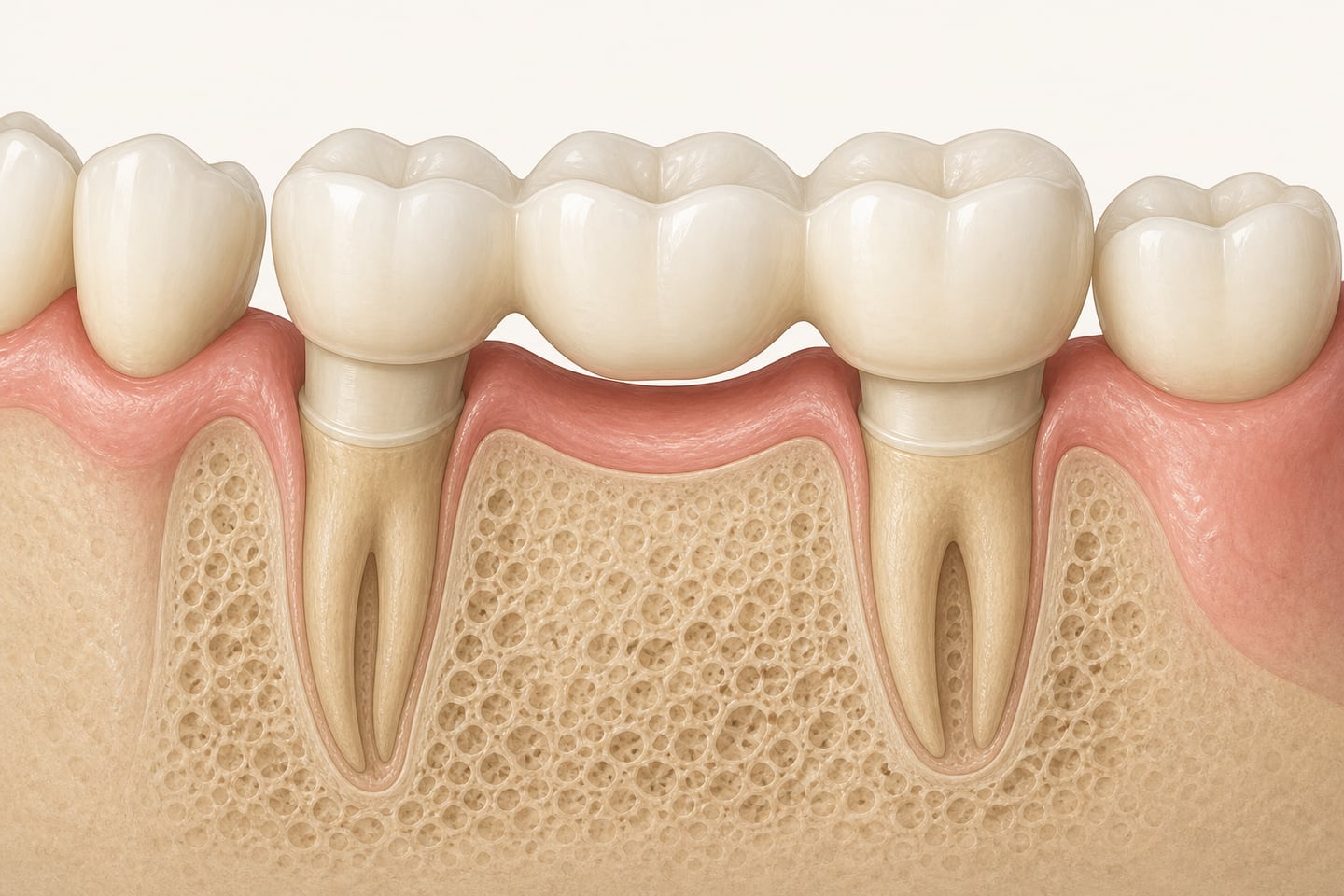
Four bridge designs are in common use, and what separates them is what holds the false tooth up. A traditional bridge is cemented onto crowns cut into the teeth on both sides of the gap. A cantilever hangs from a crown on one side only. A Maryland bridge is bonded to the backs of its neighbors with thin wings. An implant-supported bridge rests on posts placed in the jaw and touches no natural tooth.
Which one suits a gap is mostly decided by the gap: which teeth are still standing, what condition they are in, how wide the span is, and how much chewing force lands there. What follows is what each design asks of your mouth, including the cost that rarely appears on a treatment plan.
The parts every bridge has
The American Dental Association calls a bridge a fixed partial denture, and describes it as replacing missing teeth with artificial teeth that literally bridge the gap where one or more teeth used to be. The false tooth in the middle is a pontic. Whatever grips the teeth or implants on either side is a retainer, and the tooth or implant underneath is an abutment. The whole thing is made as one connected piece, so ordinary floss cannot pass between its parts, which is the single biggest change to your daily routine. A dental bridge of any design is fixed: unlike a removable bridge, the ADA notes, a fixed bridge can only be removed by a dentist.
The ADA lists gold, alloys, porcelain, or a combination of these as bridge materials. Which category fits a given case depends on where the bridge sits, how much room there is between your jaws, and how hard you bite. Ask what your bridge will be made of and why that material was chosen for your case.
Traditional bridge: crowns on the teeth either side
This is what most people mean by the word bridge. The teeth on both sides of the gap are numbed and reduced on every surface, crowns are made to fit over them, and the pontic is joined between those crowns. The ADA puts the mechanism plainly: crowns can also be used to attach bridges. Two crowned teeth carry a third tooth between them, cemented as one unit.
It is fixed, it involves no surgery, and it finishes in a handful of visits over a few weeks rather than the months an implant needs. For a single missing tooth with solid teeth on both sides and healthy gums, it works, and it has worked for a very long time.
The part most pages skip
Preparing an abutment tooth for a crown removes healthy enamel and dentin, and none of it grows back. The American Academy of Periodontology states it without softening: a tooth-supported fixed bridge requires that adjacent teeth be ground down to support the cemented bridge. If those two teeth were sound, you have spent two intact teeth to replace one missing one, and both will need a crown of some kind for the rest of their lives. Whether that trade is worth making is the real decision, and it is worth making before anyone picks up a handpiece.
A second cost rides on the first. A tooth prepared for a crown sometimes reacts with nerve inflammation and needs root canal treatment afterward. It is uncommon and it is not predictable in advance, which is exactly why it belongs in the conversation rather than in a surprise phone call three months later.
The calculation changes completely when the neighbors are already broken down, cracked, or carrying large old fillings. Then the crowns were going to happen anyway and the bridge puts that work to double use. That is a traditional bridge at its most sensible, and it is a very different proposition from cutting into two untouched teeth. If you are unsure which situation you are in, what a crown appointment actually involves gives you the other half of the picture.
One more thing a traditional bridge does not do: it does not replace the root. The AAP notes that with a bridge, some of the bone that previously surrounded the tooth begins to resorb or deteriorate. Years later that can open a visible space under the pontic.
Cantilever bridge: anchored on one side only
A cantilever has its abutment or abutments on one side of the gap and nothing on the other. The pontic hangs off the end the way a balcony hangs off a wall. Preparation is the same crown preparation as a traditional bridge, on fewer teeth, so it spends healthy tooth structure from one or two teeth instead of two.
The physics are the trade. Every bite on the unsupported end levers the abutment, trying to tip it or break the cement seal, and a leak under a crown is where decay starts. So cantilevers are used sparingly, kept to a single pontic, and generally kept away from the back of the mouth where chewing forces are highest. Where they do appear it is usually toward the front, in a light bite, with only one usable neighbor.
A cantilever is a reasonable answer to a specific problem: a gap with a sound tooth on one side and nothing worth anchoring to on the other. It is a poor answer to a molar gap in a grinder.
Maryland bridge: bonded wings, little or no drilling
A Maryland bridge, also called a resin-bonded bridge, swaps the crowns for thin wings bonded to the inside surfaces of the teeth on either side. Preparation is minimal, and in some designs there is none at all. It is the only bridge that leaves the neighboring teeth essentially as it found them. Single-wing versions bond to one side only.
It buys that restraint with grip. A wing holds by adhesion to enamel rather than by wrapping the whole tooth, so it debonds more readily than a cemented crown. That is partly a feature: when a Maryland bridge fails it usually comes off intact, it can often be cleaned and rebonded, and the teeth underneath are still whole. A failed traditional bridge leaves you with two prepared teeth and no way back.
It tends to be used for a missing front tooth in a mouth with healthy, largely unrestored neighbors and a bite that does not load the area hard, and as a long-term placeholder for a young patient whose jaw is still growing and who is not ready for an implant. It is a poor fit for heavy grinders, for a deep bite where the lower teeth strike the wing edge-on, and for back teeth.
Implant-supported bridge: nothing borrowed from the neighbors
Here the abutments are dental implants rather than teeth. Two or more posts are placed in the jaw, left to fuse with the bone over months, and a bridge is made to sit on them. The ADA describes an implant bridge as attaching artificial teeth directly to the jaw or under the gum tissue. No natural tooth is touched.
That is the whole argument for it, and it is strong. The AAP notes that because an implant replaces the tooth root, the bone is better preserved. An implant-supported bridge also solves spans a tooth-supported bridge cannot: several missing teeth in a row, or a gap at the very back of the arch with no rear tooth to anchor to.
The costs are time, surgery, and bone. Placement is a surgical appointment, the fusing period runs months before anything is built on top, and there has to be enough bone at each post site or grafting comes first. Not everyone is a candidate, and an exam with a three-dimensional scan is what settles it.
Which design tends to go where
- One missing tooth, sound teeth on both sides. An implant or a Maryland bridge preserves those neighbors. A traditional bridge is the option that spends them.
- One missing tooth, neighbors already needing crowns. A traditional bridge does two jobs at once and is genuinely efficient here.
- A missing front tooth, healthy neighbors, light bite. Maryland territory, and often the most conservative real option.
- A gap with a usable tooth on one side only. A short cantilever, if the bite is light, or an implant.
- Several missing teeth in a row, or the last tooth in the arch. Implant-supported. A tooth-supported bridge with a long span puts more load on its abutments than they were built to carry.
What actually ends each design
- Traditional and cantilever: decay at the crown margins, which hides under the crown and can be advanced before anything hurts. This, not fracture, is the usual cause of failure.
- Maryland: debonding, usually of one wing, usually recoverable.
- Implant-supported: gum inflammation and bone loss around the posts, plus the mechanical failures that come with parts, such as a loose screw or a chip in the surface material.
- All four: neglect of the space underneath the pontic, where plaque collects against the gum and the abutments.
Cleaning under a bridge takes a floss threader, super floss with a stiff end, or a water flosser, once a day, on top of ordinary brushing. Your hygienist should show you the technique the day the bridge is delivered. It is the single biggest factor you control in how long any of these lasts.
When doing less is reasonable
A bridge is not compulsory. A single missing tooth at the very back of the arch, with no tooth behind it, sometimes gets monitored rather than replaced, and that can be a defensible plan. What is not defensible is drifting into it by accident: an unfilled gap lets neighboring teeth tilt in and the opposing tooth drift down, which is covered in what happens while you wait to replace a missing tooth and, for molars specifically, in why a missing back tooth matters. Choosing to leave a gap should be a decision with a review date attached, not a default.
What to ask before any tooth is prepared
- Which of the four designs is this, and why that one for my mouth?
- Are the abutment teeth healthy right now, or do they already need crowns?
- How much of each abutment tooth is being removed, and is any of it reversible?
- What is the plan if an abutment tooth needs root canal treatment after preparation?
- How do I clean under it, and can someone show me before I leave with it?
- If this fails in ten years, what are my options then?
That last question is the one that separates the designs. A Maryland bridge that fails leaves you with your own teeth. A traditional bridge that fails leaves you with two prepared teeth and a shorter list. Ask for the design to be named in writing on the plan, and for the bridge-versus-implant comparison to be laid out side by side before the first appointment. Treatment can be paid for through third-party financing, subject to credit approval, with lenders that differ by office. When you want the comparison done on your own X-rays, request an appointment at the office nearest you.