
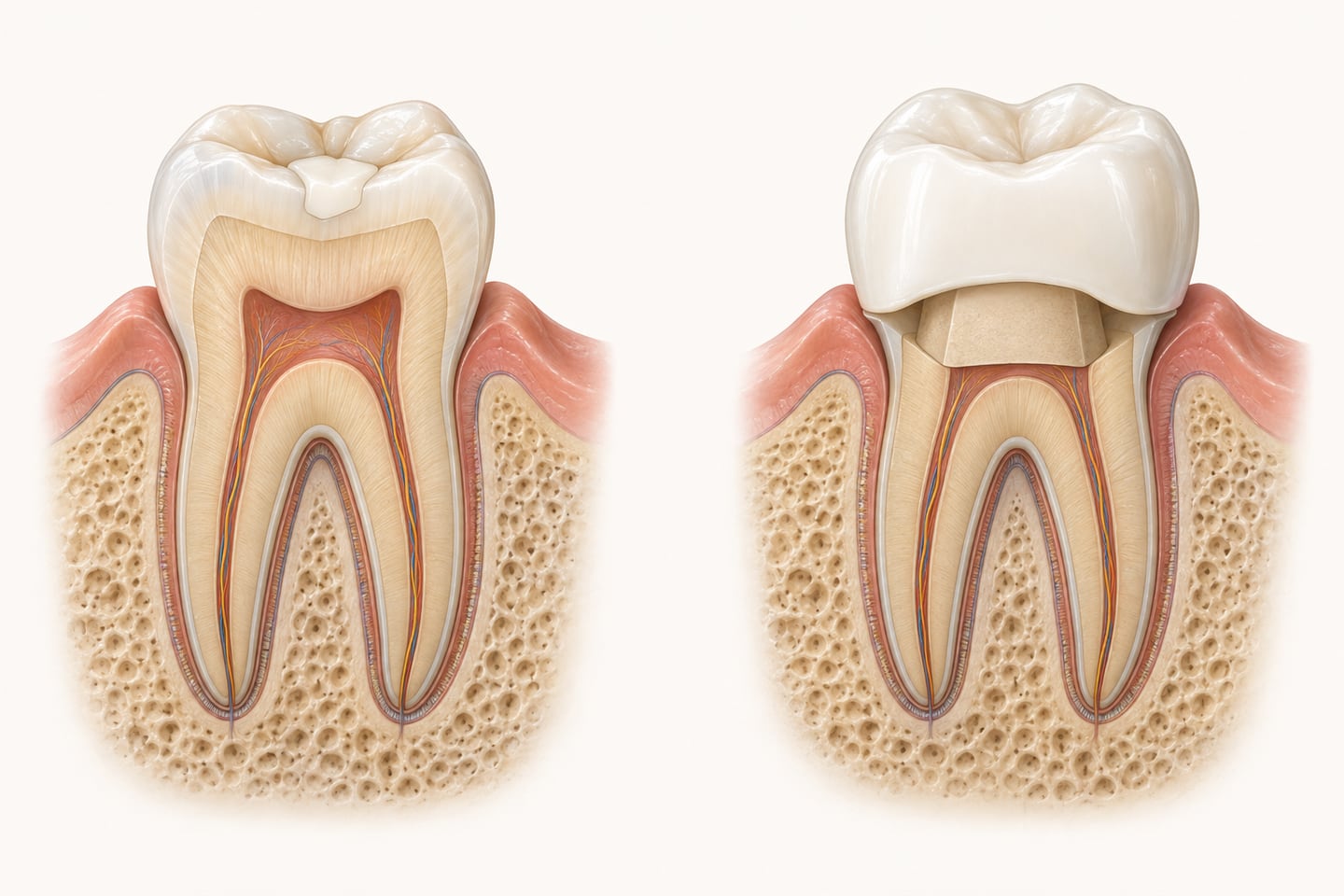
A filling replaces the part of the tooth that is missing. A crown covers what is left of the tooth and squeezes it together. Which one a tooth needs comes down to four things: how much sound structure remains, whether the tooth is cracked, whether it has had root canal treatment, and where your bite lands on it. Neither one is better in general, and any dentist who answers the question before looking at an X-ray is guessing.
What each one actually does
A filling fills a space
With a filling, the decayed or broken part is removed and the space left behind is packed or bonded with a material that hardens into the shape of the missing piece. The tooth's own walls stay where they are and keep doing the structural work. The ADA describes tooth-colored composite resin as durable and fracture-resistant in small to mid-size fillings that take moderate chewing pressure, which is a precise way of saying a filling's job has a size limit.
The ADA is explicit that choosing among filling materials is your decision to make with your dentist, not something handed to you. Which ones a given office keeps on hand is a question for that office.
A crown covers a tooth
A crown is a shell. The tooth is reduced on every side, an impression or a digital scan is taken, and a cover is made to fit over the whole tooth above the gumline. That cover then carries the chewing force and holds the remaining tooth inward instead of letting it flex outward. The ADA lists the usual reasons: strengthening a tooth with a large filling when not enough tooth is left to hold that filling, protecting a weak tooth from breaking, and restoring one that has already broken.
The four things that decide it
1. How much sound tooth is left
This is the main one. Picture a molar as a box with walls. A filling works while the box still has walls of reasonable thickness; the filling sits inside and the walls hold. Once a wall is thin, undermined by decay, or gone, the filling has nothing to lean against. Worse, every bite drives a large filling downward like a wedge and pushes the remaining walls apart.
There is no single measurement that flips the decision, which is why two dentists can look at the same tooth and land in different places at the margins. What they are judging is how thick the walls are, how far the old restoration runs down between the teeth, and whether the cusps still have solid tooth underneath them.
2. Whether the tooth is cracked
A crack changes the answer completely. The American Association of Endodontists sorts them into craze lines, which affect only the outer enamel and are extremely common in adult teeth; a fractured cusp, where a piece of the chewing surface breaks off, often around a filling; a cracked tooth, where the crack runs from the chewing surface down toward the root; a split tooth, where the segments can be separated; and a vertical root fracture, which starts in the root and travels up. What to do in the first day after a tooth cracks is a separate question from what fixes it.
A filling does not stop a crack, because a filling does not hold anything together. A crown can, by binding the segments so they cannot flex apart under load. The AAE is careful about how far that goes: a crown gives a cracked tooth the most protection available, and it still does not guarantee success in every case. A split tooth or a vertical root fracture is usually past saving, and no crown changes that.
3. Whether it has had root canal treatment
Root canal therapy takes the nerve and blood supply out of the inside of the tooth and seals the canals, and the access opening cut through the chewing surface removes more structure on the way in. The AAE describes the tooth afterward being restored with a crown or a filling for protection. For a molar or premolar carrying grinding force, that generally means a crown. For a front tooth with a small access opening and an otherwise intact body, a filling is often enough. Why the second step protects the first goes into the timing, which matters more than most people are told.
4. Where the chewing force lands
Molars and premolars take the heaviest load, and they take it straight down through the cusps, which is exactly the direction that splits a weakened tooth. Front teeth take a shearing force at an angle and much less of it. The same amount of damage in a molar and in an incisor does not produce the same recommendation, and that is not inconsistency.
If you grind or clench, add a level to everything above. Grinding loads a restoration for hours at a stretch, and it is a common reason for full coverage on a tooth that would have been a filling in a different mouth.
Side by side
Tooth structure removed
- Filling: only the damaged part, plus a small amount of sound tooth to give the material a clean edge to bond or pack against.
- Crown: a layer from every surface of the tooth, all the way around and off the top, to make room for the shell. This is the real trade, and it does not reverse.
Durability under chewing force
- Filling: good while the surrounding walls are sound. A filling relies on the tooth; it does not support it.
- Crown: carries the load itself and protects what is underneath. This is the reason to accept the structure loss.
Appointments
- Filling: usually one visit, start to finish.
- Crown: commonly two, with a temporary crown in between while a laboratory builds the final one. Some practices mill a crown in the office instead. Ask the office you plan to visit which applies, because it changes the visit count.
What drives the cost
No price appears on this page, but the drivers are worth knowing so a quote makes sense when you see one. A filling is priced mostly by how many surfaces of the tooth it covers and which material is used. A crown adds a laboratory fee, more chair time across more visits, and often a build-up first if too little tooth is left to hold the crown. A crown after a root canal is two procedures on one tooth, and both belong in the plan from the start.
Each office works with third-party financing, which each office arranges through its own lenders, subject to credit approval. Ask for the treatment plan itemized in writing before anything is prepared, including the build-up if there is one.
Longevity
- Filling: a well-placed filling in a tooth that still has good walls can serve for many years, and it is straightforward to replace when it wears out.
- Crown: typically longer, because it is not asking a weakened tooth to hold itself together. Both depend far more on your cleaning and your grinding habits than on the material.
How each one fails
- A filling fails by chipping at the edge, by leaking where the margin meets the tooth so new decay starts underneath, or by acting as the wedge that fractures a cusp off the tooth it was supposed to repair.
- A crown fails at the margin too, because decay can start where the crown meets the tooth at the gumline. It can also come loose, or the tooth underneath can crack or need root canal treatment later, in which case the crown is drilled through and repaired or remade.
Neither failure mode is rare, and neither is a sign of bad work. Both are why crowns and fillings need the same checkups and the same flossing as everything else in your mouth.
Who a filling suits
- Decay caught early, before it has undermined the cusps. The NIH's dental institute notes that decay can even be stopped or reversed at the white-spot stage with fluoride, before any drilling.
- A small to mid-size cavity in a tooth with thick, intact walls.
- A chip on a front tooth where appearance is the issue and the tooth is otherwise sound.
- Replacing an old filling that has worn or stained but has not undermined anything around it.
Who a crown suits
- A tooth where the old filling is wider than the tooth remaining around it.
- A cracked tooth or a fractured cusp, where holding the pieces together is the whole point.
- A back tooth after root canal treatment.
- A tooth so worn by grinding that there is no height left to build a filling into.
- A tooth that has already broken once and been filled, and then broken again.
The option in between
There is a third answer that patients are often not offered by name. An inlay or an onlay is a laboratory-made piece that covers more than a filling and less than a crown: an onlay can cap one or two weakened cusps and leave the rest of the tooth untouched. The ADA lists gold inlays and onlays among filling options for exactly this reason. It costs more than a filling, takes the same two visits as a crown, and saves tooth structure a crown would remove. If a tooth is on the line between the two, it is a fair question to ask out loud.
When doing less is the reasonable call
A crown is not automatically the safer choice just because it is the bigger one. Preparing a tooth for a crown removes healthy structure that never comes back, and it carries a real chance of irritating the nerve enough that the tooth later needs root canal treatment. On a tooth with good walls and a modest cavity, a filling is the conservative and correct answer, and a plan that crowns it anyway is treating the dentist's convenience rather than your tooth.
There are also teeth where a crown is the wrong direction entirely. If a tooth is split, or if decay runs so far below the gumline that no clean margin can be made, no crown will hold it. That conversation moves to extraction and then to replacement, which is where a bridge or a dental implant comes in. Hearing that early is better than paying for a crown that lasts a year.
This is not the veneers question
If your complaint is how a healthy front tooth looks rather than how much of it is left, you are in a different decision. Veneers versus crowns covers that one. The short version: veneers change the appearance of a sound tooth, crowns rebuild a damaged one, and the page you are reading is about damage.
What to ask before you agree
- How much sound tooth wall is left, and can you show me on the X-ray or the intraoral photo?
- Is there a crack, and if so, which kind?
- Would an onlay work here instead of a full crown?
- If we place a filling and it does not hold, what is the next step and what does it cost me to have tried?
- Does this tooth need a build-up before the crown, and is that in the written estimate?
- Will the crown be made in a laboratory or in the office, and how many visits is that?
The answers to those come from an exam, an X-ray, and someone pointing at your actual tooth. Request an appointment at the office nearest you and bring the question with you in that form: not "do I need a crown" but "how much tooth is left, and what does that leave us." If the crown appointment itself is the part you are dreading, what a crown visit is like step by step walks through it.