
Most crowns last at least five years, and many last 15 to 20. That range comes from the National Library of Medicine's patient encyclopedia, and the NIH's dental institute puts the ceiling on it: fillings and crowns do not last a lifetime and may need to be replaced. What ends a crown is rarely the crown. It is the tooth underneath, the cement, or a bite that hits it harder than it was built for.
Why the crown itself is rarely the part that fails
A crown is a cap. It goes on a tooth that has already lost enough structure that a filling could not hold it together, and the American Dental Association describes it as something that makes a tooth stronger and protects a weak tooth from breaking. The cap is hard, and the cap cannot decay.
The tooth sealed under it is still a living tooth. It has a nerve, a root, a gum around it, and a line where the crown stops and the tooth continues, usually at or just below the gumline. That line is called the margin, and it is where most crowns are lost.
The margin: a crowned tooth can still get a cavity
The NIH's patient encyclopedia says it in one sentence: your tooth under the crown can still get a cavity. Plaque collects at that gumline the way it collects on any tooth. The ADA describes decay forming around the edges, or margin, of dental work, where bacteria settle into tiny crevices and the acid they produce builds up until the surface breaks down.
A crown does not seal a tooth away from that. It covers it, which is why crowned teeth are checked with an X-ray rather than by looking at them. Decay under a crown is quiet, and by the time it can be seen from outside there is often not enough sound tooth left to hold a replacement.
This is the single most common reason a fifteen-year crown becomes a five-year crown. Nothing chipped, nothing came loose, and nothing hurt. Decay worked in under the edge. Cleaning that margin every day does more for how long your crown lasts than which material it was made from.
Grinding: the second clock
The ADA lists chipped or cracked teeth and worn, damaged spots along the edges of teeth among the signs a dentist looks for in a patient who grinds, and names stress, sleep disorders, a bite that does not line up, and missing or crooked teeth as causes. A crown living in that mouth absorbs the same forces. It chips at the edge, wears flat on top, or works loose long before its material was going to give out. If you grind, a night guard is part of owning a crown rather than an upsell. The ADA notes that a custom guard, made from a mold the dentist creates, gives the closest fit, and that over-the-counter guards may not offer the same protection.
Grinding is also the usual reason a crown that fit perfectly starts to feel slightly loose. Repeated force fatigues the thin cement layer before it fatigues the porcelain above it.
What “my crown fell off” usually means
A crown that comes off in one piece with a clean inner surface has outlived its cement, not its own useful life. Cleaned up and recemented, it often goes back on and keeps working. A crown that comes off with a piece of tooth still inside it is a different problem, and how much sound tooth is left decides what happens next. Either way the first few hours matter, and they are covered step by step in lost a filling or crown: what to do tonight. Leaving a prepared tooth uncovered for weeks is what turns a recement into a remake.
The nerve can still give out under a crown
A crowned tooth can need root canal therapy years after the crown went on. Deep decay, a crack, or the original damage can leave a nerve that dies slowly, and no exam predicts that reliably in advance. It does not mean the crown was made badly. It also does not always cost you the crown: treatment can often be done through a small access hole that is then sealed. The reverse order, when endodontic treatment comes first and the crown follows, is laid out in root canal, then crown.
What the material decides, and what it does not
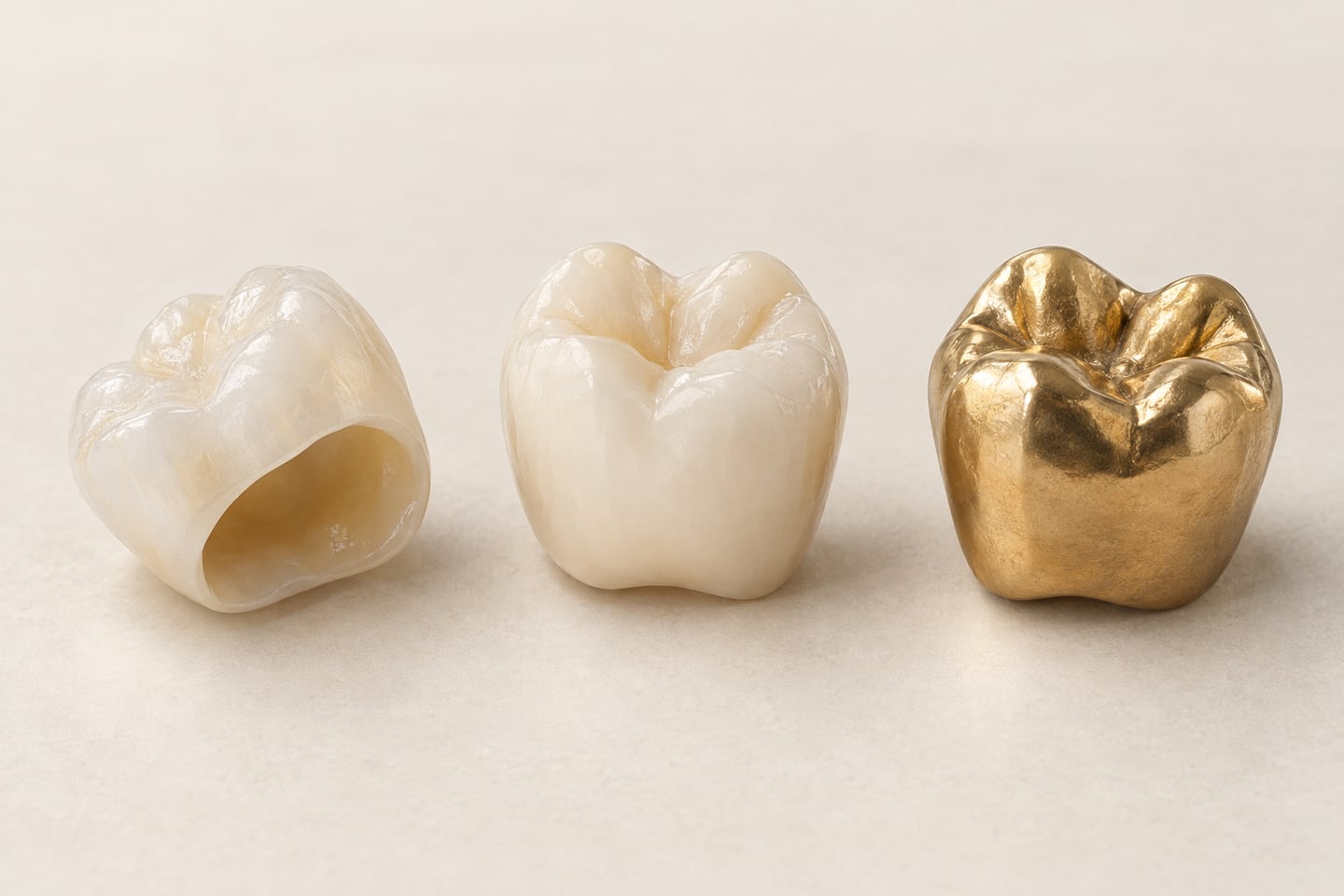
Crowns are made in a few broad categories: all-ceramic and porcelain, porcelain fused to metal, gold and other metal alloys, and zirconia. Metal-based crowns tolerate heavy back-tooth force well and can be made thinner, which means removing less tooth. All-ceramic crowns look most like a natural tooth and are the usual choice where the crown will show. Zirconia sits between the two on strength.
Material matters less than people expect. A well-made crown of any of these categories on a clean, well-maintained tooth outlasts the best material on a tooth whose margin is never flossed. Ask which material is planned for your tooth and why that one; a good answer is about your bite and where the tooth sits, not about a brand name.
What actually extends a crown's life
None of this is glamorous, and all of it works better than anything done at the appointment itself:
- Clean between the teeth every day. The ADA recommends flossing once a day, using a gentle rubbing motion and never snapping the floss into the gums. The margin of a crown is the spot that repays this most.
- Wear the night guard if you grind or clench. Not most nights. Every night, including the ones you get home late.
- Keep routine exams and the X-rays that go with them. Margin decay is found on film years before it is found by symptoms.
- Stop using that tooth as a tool. Ice, popcorn kernels, pens, and packaging break crowns and natural teeth alike.
- Report a bite that feels tall within days, not months. A crown taking more force than its neighbors wears and loosens faster than one sharing the load.
- Treat gum disease. Receding gums move the margin out into the open, where decay starts more easily.
Signs a crown needs looking at before your next checkup
- It moves when you press it with your tongue, or it feels different when you bite.
- Floss shreds or catches at the same spot on that crown every time.
- A dark line at the gumline that was not there before, or a gum that bleeds only around that tooth.
- Sensitivity to cold or to sweet things that starts months or years after the crown had settled in.
- A bad taste or an odor that keeps coming back from one spot.
Pain on biting that is getting worse, a throb that wakes you at night, or any swelling in the gum or face is not a wait-and-see item. That is an urgent visit, and swelling that affects breathing or swallowing belongs in a hospital emergency room instead.
Why a lifetime figure would be dishonest
Five to twenty years is a population range. It is not a prediction about your tooth. Two people can have identical crowns cemented on the same afternoon, and one keeps hers for two decades while the other loses the tooth in four years, because one cleans the margin and does not clench and the other does neither.
Anyone offering you a crown for life is either not counting the tooth underneath or not planning to be around when it fails. The accurate version is duller and more useful: a crown is a repair with a service life, and most of what sets that service life happens after you leave the office.
If a crown does fail, what comes next
There is a ladder, and it is worth knowing where you are on it before anything goes wrong.
- Recement. The crown is intact, the tooth under it is sound, and it goes back on at a short visit.
- Remake. The crown is damaged or no longer fits, but the tooth still has enough structure. A new crown is made, sometimes over a build-up that rebuilds the foundation first.
- Root canal, then remake. The nerve has given out but the root is sound.
- Extraction and replacement. Too little tooth is left to hold anything.
That last rung is the one worth avoiding, because replacing the tooth is a bigger project than repairing it: a dental implant or a bridge rather than a cap. It is also the rung people reach by ignoring a crown that felt slightly loose for a year.
The number for your own tooth
There is no way to produce it in advance, but there is a way to keep it high. If a crown of yours is several years old and has not been X-rayed lately, that is the visit worth booking rather than waiting for it to hurt. Request an appointment and ask specifically for the margins on your existing crowns to be checked, not just the teeth that have never been worked on. If replacement work turns out to be needed, financing is arranged per office and is subject to credit approval. And if you are wearing a temporary right now, how to look after it is a shorter and more immediate list than this one.