
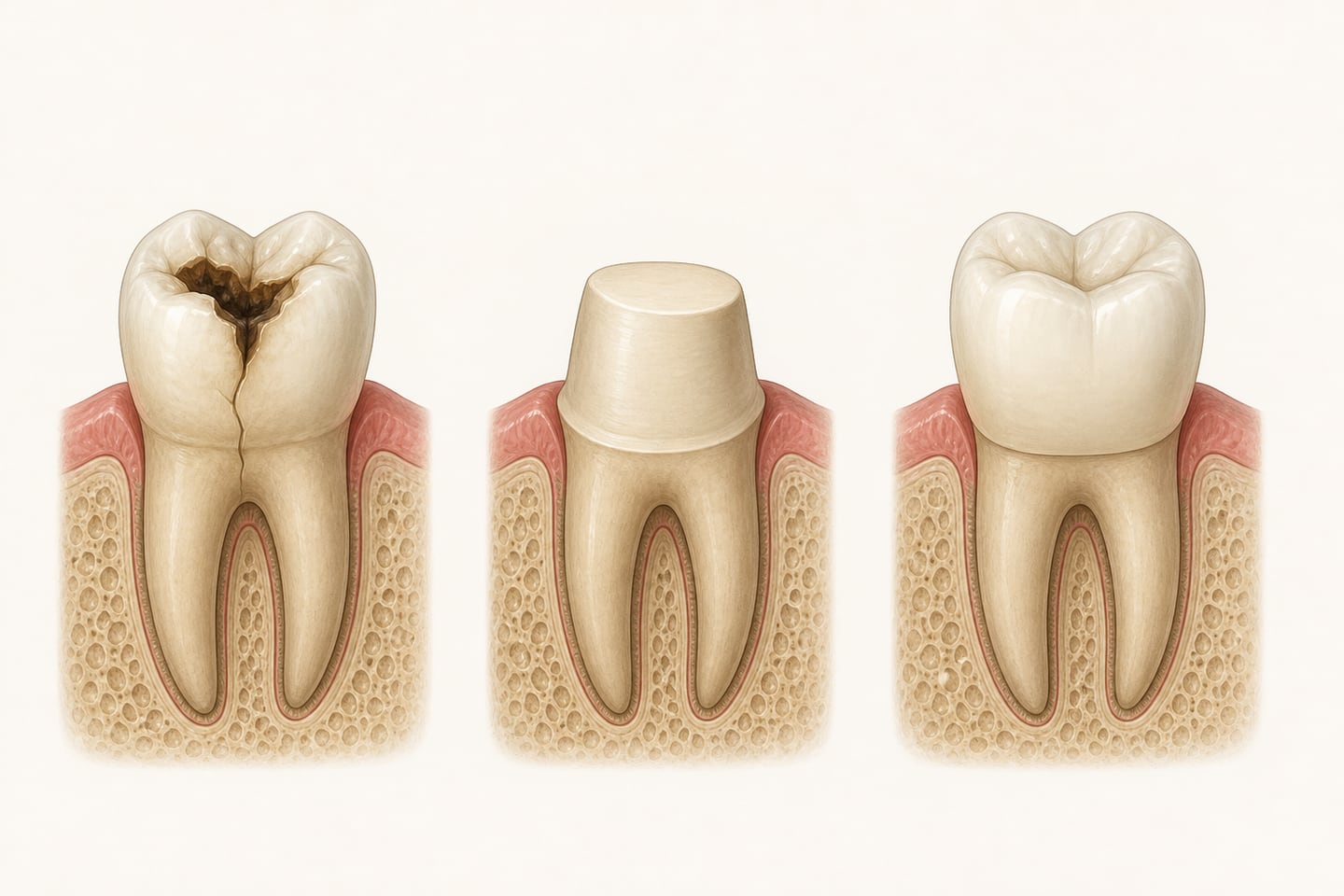
The signs that most often lead to a crown are a large old filling breaking down at its edges, a cracked tooth or a cusp that has snapped off, a sharp jolt when you release a bite rather than when you press down, a back tooth that has just had root canal treatment, and teeth worn flat by grinding. Not one of them settles the question by itself. Each has other explanations, and an exam with an X-ray is what separates them.
Sign 1: a large old filling that is breaking down
You notice a rough edge with your tongue, food packing between two back teeth that never used to trap food, floss shredding in one spot, or a dark line at the border of a silver filling. Sometimes there is no feeling at all and it shows up on an X-ray at a checkup.
The reason this points toward a crown is arithmetic rather than symptoms. A filling relies on the tooth walls around it. When an old restoration has been enlarged once or twice, there may not be enough sound wall left to hold the next one. The ADA describes strengthening a tooth with a large filling, when not enough tooth remains to hold that filling, as one of the standard reasons for a crown. What decides between the two goes through the judgment in detail.
What else it could be: a stained margin on a filling that is still perfectly sealed, which needs watching and nothing more. Food packing can also come from a contact point that has opened between two teeth, or from gum recession, neither of which is fixed by a crown.
Sign 2: a cracked tooth, or a cusp that has broken off
Something gives way while you are eating, often on something harmless like bread. A piece comes off, usually a corner of a back tooth, and the tooth is suddenly sharp but may not hurt much. The American Association of Endodontists calls this a fractured cusp: a piece of the chewing surface breaking off, often around a filling. A crown is the usual answer, because the point is to hold what is left together rather than to fill in what is gone. The first 24 hours after a tooth cracks covers what to do before you are seen.
What else it could be: craze lines. The AAE describes these as tiny cracks affecting only the outer enamel, extremely common in adult teeth, and they generally need no treatment at all. If someone looks at a mirror photo of hairline marks on your enamel and proposes crowning several teeth, get a second opinion before anything is prepared.
Sign 3: a sharp pain when you let go of a bite
This one is oddly specific and worth learning, because most people report it backwards. You bite down on something and nothing happens. Then you release, and a bright, brief jolt goes through the tooth. It comes and goes. You may not be able to say which tooth it is. Cold may set it off too.
The AAE lists pain on the release of biting pressure among the signs of a cracked tooth. The mechanism is that biting flexes the crack open and releasing snaps it shut against the nerve inside. A crown is the treatment that stops the flexing, and depending on how deep the crack runs, root canal treatment may be needed first.
What else it could be: a filling that sits a fraction high and is taking the whole bite, which is adjusted in minutes. A recently placed restoration can also be tender for a while as the nerve settles. Sinus pressure refers pain to upper back teeth convincingly enough that people arrive certain a tooth is at fault.
Sign 4: a back tooth that has had root canal treatment
This is the one sign that is not really a symptom. It is a fact about the tooth. Root canal treatment removes the tissue from inside the tooth, and the opening cut through the chewing surface to reach it takes more structure. The AAE describes the tooth afterward being restored with a crown or a filling for protection. On a molar carrying full chewing load, that generally means a crown; on a front tooth with a small access opening, a filling is often enough.
The failure people run into here is delay. The tooth stops hurting, life gets busy, and the final restoration is put off. Root canal, then crown explains why that gap is the most common way a saved tooth is lost afterward.
Sign 5: teeth worn flat, or noticeably shorter
You look in the mirror and the biting edges of your front teeth are flat, or a back tooth has a shallow dish worn into it. Your partner mentions the noise at night. You wake with a tight jaw or a dull headache. The ADA notes that dentists spot grinding by chipped or cracked teeth and by worn, damaged spots along the edges of teeth.
Severe wear can reach the point where a tooth has too little height left to hold a filling, and full coverage becomes the way to rebuild the shape. But treating the wear without treating the cause is a short-term repair. The ADA's usual first move is a night guard to protect the teeth during sleep, and a new crown placed into an unguarded grinding habit is loaded the same way the original tooth was.
What else it could be: acid erosion from reflux, frequent sour or carbonated drinks, or vomiting, which wears teeth in a different pattern and calls for a different conversation. The ADA also notes plainly that jaw pain has causes other than grinding, so a sore jaw on its own is not evidence about your teeth.
Signs that usually mean something other than a crown
- Cold sensitivity that stops as soon as the cold goes. Common, and more often exposed root surface from recession or a worn spot at the gumline than anything structural.
- A visible cavity with no pain. Often a filling. The NIH's dental institute notes that decay at the early white-spot stage can be stopped or reversed with fluoride before any drilling.
- Aching that you cannot localize, along a whole quadrant. More typical of a sinus problem or a nerve issue than a single failing tooth.
- Bleeding gums around one tooth. A gum question first. A crown placed over untreated gum inflammation inherits the problem.
- Throbbing that wakes you at night, or facial swelling. Not a crown question at that moment. That is a same-week call to a dentist, and swelling that is spreading is urgent.
- A crown or filling that has just fallen out. Its own situation entirely.
If the last two describe tonight, what to do when a filling or crown comes off is the more useful page.
Why only an exam and an X-ray settle it
The limit of everything above is that the deciding facts are not visible to you. How much sound wall a tooth has left is judged on an X-ray and by looking at the tooth with the old filling removed, and a dentist sometimes changes the plan mid-appointment once that filling is out and the picture underneath is clear.
Cracks are harder still. Many do not show on an X-ray at all, because an X-ray is a shadow image and a crack running front to back is invisible from that angle. Finding one takes a bite stick tested cusp by cusp, a bright light shone through the tooth, dye, or magnification, and even then a crack can be suspected rather than proven. That uncertainty is a real part of this diagnosis, and a dentist who tells you a crack is likely but not confirmed is being accurate, not evasive.
What happens if you wait
Waiting is not automatically wrong. A stained margin can be watched at checkups for years. But three of these signs get more expensive the longer they run. A cracked tooth can extend its crack toward the root, which turns a crown into a crown plus root canal treatment, and eventually into a tooth that cannot be kept. A tooth after root canal treatment that is left unprotected can fracture below the gumline. Severe wear that continues removes the very height a restoration needs.
Once a tooth cannot be kept, the decision moves from repair to replacement: a bridge, a dental implant, or accepting the gap. Every one of those is a bigger project than the crown would have been.
When a crown is not the answer
A crown cannot rescue everything. A split tooth, where the segments separate, and a vertical root fracture starting in the root are generally not restorable. Decay that runs far below the gumline may leave no clean edge for a crown to seal against. A tooth with advanced bone loss around it can be structurally fine and still not worth crowning. And the AAE's own wording on cracked teeth is worth carrying into the conversation: a crown gives the most protection available, and it does not guarantee success in every case.
There is also the opposite error. Not every worn or filled tooth needs covering. Preparing a tooth for a crown removes healthy structure that does not grow back, and it carries a real chance of irritating the nerve enough that the tooth later needs root canal treatment. Watching a stable tooth is a legitimate plan, and so is an onlay that covers one weak cusp instead of the whole tooth.
What to ask at the appointment
- Which tooth, and can you show me what you are seeing on the X-ray or the photo?
- Is this decay, a crack, wear, or a failing restoration? They lead to different treatments.
- How much sound tooth wall is left?
- Would a filling or an onlay work here instead?
- If we watch this instead of treating it now, what would we be watching for and how long is that reasonable?
- Does this tooth need a build-up or root canal treatment before a crown, and is that in the written estimate?
If two or three of the five signs describe a tooth of yours, that is worth an exam rather than a search result. Request an appointment at the office nearest you, say which tooth and what you notice and when, and ask to see the image the recommendation is based on. Bringing the specific symptom is more useful than bringing the conclusion.