
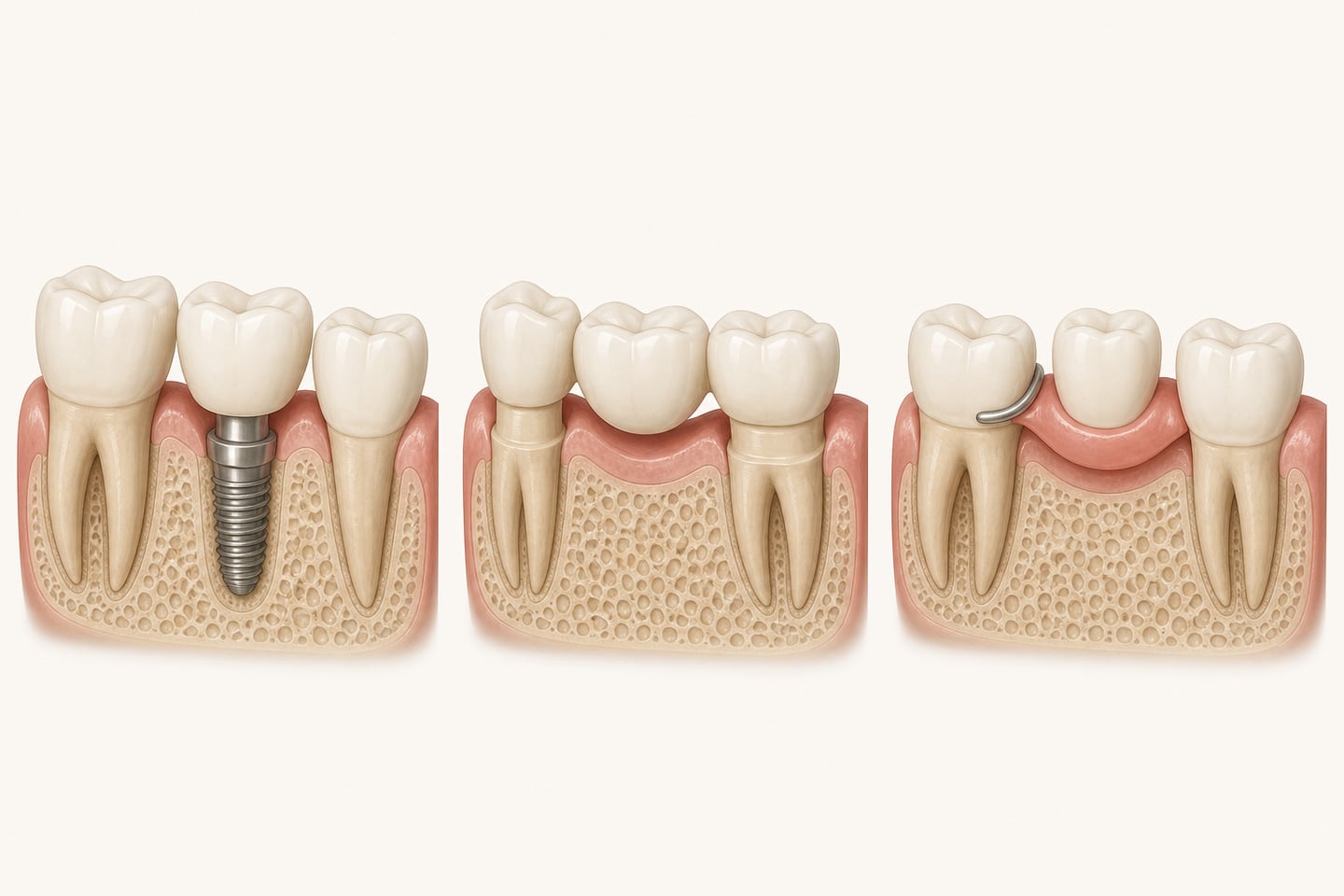
An implant replaces a missing tooth with a post in the jawbone and a crown on top, and it stays put. A removable partial denture replaces one or several missing teeth with false teeth on a base that rests on your gums, clasps to the teeth you still have, and comes out to be cleaned. Neither is better across the board. What decides it is how much bone you have, the condition of the teeth beside the gap, how many teeth are missing, and what you can spend.
The fixed option and the removable one
The implant
An implant is the fixed one. A post goes into the jaw where the root used to be, the bone grows around it over several months, and a connector and a crown are attached on top. From then on it is a tooth you brush, floss, and never take out.
The removable partial denture
A partial denture is the removable one: replacement teeth on a gum-colored base. Some have a metal framework with clasps that grip your remaining teeth; others use connectors designed to show less metal. It rests on your gums and the teeth that hold it, and comes out to be cleaned, usually overnight as well.
Side by side
What drives the cost of each
An implant is priced as a sequence: imaging and planning, any extraction or bone grafting, the post, the connector, the crown, and the visits between. Every preparatory step adds to it. A partial is priced mostly as one appliance plus the appointments to fit it, and the number of teeth it carries moves the price less than people expect. Its cost accumulates later, in relines, repairs, and eventual replacement. No prices appear on this site, so ask each office for an itemized quote. What drives the cost of dental implants breaks the implant side into its parts.
How long treatment takes
An implant is measured in months, because the post has to fuse to bone before the final crown goes on, and grafting adds its own healing time before placement begins. A partial is measured in weeks: impressions or a scan, lab fabrication, a fitting, adjustments. If the tooth has just come out, both paths usually wait for the socket to settle, though a temporary partial can fill a visible gap during that wait.
How long each lasts
Neither is permanent, and anyone quoting you a number of years is guessing at your habits. Implants can serve for many years, though the crown on top wears like any crown and may be replaced sooner than the post under it. How long dental implants last covers what shortens that. Partials are expected to change: the ADA says bone and gum ridges recede over time, so relines are routine and remakes come around.
What upkeep looks like
- Implant. Brush and floss it like a tooth, keep regular cleanings, and watch the gum around it. Inflammation there is peri-implant disease, and ignoring it can cost you the implant.
- Partial. Rinse it after meals when you can, brush it daily with a denture brush and cleanser rather than toothpaste, which the ADA notes is too harsh, and soak it as directed. The teeth carrying the clasps need extra attention, because a clasp holds plaque against the tooth it grips.
What each does to the bone
This difference is easy to miss and hard to reverse. An implant post carries chewing load into the bone, keeping that area of jaw under stimulation. A partial rests on the ridge and does nothing to slow resorption, so the bone under the gap keeps shrinking. That is why a partial's fit drifts, and why the implant option can narrow over time. What happens if you wait to replace a missing tooth covers that timeline.
What daily life feels like
After healing, an implant is a tooth you stop thinking about. Nothing comes out, and chewing force is close to natural. A partial has bulk you feel and clasps you can find with your tongue, plus a break-in period the ADA describes in terms of soft food cut small and chewing on both sides. Some people adapt in a few weeks and forget it is there. Some never quite do, which is worth knowing before you choose rather than after.
Who an implant tends to suit
- Enough bone at the site, or a willingness to graft first and wait longer.
- Healthy gums. Active gum disease is treated before an implant is placed, not alongside it.
- General health that supports healing. Smoking works against integration, and the ADA notes chronic illness such as diabetes can interfere with healing after surgery.
- One or two gaps rather than several scattered across an arch.
- Someone who does not want to remove anything and can live with a months-long timeline.
Who a partial denture tends to suit
- Several missing teeth in the same arch, especially spread across both sides.
- Not enough bone for implants, when grafting is not wanted or not advisable.
- Health conditions or medications that make elective surgery a poor idea right now.
- A budget that has to work with the smaller number today.
- A visible gap that needs something soon, including as a deliberate interim step.
What each one does well
Implant
- Leaves the neighboring teeth untouched. Nothing is shaped, clasped, or loaded.
- Cleans like a natural tooth, with no appliance to manage.
- Handles chewing force well, which matters most on back teeth.
Partial denture
- No surgery, and no healing period before you have teeth.
- Replaces several teeth at once, including gaps an implant plan would treat separately.
- Reversible. Nothing has been placed in bone, so a different plan later is still open.
Where each one falls short
Implant
- It is surgery, with the risks any oral surgery carries.
- Not everyone is a candidate. Bone volume, gum health, medications, and systemic conditions decide it, and only an exam and a scan can say.
- Integration can fail. It is uncommon, but it happens, and the question to ask is what the plan is if it does.
- The gum around an implant can become inflamed and the supporting bone can be lost, which the American Academy of Periodontology calls peri-implant mucositis and peri-implantitis. Previous gum disease, plaque, smoking, and diabetes raise that risk.
Partial denture
- The fit will need adjusting, relining, and eventually replacing. That is normal, not a defect.
- Clasps load and trap plaque against the natural teeth that hold them, which is a real demand on those teeth.
- It comes out, which some people dislike and some find harder than expected.
- A poorly fitting partial can cause sore spots or infection, so one that has stopped fitting is a reason to go in, not a reason to soldier on.
When waiting is a reasonable choice
There are good reasons not to decide this month. If you are quitting smoking, finishing that first changes the odds. A socket extracted last week is not ready, and gums still under treatment are not ready either. Funding matters too: starting a multi-stage sequence you cannot finish is worse than starting later, and a partial used as an interim is a legitimate plan rather than a compromise. What waiting costs is bone, so ask what the dentist expects the scan to look like in two years.
Questions to ask a dentist
- What does the scan show about bone at this site today?
- If grafting is needed, how many extra months does it add, and what does it add to the total?
- If I choose a partial, which of my teeth will carry the clasps, and what does that ask of them?
- How often would you expect this partial to need a reline, and when would you remake it?
- What is the plan if the implant does not integrate?
- Could I start with a partial now and move to implants later? Does that change how you would plan today?
Where this sits among the other choices
If the teeth beside the gap are already crowned or need crowning anyway, a fixed bridge belongs in the comparison, and dental implants vs. bridges works through that pairing. If you are missing most or all of an arch, All-on-4 vs. implant-supported vs. conventional dentures is the comparison to read instead of this one.
An exam and a scan are the only way to know which of these constraints are yours. Request a consultation and ask for both plans in writing: the implant sequence with every preparatory step named, and the partial with its expected adjustments. Third-party financing is arranged office by office and subject to credit approval, with each office's roster of lenders on that page. Raise cost at that first visit rather than after the plans are drawn, because for most people the number is not a footnote to this decision. It is one of the four facts that make it.