
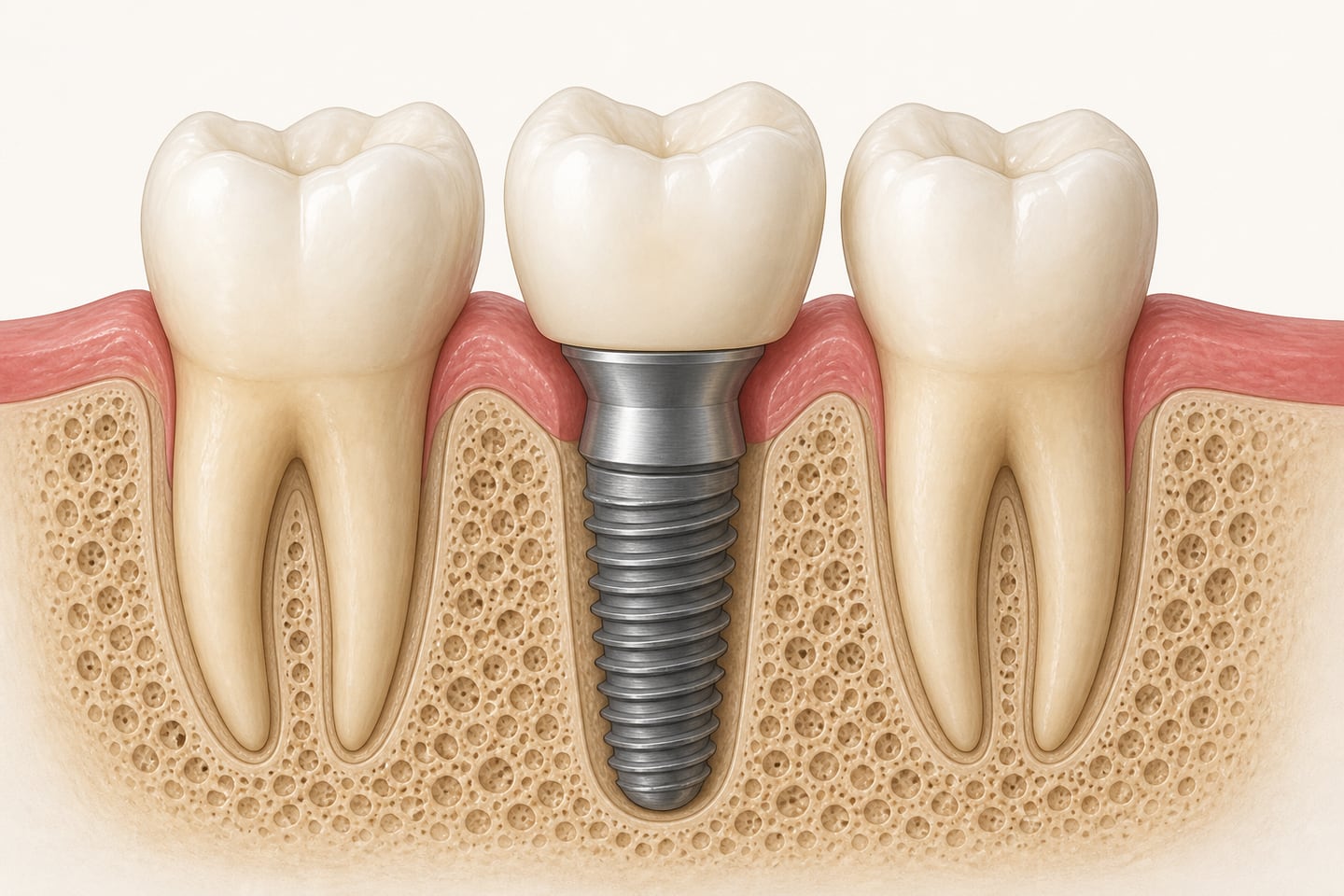
A single dental implant is usually four to six appointments spread across several months, and only one or two of them are surgery. The rest are a scan, a stitch check, an impression, and a fitting. What surprises people is not the appointment count but the gaps between the appointments: the longest stretch of an implant plan is months of bone healing with nothing on the calendar at all.
Visit 1: the consultation and the scan
The first appointment is an exam and imaging. Most implant plans use a three-dimensional scan as well as X-rays, because a flat image cannot show how wide the ridge is or where the nerve in the lower jaw and the sinus above the upper back teeth sit. That scan turns a general idea into a plan with a position, an angle, and a size for the post.
The dentist checks how much bone is at the site and what quality it is, whether the gums are healthy, and whether anything in your medical history affects healing. Bring your actual medication list, including bone medications and blood thinners, rather than a summary from memory.
You should leave with a written, itemized plan naming the phases and roughly when each falls. This is also where some people learn they need something else first, and a few learn an implant is not the right choice for their mouth. Not everyone is a candidate, and a dentist who says so at the scan stage is doing the job correctly.
The visits some people need before the implant
These are the reason two people quoted for “an implant” can have completely different calendars.
- Extraction. The tooth being replaced has to come out first if it is still in the mouth. That is sometimes the same appointment as the placement and sometimes two visits months apart, and which version you get is decided by the socket rather than by the schedule.
- Bone grafting. A small amount of graft material placed around the post at surgery adds no separate appointment. A larger graft is a surgery of its own, so it brings its own placement visit and its own stitch check, and the implant is not placed at either of them.
- Gum treatment. If active gum disease is found, it gets treated first. The bacteria that destroy bone around teeth do the same thing around implants.
Which type of graft applies to which site is covered in bone grafting before dental implants. For sequencing, the thing to know is that a separate graft resets the clock: the implant conversation restarts once the graft has healed.
Visit 2: placing the post
The area is numbed with local anesthetic. The gum is opened over the site, the bone is prepared in stages with progressively wider instruments under cool irrigation, and the titanium post is threaded into the channel. A cover screw or healing cap goes on top, the gum is closed with stitches, and you leave with gauze and written aftercare instructions.
You are awake for this unless something else was arranged in advance. Sedation is on some of the group's office menus and not others, so ask the office you plan to visit what it can arrange, and plan on a driver if the answer is anything beyond local anesthetic. The surgical part is usually shorter than people expect for a single post; the appointment runs longer than the surgery because of setup, anesthetic, and instructions. You go home that day.
Visit 3: the stitch check, about a week later
A short appointment roughly seven to ten days after surgery. Stitches come out or are confirmed dissolved, and the dentist checks that the gum is closing cleanly over or around the healing cap. Nothing is built here; the visit exists to catch a problem early. What is normal and what is not during that first week is worth reading before surgery day, not after.
The months in between: the bone fuses to the post
This is the longest stretch of the sequence and the only one with no appointments in it. The post and the jaw are growing together, which is called osseointegration, and it is why the plan is drawn in months rather than weeks. The American Dental Association sorts implant treatment into three phases, and this is the middle one: place the post, wait for the bone to take it, then build the tooth. What sets the number of months for your own jaw is worked through in how long implant treatment takes.
You cannot feel this happening and you cannot speed it up. The gum looks healed long before the bone underneath is ready to carry chewing force. A temporary tooth, if you were given one, is there so you are not walking around with a gap. It is not there to chew with.
Visit 4: uncovering the post, if your plan has this step
Not everyone has this appointment. In a two-stage plan the post was buried under the gum, and a short second procedure uncovers it and fits a healing cap so the gum forms a collar around it. The AAP describes the gums then healing for a couple of weeks before the tooth is built. In a one-stage plan the healing cap went on at surgery and this visit does not exist. Ask which one you are having; it changes the count by one.
Visit 5: the abutment and the impression
Now the tooth gets built. The healing cap comes off and the abutment, the connector between post and crown, is fitted or selected. Abutments can be stock components or custom-made; front teeth more often need the custom version, because the gum shape around them is visible. The dentist takes an impression or a digital scan, records the shade of your neighboring teeth, and sends it to a laboratory, which makes the crown over a couple of weeks. A temporary crown may go on meanwhile.
Visit 6: fitting the final crown
The crown is tried in and checked for how it contacts the teeth on either side, how it meets the opposing tooth when you bite and slide your jaw, and how it looks against its neighbors. Then it is screwed into the abutment through a small access hole that gets filled, or cemented on. Small adjustments are normal and are not a sign anything went wrong.
Ask for an X-ray at this visit, not because anything is wrong, but because the bone level around a brand-new implant is the baseline every future X-ray gets compared against.
So how many visits is that?
- Bone already healed, one-stage plan: about four. Consultation, placement, stitch check, then impression and crown fitting.
- Bone already healed, two-stage plan: five or six, with the uncovering visit and its gum-healing wait added.
- Extraction, a graft, or gum treatment first: add one to four appointments before placement, plus their healing time.
All-on-4 and other full-arch plans work differently again: the surgery is front-loaded into one longer appointment, a fixed temporary bridge often goes on early, and the final bridge is made months later. Fewer surgical days, more laboratory visits.
What can change the sequence after it starts
Plans move. None of these is unusual enough to be alarmed by:
- The bone turns out softer than the scan suggested, so the dentist adds graft material or leaves the post to heal longer before building on it.
- The post does not integrate. Uncommon, but it happens, and the sequence restarts rather than ends: the post comes out, the site is given time, and a second attempt is often possible later.
- A healing cap loosens or the gum inflames, adding one short visit.
- A front-tooth case adds appointments on purpose, because the gum around the crown is shaped for appearance over several visits.
What to ask before you agree to the plan
- How many appointments, start to finish, and which of them are surgical?
- Is my plan one-stage or two-stage?
- Will I have a temporary tooth during the healing months, and can I chew on it?
- What would make you change this plan once you have started?
- Can I have the whole sequence itemized in writing before the first surgical visit?
Request an implant consultation and ask, at that first appointment, for the visit list on paper: which visits are surgical, which are impressions, and which are only checks. A sequence you can see laid out is easier to commit to than one that arrives a visit at a time.