
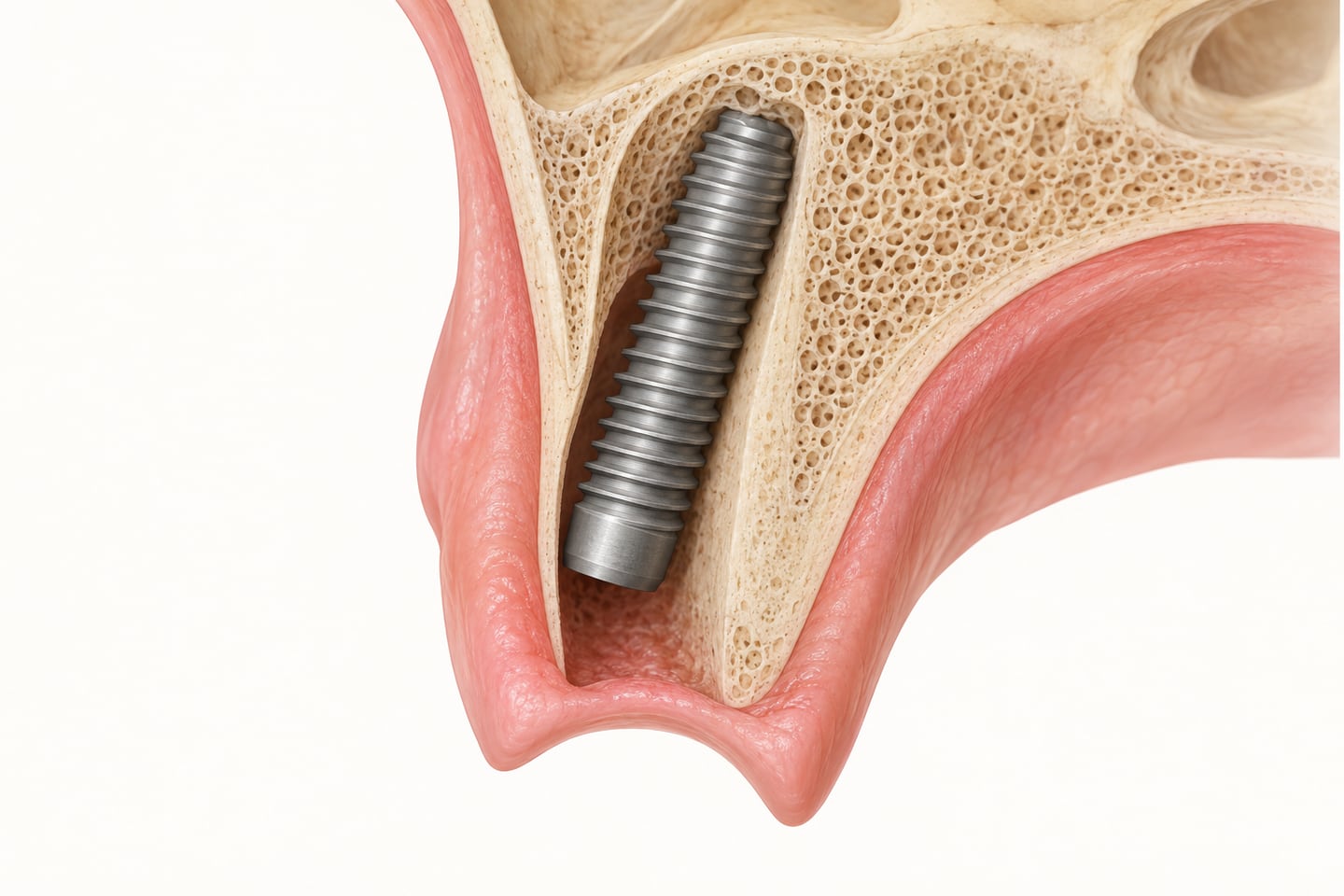
Sometimes it can. A tooth can be removed and an implant placed into that same socket in one appointment when the socket is clean and the bone around it is sound. Dentists call this immediate placement. It is a real technique with real conditions attached, and the conditions are about your socket, not about scheduling. When they are not met, the site is repaired or left alone to heal and the implant goes in later. This article is about how that call gets made, and about what the word immediate does and does not cover.
Read this as clinical background rather than as a service on offer. Whether it is possible for your tooth is decided by an exam and a scan, and sometimes only after the tooth is actually out. No web page can promise it for you, and this one is not trying to.
Three different things get called “immediate”
Most of the confusion is vocabulary. Three separate steps get collapsed into one word, and each can happen fast or slow independently of the others.
The placement itself
The post goes into the socket at the same visit the tooth comes out, instead of after a healing period. This is the step this article is about.
The temporary tooth on top of it
A temporary crown is attached to the post right away, so you do not walk around with a visible gap. This is a separate decision, and it depends on how firmly the post is seated and where in the mouth it is.
The final tooth
The finished crown comes at the end, after the bone has fused to the post. The FDA's patient guidance puts it plainly: healing of the implant body may take several months or longer, and during that time you typically have a temporary in place of the tooth. Implants are a months-long project no matter how the first visit goes, and the months are counted the same way whether or not the post went in early.
So the answer comes to this: immediate placement can save you a surgical appointment and some months of waiting before the post goes in. It does not hand you a finished tooth that afternoon.
What has to be true for the implant to go in at that visit
The post needs to be steady in bone from the moment it is placed. Everything on this list serves that requirement:
- No active infection at the site. An abscess or a socket full of infected tissue rules it out. Bone that is busy fighting an infection is not bone that will hold a post.
- Intact socket walls. The bone that surrounded the root has to still be there. A wall that broke during the extraction, or one that was already destroyed by infection, leaves nothing to hold the post.
- Solid bone beyond the socket. The socket is the shape of the old root, and the implant is not. Stability usually comes from bone past the tip or around the sides. The American Academy of Periodontology names adequate bone as a basic requirement for implants at all.
- Healthy gums. The same source lists gum tissues free of periodontal disease as a requirement. Active gum disease has to be treated first.
- A tooth the extraction will cooperate with. Single-rooted front teeth come out of a narrow, predictable socket. A molar leaves a wide crater where several roots used to be, and that shape often does not grip a post.
- A body that heals normally. The FDA notes that overall health affects how long healing takes and how long the implant stays in place, and that smoking can affect healing and long-term success.
What rules it out
The other side of the same list, plus a few reasons people do not expect:
- An abscess, a draining sore, or a tooth that has been infected for a long time. The site needs to be clean before anything is anchored into it.
- Bone loss around the root, whether from infection or from gum disease. The AAP describes ridge modification and sinus augmentation precisely because deformities can leave too little bone to place an implant into.
- Upper back teeth sitting close to the sinus, where the available height is often the limiting factor.
- Heavy bite forces. A grinder, or a molar doing the hardest chewing in your mouth, puts load on a post that has not yet fused to bone.
- Anything that makes the surgeon's view of the socket a surprise. Occasionally the tooth breaks on the way out and the plan changes in the chair.
None of these is a verdict on implants generally. They are reasons the first visit becomes a preparation visit rather than a placement visit.
What happens instead when the answer is no
Usually a socket graft. Bone or a bone substitute is packed into the socket at the extraction to keep the ridge from collapsing while it heals, and the implant is placed months later into a site that is now suitable for it. The AAP describes this kind of ridge work as filling the void with bone or a bone substitute to build the area back up. Bone grafting before dental implants covers what that adds in time and healing.
That path is not a downgrade. Grafting at the extraction preserves the option to place an implant at all. The tempting mistake is the third option: pulling the tooth, planning nothing, and letting the gap sit.
That is the version that costs the most. The bone under an unreplaced gap shrinks, the neighbors drift, and the opposing tooth moves, and a case that needed no graft this year can need one later. If you are not ready for an implant, decide that deliberately, and ask what to do at the extraction to keep the option open.
Is immediate placement better?
It has genuine advantages: one surgical appointment instead of two, one recovery instead of two, and months removed from the front of the timeline. It also has a narrower margin for error, because the post has to find stability in bone that was not shaped for it, in a site that has just been through an extraction. When it does not hold, the implant fails early and you graft anyway, further behind than if you had grafted first. That trade is the whole decision, and it is not a guarantee in either direction.
Fewer surgical visits is also not automatically a smaller bill, because grafting, temporaries, and imaging move the number more than visit count does. What drives the cost of dental implants walks through the line items.
The part people are not warned about
The plan can change mid-appointment. Until the tooth is out, nobody can see the condition of the socket walls, and a scan does not fully settle it. A case planned for immediate placement can turn into an extraction with a graft once the site is visible.
Ask about this before the day of the surgery. What happens if the socket is not suitable, what gets done instead, and what that changes about the timeline and the cost. A plan that has already answered those questions is not derailed by them.
If you are not having an implant at all
The timing question only matters if an implant is the plan. A bridge uses the neighboring teeth as anchors and does not wait on bone. A partial or full denture is removable and the least invasive route. For an arch that is mostly gone, full-arch options such as All-on-4 are planned as a different kind of case. Not everyone is a candidate for every one of them.
Questions to bring to the consultation
- Looking at my scan, does this tooth's socket look like a candidate for placing at the same visit?
- If it is not, would you graft the socket that day, and why or why not?
- How long before the final crown, in either version?
- What would I have in the gap while I wait, and does that change for a front tooth?
- What is your plan if the tooth does not come out as cleanly as expected?
The exam and the three-dimensional scan are what answer this, and they answer it for your tooth rather than for teeth in general. Request an implant consultation and bring the question with you. If the tooth is painful or swollen right now, treat that first: swelling in the face is an urgent visit, and an infected site is a common reason the implant has to wait.