
Full-mouth restoration is a way of planning more than a procedure. Instead of treating the tooth that hurts this month and the one that breaks next spring, the dentist looks at every tooth, the gums, the bone and the bite at once and builds one plan that ends with a mouth that works. People usually arrive at it after years of decay, gum disease, broken teeth, repeated dental work, or a denture that never sat right. What the plan contains depends entirely on what is still healthy — which is why two people with the same diagnosis can leave with very different plans.
Not every tooth has to go
The phrase gets used as though it always meant new teeth on implants. It doesn't. One plan might keep a dozen sound teeth, crown the cracked ones, bridge a gap and place implants only where teeth are already missing. Another, where most of an arch can't be predictably saved, replaces the whole arch. A sound tooth should never come out because replacing everything makes the plan tidier, and if a plan calls for removing teeth, it is fair to ask why each one can't be kept. That question is a good test of the plan.
Three ways an arch gets rebuilt
Work around the teeth you keep
When enough healthy teeth remain, the plan is built around them: crowns on teeth that are broken or heavily filled, bridges or single implants where teeth are missing, and gum treatment where the foundation needs it. This is still full-mouth restoration — everything is planned together — even though most of the teeth stay your own.
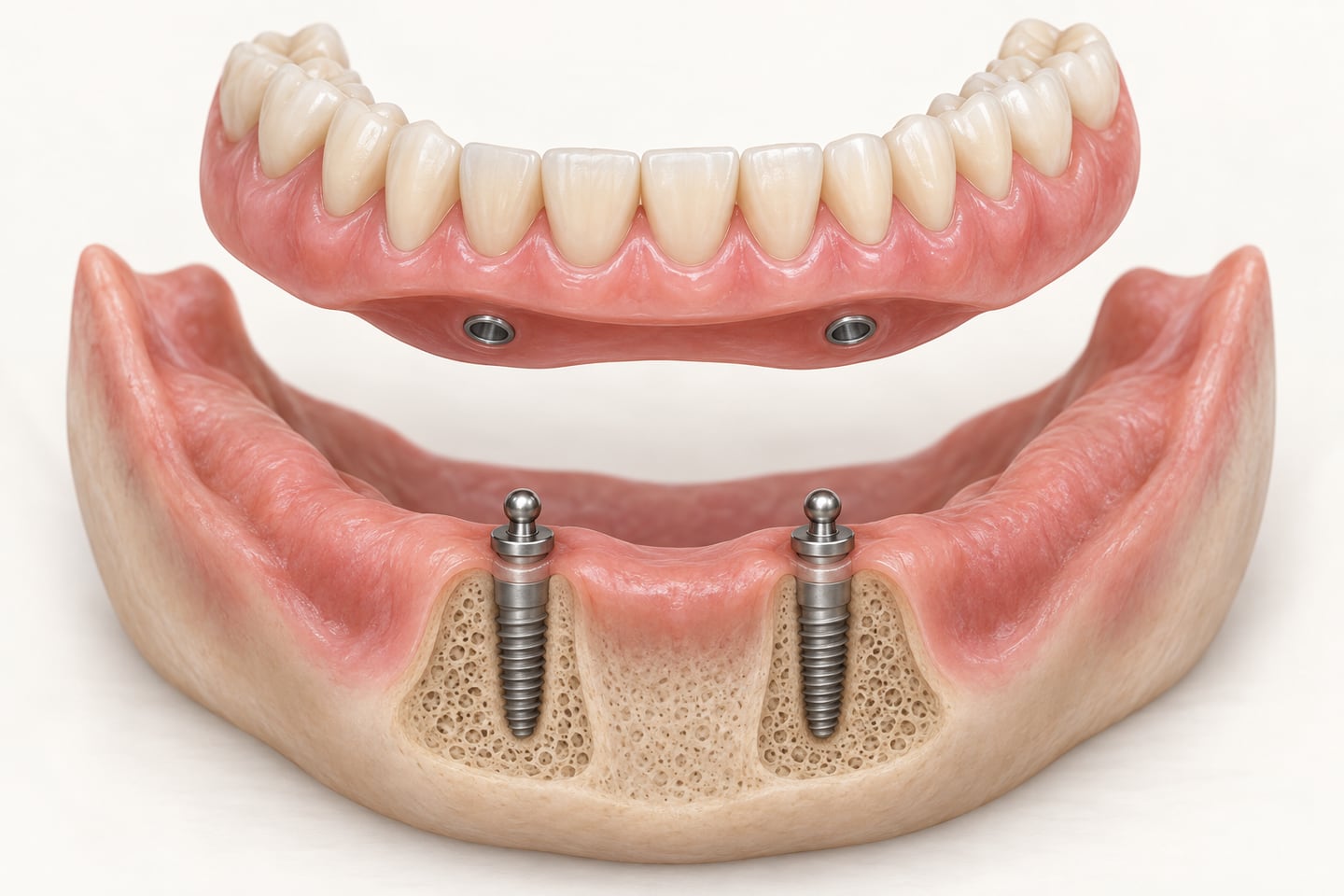
A denture held by implants
A removable denture that clips onto two or more implants in the jaw. It stays put far better than a denture held by suction and adhesive, still comes out for cleaning, and usually needs fewer implants than a fixed arch. For a lower denture that has never stayed in place, this is often the step that changes daily life most.
A fixed arch of teeth on implants
A complete bridge of teeth attached to several implants and removed only by the dental team at maintenance visits. This is what gets marketed under the All-on-4 and All-on-X labels; what separates those two is the number of implants, not the idea. It is the closest to the feel of natural teeth, and it asks the most of the planning. All three full-arch routes side by side, including a conventional denture, is its own comparison.
The order of work, and why it matters
Planning starts with a conversation about what isn't working — the food you avoid, the denture that moves, the teeth that keep breaking — then an exam of every tooth and the gums, X-rays, and usually a three-dimensional scan. The scan shows how much bone there is and where the nerve in the lower jaw and the sinuses above the upper back teeth sit, which is what decides where implants can go; why that scan comes first explains what it shows. From there the work is sequenced, and the order is not arbitrary:
- Make the foundation healthy. Active gum disease and infection are treated before anything is built. Implants and new crowns placed into inflamed tissue do poorly.
- Remove the teeth that can't be kept. Sometimes implants go in at the same visit; sometimes the sites are grafted and left to heal first.
- Let the implants fuse with the bone. This is paced by biology and takes months. A temporary set of teeth is usually worn through it.
- Make the final teeth. They are adjusted for fit, bite, speech and appearance, then checked again at follow-up visits.
Months, not weeks
Expect months from first exam to final teeth, and longer if grafting or gum treatment comes first. In some full-arch cases a temporary arch is attached the day the implants go in, which makes the calendar feel shorter — but those are temporaries protecting healing implants, not the finished teeth, and whether it is possible is decided at surgery by how firmly the implants seat. How long implant treatment takes lays the phases out on a calendar.
Why two plans with the same name cost different amounts
There is no single price for a full-mouth plan, because two plans with the same label can contain completely different work. The total moves with the number of arches, how many teeth come out, how many implants are placed, whether grafting is needed, sedation, the temporary teeth, and the material of the final teeth. An advertised implant price usually refers to one implant or one part of treatment, never a whole arch. Ask for an itemized plan that prices each phase; what drives the cost of dental implants explains the pieces, and financing can spread a large plan into monthly payments, subject to credit approval.
Keeping it: the cleaning underneath
Implants can't decay, but the gum and bone around them can become inflamed the way gums around natural teeth can, and that inflammation is what threatens an implant over the years. A fixed arch is cleaned in place every day — underneath the bridge, not just on top — with the brushes or water flosser the office shows you, plus regular professional maintenance. If you grind at night, a night guard protects the new teeth. Anyone considering a fixed arch should hear how it is cleaned before agreeing to it; the daily routine is part of the decision.
Ask for the plan in phases
A good full-mouth plan makes sense to you before anything starts: which teeth stay, which go, what happens in what order, how long each phase takes, and what each phase costs. Three of the four offices list every part of this on their own treatment menus — Rio Hondo Dental Group in Downey, Marina Dentistry in Marina del Rey and Beachside Dental Group in Huntington Beach; Pacifica Dental lists single implants but not full-arch work. Request an implant consultation and ask for the phased plan in writing — it is the document every later decision rests on.