
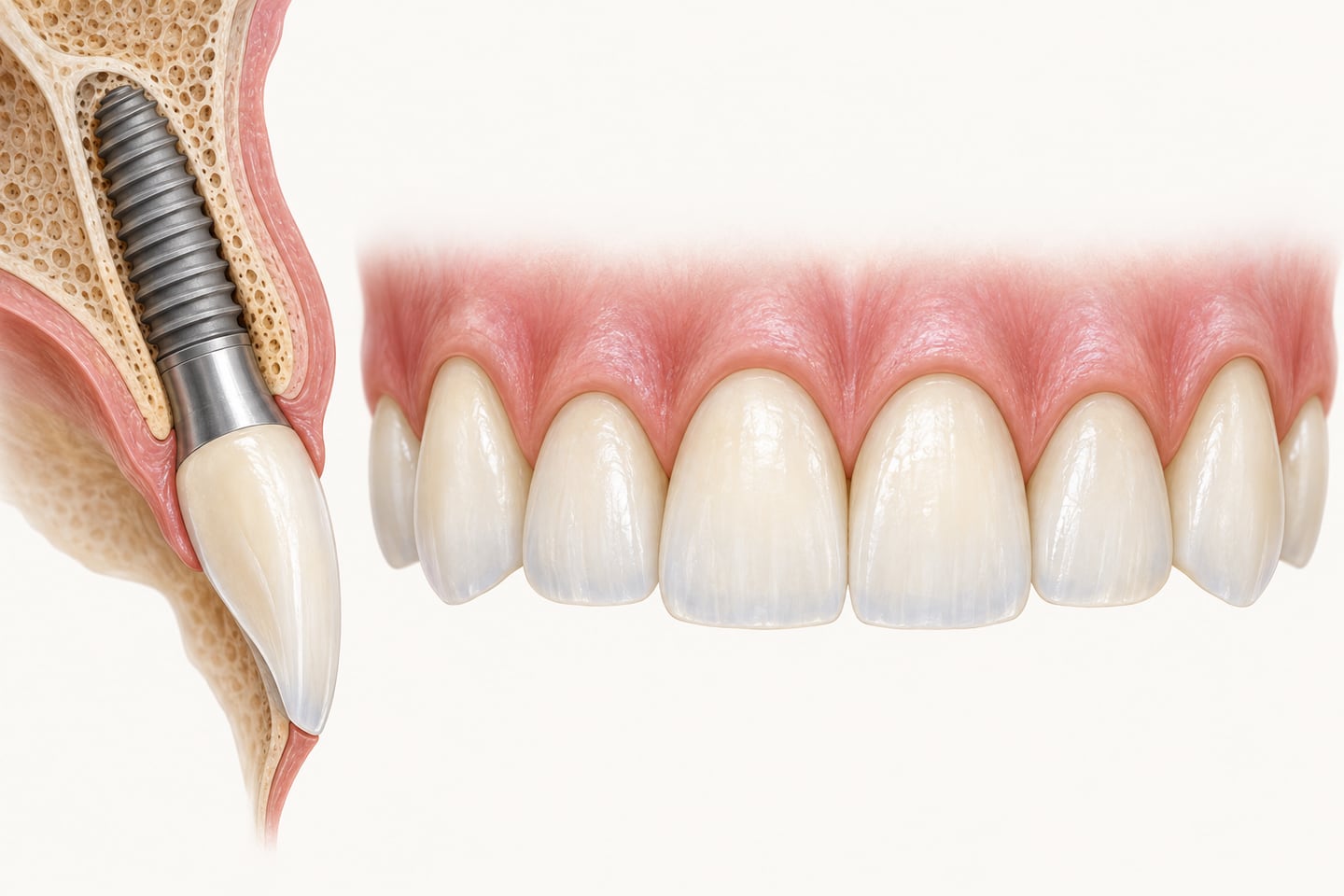
Yes. An implant can replace a front tooth, and for many people it is the best long-term way to do it, because nothing is taken from the teeth on either side. The qualifier is that a front tooth is the hardest place in the mouth to make an implant disappear into a smile. A back-tooth implant mostly has to be strong. A front-tooth implant has to be strong and invisible at conversation distance.
Three things that make the front harder
- Thin bone. The bone on the lip side of the upper front teeth is often very thin, and after a tooth is lost it tends to shrink, which can leave a dip in the gum where the tooth used to be.
- The gumline. The scalloped edge of gum around each front tooth is much of what makes a smile look natural. If the gum over an implant sits higher than its neighbors, the crown looks long — and gum is far harder to rebuild than a crown is to remake.
- Color and translucency. Natural front teeth are not one flat white; they vary and let light through at the edges. The crown has to match teeth sitting right beside it.
None of these is a reason not to have an implant. They are the reason placement has to be precise: an implant a millimeter or two too far forward, back or deep can show at the gumline for as long as it is there. A three-dimensional scan before treatment is how that position gets planned rather than approximated.
First question: can the tooth be kept?
If the front tooth is still there but damaged, keeping it is usually the first option to rule out. A root canal and a crown save many teeth that look hopeless. An implant becomes the better long-term choice when the tooth is cracked below the gumline, decayed too far under the gum, has too little structure left to hold a crown, or has failed repeated repairs. Is a root canal better than pulling the tooth? covers that fork in detail.
Same day as the extraction, or later
Sometimes the implant goes into the socket at the same visit the tooth comes out. That can mean fewer surgical visits and can help hold the gum's shape, but it needs clean, solid bone that grips the implant firmly from the start. When there is infection, or the thin wall of bone at the front is damaged, the socket is often grafted and left to heal first. Neither route is automatically better; can an implant go in right after the tooth comes out? explains how that call is made.
The temporary tooth does two jobs
Because it is a front tooth, the temporary matters. Depending on how firmly the implant is seated, it may be a temporary crown on the implant itself, shaped to stay out of the bite while it heals, or a tooth attached to the neighbors or to a removable retainer. A well-shaped temporary on the implant does a second job: it guides the gum into a natural contour before the final crown is made. Ask what kind of temporary you will have at each stage, and whether you will ever be without a tooth.
Matching the final crown
The final crown is made once the implant has fused with the bone, usually months later. Expect shade-taking, photographs and sometimes more than one try-in. One practical point: if you want to whiten your other teeth, do it before the crown's shade is chosen. A crown will not whiten afterward, so it has to match the color you intend to keep.
Who is a candidate
Most adults who have lost a front tooth can be considered. Bone loss does not necessarily rule it out, because grafting can often rebuild the site. Smoking, uncontrolled diabetes, active gum disease and grinding do not automatically disqualify anyone either, but they change the plan — a night guard, for example, protects a front crown from clenching. Implants if you smoke, have diabetes, or are older goes through each. Teenagers are the usual exception: an implant does not move with a growing jaw the way a natural tooth does, so it is normally delayed until growth is complete.
The alternatives
- A traditional bridge. A false tooth held by crowns on the teeth either side. Sensible when those teeth already need crowns; a real cost to them when they are healthy.
- A bonded (Maryland) bridge. A false tooth held by thin wings bonded to the backs of the neighbors. It removes little or no tooth structure and is often used for a single front tooth, including as an interim option.
- A removable partial. Quick and lower in upfront cost. It moves more than a fixed tooth and does nothing for the bone under the gap.
Types of dental bridges compares the bridge designs; dental implants vs. bridges weighs the two main routes.
Two questions that reveal the plan
Placing the implant is one appointment; the months around it are healing, and the crown visits for a front tooth often include small refinements. Before any of it, two questions tell you most of what you need to know about a front-tooth plan: how will the gumline be managed, and what will I wear at each stage? A plan with clear answers to both has been thought through. Request an implant consultation and ask them first.